This Week’s Highlights from @drmlb

Twitter has become a wonderful way for me to send out a variety of ideas and links that I think are helpful (and/or interesting).  Here are this week’s highlights!  If you are new to Twitter RT means Retweet (just “forwarding” it as is) and MT means Modified Tweet (“forwarding” it with a comment).

  • “This is definitely a 15 minute video every medical student should see.” The art of the physical exam bit.ly/nnmaTN @drmlb
  • Comments one makes to colleagues: as important as the interview. Professionalism = doing the right thing when no one’s watching. RT @MedPedsDoctor
  • Beginner’s mind in medicine. How to keep what we do exciting! MT@KevinMD bit.ly/qle7SJ
  • One flight of stairs = 16 calories burned. One day on call = ?10 flights ?20 ?30)..it adds up! @drmlb
  • Epidemiologist with humor?!? This is a great talk about drug development. bit.ly/ovkPyS @drmlb
  • “…small things often adds up to produce a far greater impact than any of us realize.” Surgery through different eyes bit.ly/q5XUkh  @drmlb
  • “..those of us who spend our emotions at work are not the kind to view our work as “just a job.” MT@Kevin MD bit.ly/pRAbmm  @drmlb

This Month’s Healthy Habit: Eat More Fish

One of my New Year’s resolutions this year was to come up with monthly “resolutions” for myself and for anyone who follows this blog.  Cooking Light magazine (which is one of my favorite sources of recipes and ideas for healthy living) had the same idea, so I am shamelessly borrowing their healthy habits!  This month’s healthy habit is to eat more fish.

Seafood is a great high protein, low fat food.  It’s also a great source of Omega-3 fatty acids.  It also has the advantage of being very fast to cook, a big plus for medical students, residents and busy docs.

How do you decide on which seafood to buy?

There are two things that should guide you in picking fish.  Importantly, one of them isn’t price.  You need to know about sustainability and toxicity when choosing your seafood.  Seafood that is caught or raised in a sustainable fashion with low toxicity is more expensive, but worth the extra cost.

It’s a sad fact that the oceans are being heavily overfished.  It sounds like an easy fix to farm raise the fish, but it’s not always true – sometimes the pollution that results from fish farms is worse than the overfishing.

The Seafood Watch from the Monterey Bay Aquarium is an amazing resource to find out which seafood is being caught or farmed responsibly.  It’s available on line or as an app for your phone.  Look for labels from the Marine Stewardship Council or Friend of the Sea, too.

sustainable-seafood-logos-m

For docs, it’s important to know that, like all foods, there are contaminants that can occur in seafood.  The risk – unless you are immunocompromised – is tiny compared to the benefit, though.  Another serious issue is the concentration of heavy metals (mercury and lead, in particular) in some of the larger fish.  This is particularly important for women of child-bearing age and for children.  Heavy metals are concentrated in large fish because of the food chain.  It makes sense that smaller fish will have negligible (or absent) levels.  Fortunately, they are also higher in omega-3 fatty acids making them an even better choice!  Sardines, anchovies and mackerel may not be on your usual list of foods, but give them a try.  Here’s some good sardine recipes to get you started.

What about tuna?

Canned tuna is a cheap and high-quality food, so it’s high on the list for medical students and residents.  Unfortunately, all tuna is not created equal – so you have to pay attention.  It’s more expensive, but look for pole-caught tuna in the store.  Blue fin tuna, and most other tuna used in sushi is incredibly overfished and should be avoided.

pole-caught-tuna

Fast, easy recipes to get you started

red-curry-shrimp-ck-l

Thai Red Curry Shrimp

salmon-kiwi-relish-lMarinated Salmon with Mango-Kiwi Relish

 fish_taco-l

Fish Tacos with Cabbage Slaw

Cooking Healthy, Eating Fresh Elective, Class 1 – The Hispanic Diet (Guest post)

His big red clown shoes were obvious as they peeked out from underneath the curtain. His smell overtook me immediately upon walking into the room. Pulling back the curtain, I saw him sitting there, right next to my patient. My 47 year old, obese patient with diabetes mellitus, hyperlipidemia, and exacerbation of her interstitial lung disease, had gone down stairs and picked up a meal from McDonald’s.

It’s a story we hear all to often in the medical field. And yet, these stories are not limited to our patients. As medical professionals, we too find ourselves in line for a quick bite of McyDees.

Among these stories that have now become commonplace though, there is a new story being written. One that is gaining prominence across the country, in places like the NYU medical center, Kaiser Permanente in California, and Cleveland Clinic, to name a few. And the string that binds these stories together is healthy, fresh food.

This week there was a new addition to this story with the inaugural class of the “Cooking Healthy, Eating Fresh” elective – a student run, hands-on cooking class geared towards MS2s right about to enter clinics. With a total of 5 classes this semester, each one focused on a specific health topic (e.g. diabetes, cardiovascular disease), the students in this class are getting a chance to hear from a physician in the field as well as learn to cook from a premier chef – German Mosquera, formerly at Ruggles Green, and now Head Chef at  Roots Bistro.


Class Topic – Accessibility

One of the main issues with counseling our patients, especially those with no insurance or a Gold Card, is accessibility to fresh fruit and veggies. If you’d like to read more about Houston’s food desert status and ideas already being worked on, check out this article from the Houston Chronicle.  The bottom line is that some of our neighborhoods in Houston don’t have easy access to fresh produce. There are a number of ideas being discussed, including the establishment of farmer’s markets in these communities, but share your thoughts – let us know if you have any ideas for what we can do as a community to promote accessibility.


Cool Ingredients

Butter lettuce – a versatile green leaf lettuce for wraps, salads, and sandwiches, use the hydroponic variety for cleaner, more sustainable growing.

Ancho Dried Chili – sweet and mild chili accent that can be added to any soup, sauce or marinade.

Epazote – A Latin American herb, available at a local Fiesta market, comparable to cilantro or basil.

Coconut palm sugar – a great low-glycemic sweetener option that is minimally processed.

Banana leaf – useful in Latin American cooking as a cooking vessel and flavor infuser.

Whole grain sprouted hemp tortillas – a better alternative to processed wheat or corn tortillas, contain more protein and fiber.


Random Tips

–  Learn how to handle your knife properly – allows for more precise cutting, better handling.

–  Use a type of acid, such as lime, lemon, or orange, to prevent oxidation (browning) in fruits such as avocados and apples.

–  Use Ancient sea salt instead of iodized salt because of its high mineral content. (but remember there is no iodine in sea salt)

–  Color is flavor, burnt is burnt!

–  Fresh ingredients are the key to flavorful food.

–  Simple vinaigrette ratio – 1 part acid:3 parts oil.

–  Know your dirty dozen and clean 15. This will help you save money and be more conscious when deciding what to buy organic.


Tortilla Soup

Ingredients:

  • 3 field ripe tomatoes, or 1 -14.5 oz. can diced tomatoes, drained
  • 1/2 cup coarsely chopped white onion
  • 2 cloves garlic, coarsely chopped
  • 6 cups chicken stock or vegetable stock
  • 3 tablespoons olive oil
  • Sea salt
  • 4 large fresh epazote sprigs or cilantro

For the condiments:

  • 2 pasilla chiles, seeded and cut into small squares or strips
  • Hemp tortilla strips or squares
  • 1/2 lb. local artisan cheese
  • 1 ripe Hass avocado, pitted and peeled, then diced

Directions:

1. Sauté the onions, tomatoes, and garlic with olive oil until soft.


2. Add the stock and bring to a boil.  Season to taste with sea salt, reduce the heat to medium-low, cover, and simmer for 5 minutes.  Add the epazote or cilantro and continue to simmer for another 5 minutes. (Add chicken if desired).


3. To prepare the condiments, heat the oil in a small frying pan over medium heat.  Add the chiles and fry quickly until crisp, about 1 minute.  Using a slotted spoon, transfer the chiles to paper towels to drain, the pat them with more paper towels to absorb the excess oil.  Repeat the same steps for the tortilla strips.


4. When ready to serve, remove the epazote sprigs from the soup.  Put equal amounts of the tortilla strips and cheese in the bottom of each warmed bowl.  Ladle the hot soup and top with the fried chiles and the avocado.


Makes 6 servings


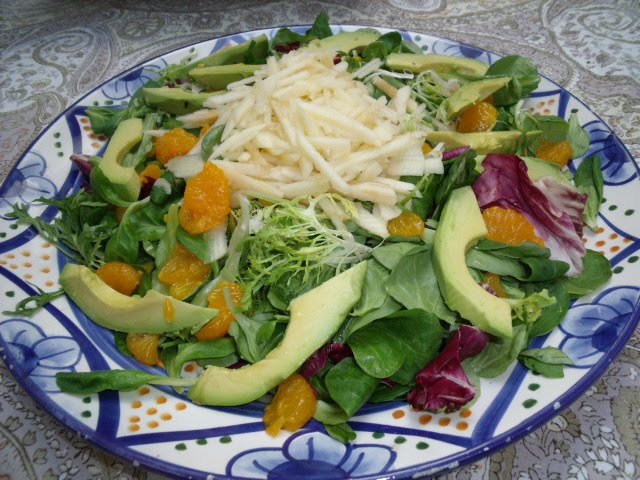
Butter Lettuce Salad with orange, jicama, and avocado

Ingredients:

  • 1/3 cup fresh lime juice, strained (about 2 limes)
  • 1 chipotle chile, pureed
  • Sea salt and freshly ground pepper
  • 1/2 cup extra-virgin olive oil
  • 2 navel oranges
  • 2 bunches greens of choice, about 1/2 lb, large stems removed
  • 1 small jicama, about 3/4 lb, peeled and finely julienned
  • 1 ripe Hass avocado, pitted and peeled, then sliced lengthwise


Directions:

1. In a small bowl, whisk together the lime juice, chile, 1 teaspoon sea salt, and pepper to taste.  Pour the oil in a thin, steady stream while whisking constantly until thoroughly emulsified, forming a vinaigrette.  Set aside.


2. Working with 1 orange at a time, cut a slice off the top and the bottom to reveal the flesh.  Place the orange upright on the cutting board and, using a sharp knife, cut down along the sides, removing all the white pith and membrane.  Cut the orange in half vertically then cut each half crosswise into slices 1/4 inch thick.  Repeat with remaining orange.  Place in a bowl, add the greens and jicama, and toss to mix.


3. Just before serving, drizzle the vinaigrette over the greens mixture, then carefully fold in the avocado slices.  Taste and adjust the seasoning with sea salt.


Makes 4 servings

Link to photo and alternate salad recipe


Jasdeep Mangat & the Cooking Healthy Team
(Recipes courtesy of German Mosquera)
 

Healthy Habits: Go Meatless (at least) One Day A Week

One of my New Year’s resolutions this year was to come up with monthly “resolutions” for myself and for anyone who follows this blog.  Cooking Light magazine (which is one of my favorite sources of recipes and ideas for healthy living) had the same idea, so I am shamelessly borrowing their healthy habits!  So, for August, think about setting a goal to go meatless one day a week.

It’s impressive to me how many of my colleagues, students and friends have become vegetarians.  They have different reasons, from ethical concerns for how animals are treated to issues with their health.  If you’ve thought about trying a vegetarian diet, this is a good month to experiment by going meatless one day a week.

What are the advantages of a vegetarian diet?

  • It will be easier to lose weight and maintain a healthy weight.
  • You’ll help the environment by decreasing the “carbon footprint” related to your food choices.

Photo source

What are the different kinds of vegetarian diets?

From Wikipedia: “An ovo-vegetarian diet includes eggs but not dairy products, a lacto-vegetarian diet includes dairy products but not eggs, and an ovo-lacto vegetarian diet includes both eggs and dairy products. A vegan diet excludes all animal products, such as eggs, dairy, and honey.”

How do you make sure you get adequate nutrients if you are not eating animal protein?

If you are going meatless a day or two every week, none of this will apply to you.  If you are thinking about a completely vegetarian diet you may want to look at the the USDA resource page on Vegetarian Nutrition.  The four nutrients that may be deficient in some vegetarian diets are:

  • Protein.  If you include eggs and dairy products, it’s realtively easy to get enough protein in a vegetarian diet.  Good protein sources include beans, soy products (tofu has 20gm of protein per cup) and nuts.  In the past, people who ate a vegetarian diet were told to combine food to make sure they got complete proteins. Current thinking is a little different – as long as you are eating a variety of proteins during the day, you’ll be fine.  Women need about 50 gm of protein a day, men a little over 60 (unless you are an endurance athlete, pregnant or nursing). Here’s a list of protein sources from SportsMed Web.
  • Calcium. If you include dairy products, calcium is not usually a problem.  For vegans, it’s important to include calcium rich foods or consider a supplement.

fn7_vegetarian

Photo source

Where can I get good vegetarian recipes?

How to Cook Everything Vegetarian: Simple Meatless Recipes for Great Food by Mark Bittman

Vegetarian Cooking for Everyone by Deborah Madison

Moosewood Restaurant Cooks at Home: Fast and Easy Recipes for Any Day

Vegetarian Times

Vegetarian recipes from Epicurious.com

Vegetarian recipes from allrecipes.com

Food Network vegetarian recipes

What To Do This Summer

This week approximately 16,000 US medical students are going to receive their diplomas and become physicians. There are also about 16,000 college graduates who will start medical school later this summer or early in the fall.  Congratulations to you all!

Nearly all of you have a well-deserved month (or two)  to rest and get ready for the next step in your training.  So, I thought it might be helpful to pass on a few words of advice on how to spend your time this summer.

Photo credit


Do NOT study!

  • If you are starting your residency and you think it might help relieve your (normal) anxiety, here is what to do:  Buy one of the major textbooks and use it to get excited about what you are going to learn.   If you want to, plan how you are going to study for the year.   Skim the book if you really have to do something to feel less anxious, but don’t spend hours studying.
  • If you are getting ready to start medical school – step away from the books!  Seriously, there is nothing you can do that will make it any easier, so just enjoy your time off!

Photo credit


Take a vacation (or two or three…)

  • Visit family and friends – take a road trip and connect with people you haven’t seen in a while
  • Hang out on a beach, go for some great hikes, read some great novels
  • Sleep late, eat well, and just rest

Photo credit


Develop (or strengthen) an exercise habit

  • Use this summer to develop a daily exercise routine that you can take into your new (and crazy) schedule.  Overall, your goal for the summer should be to develop a balanced exercise program (cardio, strength training and flexibility).  If you’ve never done any strength training, hire a trainer and learn about it.  Your goal should be at least 30 minutes of cardio 4-5 times/week, 2-3 strength training sessions/week and stretching every day. If you develop a balanced exercise routine this summer, it will be much, much easier to continue this once you start medical school or your internship. Commit to doing at least 30 minutes of exercise a day this summer.
  • Running is one of the best (and most convenient) cardio exercises for medical students and residents (because it’s cheap, efficient and effective)  Use this summer to become a runner. If you hate running, find another good cardio exercise habit to develop instead – but pick one!
  • If you don’t own a bicycle, think about getting one that you can use to commute to school or the hospital.

Photo credit


If you don’t know how to cook, learn.

  • Unless you want to gain a lot of weight, have poor energy and feel bad, you are really going to have to cook for yourself (or at least plan for good food cooked by someone else).  You won’t be able to eat what you need, particularly as an intern, unless you bring the food with you.
  • Learn some basic skills to cook simple things.  If you have good cooks in your family, have them teach you.
  • If you don’t have family members who can teach you, find cooking classes near you and sign up.  Many high end grocery stores and gourmet stores offer classes for beginners – look on line for classes near you.

Photo credit

Easy, Fast Recipes: Stone Soup

I found another great recipe site to share – Stone SoupJules Clancey, who developed her blog to share recipes, also runs a cooking school and has authored an ecookbook.  The site has a great collection of recipes with only 5 ingredients – and that are usually well within the parameters of the “pizza rule”.

Zucchini “surprise” pasta

Chickpea and Rosemary Fritatta

Simple Salmon Kedgeree

Super moist carrot cake

Healthy Habit – Eat Whole Grains

One of my New Year’s resolutions this year was to come up with monthly “resolutions” for myself and for anyone who follows this blog.  Cooking Light magazine (which is one of my favorite sources of recipes and ideas for healthy living) had the same idea, so I am shamelessly borrowing their healthy habits!

Cooking Light’s 12 Healthy Habits

It’s a lot easier to commit to 30 days of a new habit than a full year.  So this month’s goal is to eat three servings of whole grains every day.

Definition of grains (from Wikipedia): Cereals, grains, or cereal grains are grasses (members of the monocot families Poaceae or Gramineae)cultivated for the edible components of their fruit seeds (botanically, a type of fruit called a caryopsis): the endosperm, germ, and bran.”

“Whole grain” means you get the whole thing – the endosperm, the germ and the bran.  Processed grains are only the endosperm (which is mostly carbodydrates).  When you remove the germ and the bran, you are removing most of the vitamins, minerals and fiber.

How the companies cheat. In the USA, the words “whole wheat” or “whole grain” really don’t mean anything… products labeled “whole wheat” or “whole grain” may have trivial amounts of whole grain in them. You have to see “100% whole grain” or “100% whole wheat” on the label to be sure it’s truly a whole grain product.

In addition to buying foods with 100% whole grains, you can add whole grains to your diet by buying and cooking the actual grain. There are lots of ways to cook grains that follow the “pizza rule” (don’t cook anything that takes longer than it takes to order a pizza).

Recipes from wholegrainscouncil.org

Whole grain recipes from 101cookbooks.com

Whole grain recipes from eatingwell.com

The “easy” grains

You’ve grown up with a variety of grains – which are all familiar to you.  They all come in a processed and “whole grain” version. So, if you are used to eating white rice or eating white bread, it’s time to give the whole grain versions a try!

OATS Although oats can be cooked whole in dinner recipes, in the United States, they are usually eaten as oatmeal.

There are 4 kinds of oatmeal you can make for breakfast.  Oat groats are the untouched whole grain.  Steel cut oats are oat groats – just cut up.  Both of them take a long time to cook.  For busy people cooking them overnight in a slow cooker or partially cooking them the night before is the way to go. The other two kinds of oatmeal (rolled and instant) are more processed (i.e. less vitamins, minerals and fiber) but are still whole grain.

Oatmeal is a great way to start the day – and it’s a fantastic middle of the night snack when you are on call.  Beware the instant flavored oatmeals –they have lots of added sugar!  It’s better to take a zip-lock of instant oats and a second Ziplock of dried fruit and nuts instead. And be really wary of fast food oatmeal!

BROWN RICE Rice is consumed in mass quantities all over the world.  Brown rice takes about 45 minutes to cook, so you’ll have to plan ahead a little.  Instant brown rice takes about 10 minutes, but the rice has been processed a little (slightly less nutritious but better than white rice).   A rrice cooker is a great appliance to have (good for holiday or birthday wish lists). You can also steam veggies, shrimp, fish, etc in the rice cooker while the rice is cooking –  or use it for an easy “one pot” dinner. Rice salad is a great food for call.  I usually make it with celery, carrots, left over veggies,  tuna and a vinaigrette – but there are a lot of  variations on the theme.

.

rice-chicken-ck-1622452-l

Sesame Brown Rice Salad with Shredded Chicken and Peanuts

Leftover rice also makes a great breakfast.  You can put fruit and milk on it (like oatmeal) or put an egg over it (great with some soy sauce). (In Japan the egg is raw, but it’s probably better for health reasons to cook it first)

WHEAT Whole Wheat is most commonly turned into flour to make breads, tortillas, and pastas.  Cracked whole wheat is called bulgur and can be used in place of rice or in salads.

08recipehealth_600-articleLarge

Bulgur With Swiss Chard, Chickpeas and Feta

Popcorn. You may not think of popcorn as a whole grain, but it is.  When air popped and In the absences of movie butter, it’s a healthy food item – mainly because of the amount of fiber it provides.  It’s better to use your stove top or an air popper– commercial microwave popcorn is usually filled with transfats (and calories).  Another alternative is homemade microwave popcorn.

Grains you may not have tried (but should)

QUINOA Quinoa is one of my favorite grains – enough that I did a post on it a few months ago.  If you are going to wander into the “unusual” grains, this would be where to start.  Quinoa takes about 30 minutes to cook on the stovetop. You can eat it plain or serve it instead of rice in any recipe.  If you have a rice cooker, you can use the white rice setting and it will cook perfectly.  Put a few veggies (and maybe some shrimp, fish or chicken) into the rice cooker (or steam them on the stove) and you have a dinner like this:

Sweet potato, kale and quinoa

BUCKWHEAT Buckwheat is eaten as a grain in Eastern Europe fairly commonly.  In the USA, we are probably more familiar with buckwheat as a flour used in pancakes or in soba noodles.

Spicy Soba Noodles with Shiitakes and Cabbage

BARLEY Barley is the grain used in most beers… which does not count as a whole grain food item!  It’s a chewy, nutty grain that is delicious in soups, casseroles and salads. The classic combination (which is very delicious) is barley and beef – usually in a stew.  If you have the time, it’s well worth it.  For a faster combination you might try this recipe (add some chicken or pre-cooked beef if you want)

FNM_120109-W-N-Dinners-010_s4x3_med

Carrot-Mushroom-Barley Stew

SPELT Spelt is often sold in the stores as farro (from Italy).  Farro is delicious. by itself, in salads or soups.  It’s also great in risottos– it takes longer than rice to cook in a risotto, but you don’t have to stir.

ei0902_salad1_med

Mediterranean Farro Salad

MILLET Millet is a small grain that, like the other grains can be used in salads, casseroles or as a cereal. It’s a little more bland (less nutty) than the other grains, so it’s probably better to use it in more flavorful recipes.

EE1102_Stuffed-Tomatoes_med

Stuffed Tomatoes

WILD RICE Wild rice is in a completely different species than brown rice. Like many of the whole grains it takes 40-60 minutes to cook on the stove.  It’s often used in stuffings for chicken or other poultry and is also great in pilafs and casseroles.

EE1104_Gumbo-Zherbes-with-Wild-Rice_med

Gumbo Z’herbes with Wild Rice

TEFF Anyone who has ever eaten Ethiopian food has had teff. Teff flour is what is used in injera, the large flat bread used to eat Ethiopian meals.  Teff is the smallest grain in nature, and has high levels of protein, calcium, iron and fiber. I recently tried it for breakfast (with dried fruits and honey).  It reminded me of a nutty cream of wheat.  It’s really dense (and becomes gelatinous in the refrigerator) – but it was a nice change for breakfast.

AMARANTH Amaranth can be boiled or popped like popcorn.  Because they are smaller than other seeds, amaranth only takes about 20 minutes to cook.   Smaller seeds tend to have more concentrated nutrients; amaranth is high in calcium and protein.

Like teff, this is probably best tried as a breakfast item if you want to experiment.

picoaZFvs

Amaranth for Breakfast

Fast Easy Recipes: Skinnytaste.com

In keeping with this month’s goal of cooking more at home, I thought I’d share a website with you. Skinnytaste.com has great low fat, low calorie recipes that are easy to cook (and family tested).  Even if you are not worried about your weight, these recipes are great for being on call – lots of energy and lots of food without too much fat (which will make you sleepy).

Recipe for cheesy zucchini enchiladas

low-carb-zucchini-enchiladas

Recipe for Shephard’s Pie (LIghtened up)

shepards-pie3

Recipe for Southwestern Black Bean Salad

Healthy Habit: Get Cooking

One of my New Year’s resolutions this year was to come up with monthly “resolutions” for myself and for anyone who follows this blog.  Cooking Light magazine (which is one of my favorite sources of recipes and ideas for healthy living) had the same idea, so I am shamelessly borrowing their healthy habits!

Cooking Light’s 12 Healthy Habits

Last week I had a fairly common conversation with one of my residents.  She told me that with her schedule it’s almost impossible for either parent to cook for the family.  Secondly, she said when she does shop for food, she buys everything she thinks she might need… and half of it goes bad in the refrigerator.   They have resorted to picking up take-out as their solution to the problem.  There are at least two major problems with this strategy (and a lot of other minor problems): 1)  It costs a LOT more and 2) It is clearly not going to be as healthy.

I know this is a common scenario, hence why this month’s resolution is to cook at least 3 meals a week at home.  It’s doable!  Here’s how to get started:

Change your mindset about cooking.

Cooking is not hard and it doesn’t take as long as you think.  There are some basic skills you have to know, but you can start small and add new skills one at a time.  Make up your mind that you are going to acquire this important skill and practice!  Start with one simple act – sautéing an onion.  Here’s how to cut up an onion and how to sauté.  If you get this one simple skill down, you’ve learned the beginning of many, many recipes!

Make a plan

Decide ahead of time what you are going to cook and write it down. You can map out the whole week if you are a “gunner” – but,  at a minimum a) find 3 recipes for the week b) make a shopping list for the ingredients in those three recipes and c) go shopping.  If you plan ahead, you’ll have everything you need – but not a lot more (so no more growing interesting molds in the back of the refrigerator).  You’ll also be able to really eat well when you are on call (which is the hardest day to plan for).

Remember the pizza rule.

No one who is really busy has time to do fussy cooking.  You should look for recipes that take less than 30 minutes (the time it takes to order a pizza).  I’ve posted a lot of recipes that meet this requirement (use the tag marked “recipes” to the left of this web page).  Another strategy is to pick a cookbook, one issue of a magazine, or a website (some of my favorites are listed below) to choose the week’s recipes.  Another option is to subscribe to a site that will send you weekly menus (and will also automatically make your shopping list) – like Six O’Clock Scramble ($54.50/year) , Send Me Recipes ($65/year), Dinner Planner, ($60/year), or Make Dinner Easy (free).

Cook ahead for the week

It’s boring to eat the same thing over and over… but it beats buying fast food on the way home.  If you cook a big casserole or stew on the weekend, you’ll have it for meals on call, late at night or lunches.  If you really want to cook just once for the entire week, you can double the recipe or make two different dishes at the same time, and freeze portions for later in the week.

Supplement your main dish with lots of fruits and vegetables

If you don’t have a steamer basket, this is a cheap piece of kitchen equipment that is really worth having.  Almost any vegetable can be sautéed or steamed and it’s really easy to do.  Buy vegetables fresh, wash them, dry them and then store (clean) in the refrigerator (one less thing to do when you are tired). Refrigerator to plate will be less than 10 minutes for most veggies. (Here’s a table of cooking times for vegetables.)  Leftover steamed vegetables make a great “salad” by themselves (just add some olive oil, vinegar, salt and pepper) or as an addition to other salads.  You can also toss them into scrambled eggs or an omelet.  Having steamed potatoes in the refrigerator is particularly helpful – they are great in salads, with eggs, or just as a snack.  Frozen vegetables are more expensive, but are perfectly fine, too.

Make a list of  “emergency” meals (<5 minutes) for nights you are completely exhausted and really, really don’t want to cook. (And keep these items in your pantry and/or refrigerator.)

Here are some ideas to get you started:

1.    Scrambled eggs or egg whites (with leftover veggies and/or cheese if you have them) with toast.

2.    Angel hair pasta (takes 3-5 minutes) with bottled spaghetti sauce with a green salad

3.    Veggie (or regular) hamburgers (from the freezer) with a green salad

4.    Couscous with canned beans, canned tomatoes and any leftover (or frozen) vegetables you have

5.    Sandwiches

6.    Pancakes

Websites for “pizza rule” recipes

eatingwell.com

cookinglight.com

myrecipes.com

foodnetwork.com

My favorite magazines to cook from

Cooking Light

Bon Appetit

Clean Eating

Vegetarian Times

Cookbooks worth buying

How To Cook Everything

The Silver Palate Cookbook

The Art of Simple Food

,

How to Spend Your Day Off

“I know I should study for the Absite this weekend, but I haven’t had a real day off in over a month”.

Here’s the scenario. It’s Friday evening. You’ll be back at work on Sunday. You’re sleep deprived because you are a resident.  You haven’t spent any quality time with your significant other, friends or family because you haven’t had any real time off. Next week has plenty of call and it would really help if you planned out good food for the week and cooked something.  And, by the way, you have the inservice exam coming up, so you really should study.

There is no one answer how to balance these things. Everyone will be a little different in what is most important to them, and different weeks will be different, too. But, there are some basic concepts to think about that might help you plan how to spend your time off.

  • Sleep is actually a high priority even though it feels like you are giving up social time.  Whether it’s visiting friends, studying or just goofing off, you won’t get the benefit of your time off if you are completely exhausted. If you are sleep deprived, try going to sleep really early (8 or so) the night before your day off and see if it doesn’t make a big difference.
  • Good food is important. Be efficient, but be conscious about what and when you eat. Use a little of your down time to think about your week, plan what you are going to eat, and go shopping. Find a good recipe for something easy to make and make a big batch for the week. Or at least buy good quality frozen food that serves the same purpose.
  • Get some exercise, but be realistic. A serious workout can use up a big hunk of a day off. For some, that’s great – the hours will be more than worth it. For others, don’t beat yourself up. It’s far better to figure out how to do 30 minutes 3 or 4 times a week than to be a “weekend warrior” for 4 hours on your day off.
  • Don’t plan for huge blocks of study time on your day off. You’ll wear out your neural pathways and you just won’t remember what you are trying to learn. Like exercise, a little every day is much, much more effective than a big block on the weekend. Plan now for the big test months from now… pace yourself!  (If you’ve just started studying for the Absite later this month – go for it. But, as soon as the exam is over, map out a way to study for next year so you don’t do the same thing again.)
  • Absolutely use a significant part of your day off to socialize with your family or friends. It’s very isolating to live in the hospital and these hours are critically important.
  • Once you think about what’s important to you, and make a decision about your day – enjoy it! The worst way to spend a day off is to spend the time worrying that you should be doing something else. There’s a reason that almost every religion in the world has the concept of “Sabbath”. Human beings need real down time once a week to refuel.  It’s not “wasted” time, it’s essential time.