
Although I follow my ancestors’ spiritual path, I have incredible respect for the varied traditional paths my friends follow…and for those who follow no specific spiritual tradition. This post, which is the text of a sermon I gave today, does not and should not imply anything beyond my desire to share… and to lift up love where ever we find it.
As I walked out of my house this morning, I put two pennies in my pocket. Not because I needed pennies (who even carries them anymore?) but because I needed a physical reminder, a way to literally hold onto the lessons I learned writing this sermon.

Two weeks ago our scripture reading was the parable of the landowner who gives a full day’s wage to everyone – even if they only worked an hour. It is a parable told by Jesus to illustrate what Eugene Peterson calls “the great reversal”. Just prior to the parable, Jesus told a young man that the key to getting into heaven was to give away all he owned. He told Peter that he would get “everything” if he gave away everything… and he ended this series of lessons by telling the disciples… “many who are first will be last and the last will be first”.
Today’s text from Luke continues the story of the great reversal.
Jesus is sitting in the temple watching people as they come in to put money into the treasury, money for the temple tax every man in Judah is required by law to pay as well as donations. Several wealthy people come in and put large amounts of money into the treasury. We don’t know if these rich people are giving more than they are required by law to give… but we know they will still have plenty at home despite what they have given. Then a woman approaches the treasury. Because she’s a woman she’s not required to pay a tax or make a donation. We learn that she is an impoverished widow – one of the least in society in the first century – and that the two pennies she offers is everything she has.
We’ve already learned that stories in the Bible aren’t divided by chapters and verse and for this particular story, which is a tiny piece of a much larger story, it’s particularly important to hear the whole thing.
Today’s gospel text takes place in the Temple of first century Jerusalem.
So let’s start there, with the Temple. The temple in our story is known as Herod’s temple, and, in a way, it is the third rendition of the Temple in Jerusalem.
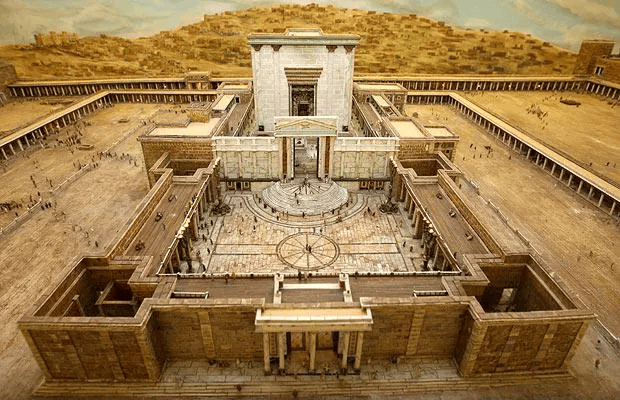
The site for the first temple was chosen by King David, and constructed by his son Solomon 1000 years before our story takes place. It was built to hold the Ark of the Covenant, to literally provide a dwelling place for God. 400 years later Babylon conquered Judah and destroyed the first temple. For the next 70 years there was no temple in Jerusalem – until Cyrus conquered Babylon and gave the Jews permission to rebuild the Temple.
The second temple stood relatively unchanged for a period of 400 years until Herod was named ruler of Judea by the Roman empire. Herod didn’t destroy the temple, but he absolutely transformed it. He created a 35 acre complex which was used by rabbis and everyone who visited the temple for prayer and other religious instruction. It was the center of all the pilgrim festivals like Passover, Pentecost, and Sukkot. But Herod’s temple was more than the house of God. It served the Roman empire as well.
The second temple was expanded by Herod to serve as the center of both Roman and Jewish life. It became the place where money was exchanged and it’s treasury served as the central bank – if you will – of Judea. Temple taxes and donations were collected in jug shaped metal containers so that metal would clang on metal. Anyone nearby would know if you were putting in a lot of heavy coins … or just two pennies.
So that’s where today’s gospel text is set… Jesus is sitting in Herod’s temple watching people put their money into the treasury.

But that’s not where this story actually starts.
This story starts two days before, on what we now call Palm Sunday, the day Jesus entered Jerusalem on a donkey from the East at the same time Roman battalions entered Jerusalem from the West.
Kindom entering from the East… Kingdom entering from the West.
We are told after he enters Jerusalem he goes to the temple where he “began to drive out those who were selling things” saying “It is written, ‘My house shall be a house of prayer,’ but you have made it a den of robbers.” (Luke 19:45) For the next two days, he teaches in the temple… and the religious authorities are there to test him… trying to set him up so they can accuse him of blasphemy.
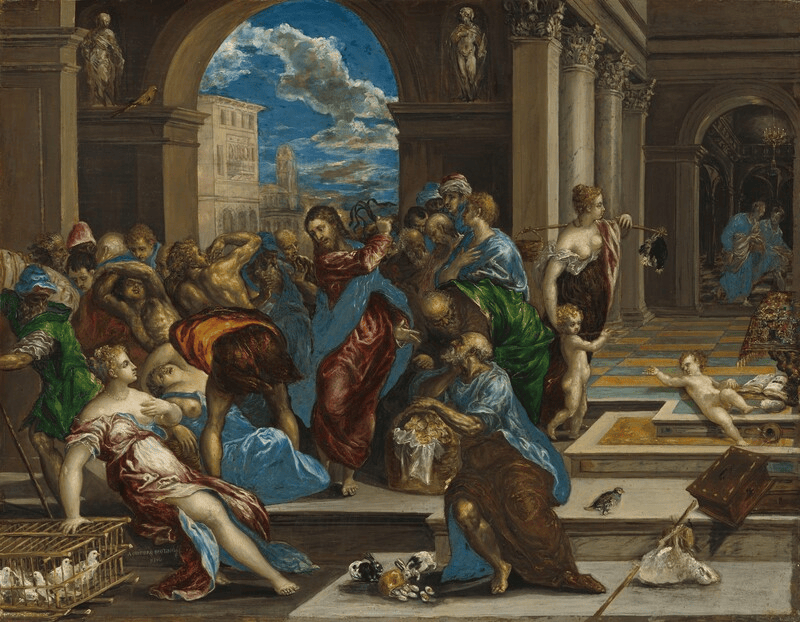
And then – the last story he tells, on the last day he ever visits the temple, is the story of the widow’s mite… a story about one of “the least” in society giving “everything”.
Jesus looked up and saw rich people putting their offerings into the Temple treasury, and then he noticed an impoverished woman, a widow, putting in two copper coins. At that he said, “The truth is, this woman has put in more than all the rest. They made contributions out of their surplus, but she from her want has given what she couldn’t afford—every penny she had to live on. (Luke 21:1-4)
Over the next two days the plot to arrest Jesus intensifies, Judas agrees to betray him, and Jesus shares a last supper with the disciples at Passover. He is then arrested and brought before Herod.
I think you’ll agree with me that this is a story that is about much more than a poor widow giving all her money to the temple.
This is a story about the powerful and the powerless.
This is a story about the great reversal – that the kindom of God is more powerful than human kingdoms and empires.
This is a story about emptying yourself completely, as both the widow and Jesus did.
This is a story about trusting in the promise of God.
That’s a story that we as a community particularly need to hear right now. We are experiencing anticipatory grief for a dear one. We are worried about our friend and organist who is caught up in the evil whirlwind of our country’s immigration policy. We feel helpless in the face of the power of empire Now more than ever we need to trust in the promise of God.

The promises of God are the focus of our other two scripture readings today. In 1 Kings 17:8-16, Elijah, along with all of Israel, finds himself in the middle of a famine. There is no grain because there is no water… and it’s not just the expected dry spell that happens every summer… this famine has been decreed by God to last three years.
God sends Elijah to Zarephath telling him that he will find a widow there who will feed him. Again… a widow, not a priest, not an official… a widow. He finds her and asks for some bread to eat. She responds quite bluntly: “I don’t have any bread—only a handful of flour in a jar and a little oil in a jug. I am gathering a couple of sticks to take home and make a meal for myself and my child. We will eat it—and then we will die.”
And Elijah, the prophet of God says – don’t worry. Go ahead and make bread with what you have and bring me some of it. God promises that if you do, you’ll have flour and oil until the rain comes back.
So she brings him the bread and, as promised, God provides. She and her son have food for the next three years.
This is a story about the powerful and the powerless.
This is a story about the the great reversal – that the kindom of God is more powerful than human kingdoms and empires.
This is a story about emptying yourself completely, as both widows and Jesus did.
This is a story about trusting in the promise of God.

In our third reading (Isaiah 25: 6-9), Isaiah tells us directly what God promises:
God promises to deliver us from oppression in a world where friends and neighbors are denied their rights by governmental authorities.
God promises to provide for us… not just enough food to sustain us, but a banquet of rich food and fine wines.
God promises to remove the mourning veil covering all peoples, to hold us as we grieve.
God promises to destroy all death forever
Praise be to God. Amen.
Discover more from wellnessrounds
Subscribe to get the latest posts sent to your email.