If you are a medical student or resident… You’re welcome!
There are teachers, and then there are master educators… Dr. BK Titanji is an infectious disease expert at Emory who recently posted this on Bluesky:
I emailed her to ask her for the original PDF so I could post it here with better resolution. This is not just a great tool for anyone who prescribes antibiotics, it’s a beautiful example of how to teach complex subjects.
How old are you on Mars?
It’s an interesting thought experiment… and a reminder of how time (the way we use it) is a construct.
While we’re on the topic of space, time, and the space-time continuum….
The ring around the galaxy cluster in this amazing photograph is called an “Einstein ring” (because he predicted that it would exist).
“An Einstein ring, also known as an Einstein–Chwolson ring or Chwolson ring (named for Orest Chwolson), is created when light from a galaxy or star passes by a massive object en route to the Earth….Gravitational lensing is predicted by Albert Einstein‘s theory of general relativity.[1] Instead of light from a source traveling in a straight line (in three dimensions), it is bent by the presence of a massive body, which distorts spacetime. An Einstein ring is a special case of gravitational lensing, caused by the exact alignment of the source, lens, and observer. “(Wikipedia, Einstein Ring)
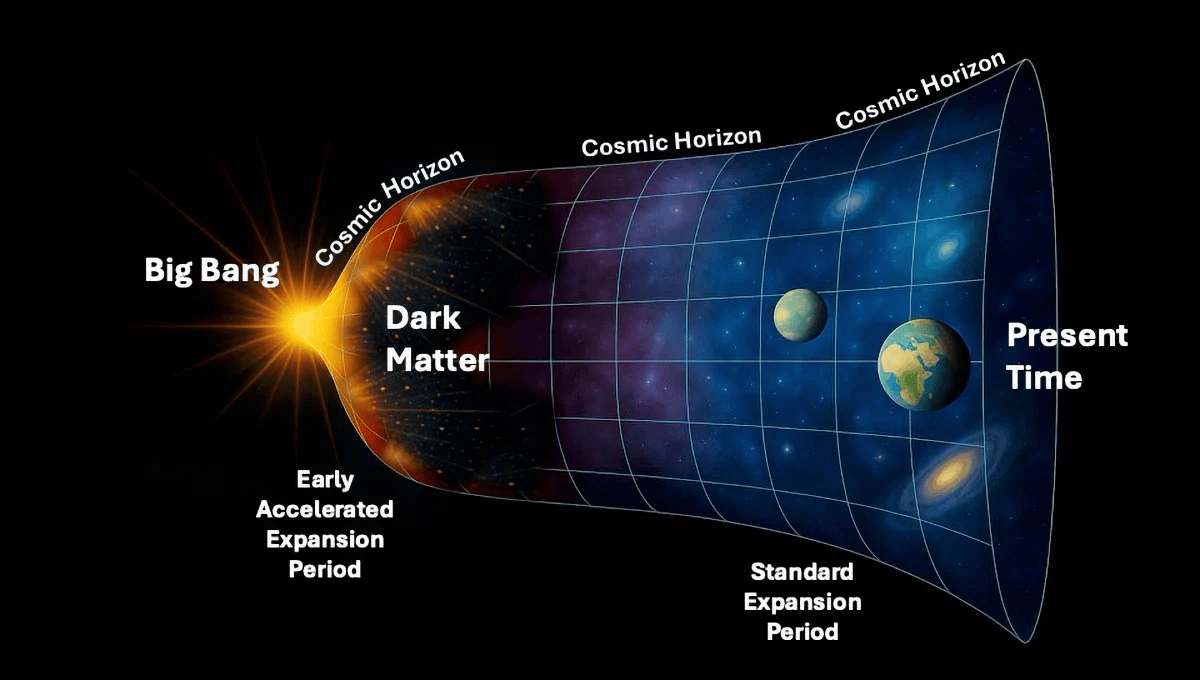
Dark matter has evaded direct detection for decades because it does not emit, absorb or reflect any light. It is as pervasive as it is inaccessible, making up 85 percent of the matter in our universe, a tease for the particle physicists keen on deciphering its nature.
I’m not a scientist, but I’m fairly fluent in most scientific concepts… and this blows my mind.
This paper (published this week) is a very complicated (for me, not for physicists) description of what the NY Times described “a single, tiny nudge of one particle into another”.
The best part is that the LZ team (250 scientists and engineers from 39 institutions) who published this finding have been looking for this “nudge” for a long time. Even though there’s only a small number of people who can understand this science, it’s clear this may be a game changer in our understanding of the universe… since this amazing team may have actually “seen” dark matter for the first. time.
Rules for a pilgrimage
I’ve been thinking a lot about my Dad this week. After he retired, he took to the road in his Prius for what turned out to be close to 100 “pilgrimages”. The process started with choosing a distant goal – and then he’d just head out in that general direction. He decided day by day on a route using five “rules” (see below). Sometime in the mid afternoon he’d find one of the many hotels on the road that had breakfast included and he’d pull in. He’d check in, pour a Scotch, and start writing.
1. Freeways are to be crossed, not driven on. 2. If the sun gets in your eyes – turn 3. If you see a Dairy Queen with pick-ups in front of it, stop to join the conversation. 4. Ask anyone who is alone at breakfast if you can join them and take the time to learn their story 5. Anything beautiful warrants a stop.
I was able to spend some time with medical students this week as a substitute teacher for their ethics course. We had a great conversation about ethics… but (not surprisingly) we also spent some time talking about more general topics like how hard it is to keep your life in balance as a medical student.
I’ve recently started reading Howard Luks’s blog, an orthopedic surgeon who mostly directs his advice towards people like me (people “of a certain age” as the French say). His advice this week was about “exercise snacks”, which is a great strategy for medical students, residents, and other busy folks (not just those of us who have a few years under our belts) when life it too busy to work exercise into your schedule. “Exercise snacks” are basically “exercise” that takes 30 seconds to a few minutes done multiple times during the day. That’s all. You can do pushups, dance to a song, or (always available in medical schools and hospitals) just take the stairs. Worth trying!
“On a good, calm day it is hard to know what to make of photos that show, in no uncertain terms, that every single thing you will ever and could ever know is simultaneously galactically insignificant and unspeakably beautiful and precious. Today, the world held its breath waiting for the 8 p.m. eastern deadline Trump set for Iran to agree to a deal to reopen the Strait of Hormuz. If his terms weren’t met, he posted this morning, “a whole civilization will die tonight, never to be brought back again.”… And yet at the very same moment, four flesh-and-blood human beings are hundreds of thousands of miles away taking pictures of our delicate little world. Their mission and their photos remind us of something else entirely—of a yearning to learn, to explore, and to band together to become something greater than the sum of our parts.”
Hildegard de Bingen, who lived in the early 12th century, was an astounding polymath, theologian, and visionary. I’ve recently rediscovered her “mandalas”, designs meant to open our eyes to new ways of seeing…
“The [mandalas] were thought to be as strong or stronger than the words themselves. There is a gestalt immediacy, what Hindu’s refer to as darshan, meaning the simultaneous act of seeing and being seen by a deity.”
The astronauts hugging each other after naming a crater after Reid Wiseman’s late wife Carroll. Link to the video
“Unlike happiness, joy can live alongside sadness, boredom, fear, or despair. It expands our capacity to hold contradictory truths at the same time—and because we know joy, we recover a strange, steady confidence that life is still worth loving, even when it hurts.”