Knots, Contemplative Practice, and the Origin of Satsumas

Maybe it’s because I’m a surgeon, but I’ve always loved knots… and this website is great resource to learn how to tie them.

PSA for holiday wrapping…this surgical knot lets you tie your ribbons without them being loose (or needing someone to put a finger on the first knot)

This Book

Not long ago I saw a post by someone on Bluesky (which I can’t find now) that said we should reread books that “break us open”. I just finished this truly remarkable translation of the contemplative classic, Practice of the Presence of God by the 17th century monk, Brother Lawrence. It “broke me open”, and I’m already halfway through my second reading. 

​​

Although Brother Lawrence and Carmen Acevedo Butcher are both from the Christian tradition, I am convinced that the practical contemplative practice of “Turning to Love” that is described here can be reframed only slightly by those who are of other traditions (or none).

Practice of the Presence offers new ways of seeing that surpass our sometimes tense and either-this-or-that mindsets. And my work with this translation seeks to honor and share his positive, open-hearted wisdom.

Carmen Acevedo Butcher

On Oranges, Satsumas, and Not Taking Common Things for Granted

“What exactly is a satsuma?”  

Photo of Satsumas from Buchanan’s Native Plants, my favorite nursery in Houston

Thanks to my mother-in-law (who asked me this question at Thanksgiving) I got to do a deep dive into something I hadn’t really thought about. 

The history of citrus begins around a billion years ago as Algae developed from cyanobacteria and photosynthetic eukaryotes… followed by what we would recognize today as land plants which evolved around 400 million years ago. The family of land plants that evolved into the first citrus plant probably originated in Southeast Asia, specifically in the southeast foothills of the Himalayas. What we recognize now as the three “ancestral” citrus fruits, the pomelo, the citron, and the mandarin, evolved from this original, profoundly acidic (and therefore inedible) citrus fruit. 

The three ancestral fruits evolved, in different genetic combinations, into the citrus fruits we know today.

Source

It turns out the satsuma is a mixture of mandarins with a little pomelo…. One of the  Type 3 or late-admixture mandarins. 

Source

A Clot of Hematologists, the Full Moon, and Eco Divina

Here’s what caught my eye this week..

This post about collective nouns from Jono Hey

I’ve always thought we missed a great opportunity in medicine for collective nouns…  A flow of urologists? A clot of hematologists? …😂

Day Light Savings Time. It’s easier for your body clock to adjust when flying east to west through time zones which is why it is easier to adjust to the “fall back” to standard time that we just experienced. There are lots of theories about how daylight savings time got started and why. It’s also known that a) it’s better for us to not go back and forth between daylight savings and standard time and b) if we have to pick one or the other, standard time is the one to choose. 

Eco Divina. Lectio divina is a powerful tool for meditation and/or prayer, a four step practice that uses the words of a text (usually a sacred text) to lead you to insight and inspiration. (If you haven’t ever tried it, here are some great instructions. Although these instructions refer to the Bible, any text, from sacred writings to poetry can be used. I had heard of visio divino, where art serves the same purpose… but eco divina was new to me (at least by that name). Like sitting with words, or with images, eco divina is sitting deeply with something in the natural world in a way that reminds you of the beauty of creation (and your part in it). 

The moon. Make sure you go outside tonight and look at the moon. It’s a supermoon and worthy of a little “eco divina” (aka awe).

I love this app to know when the moon rises and sets (and in which direction).

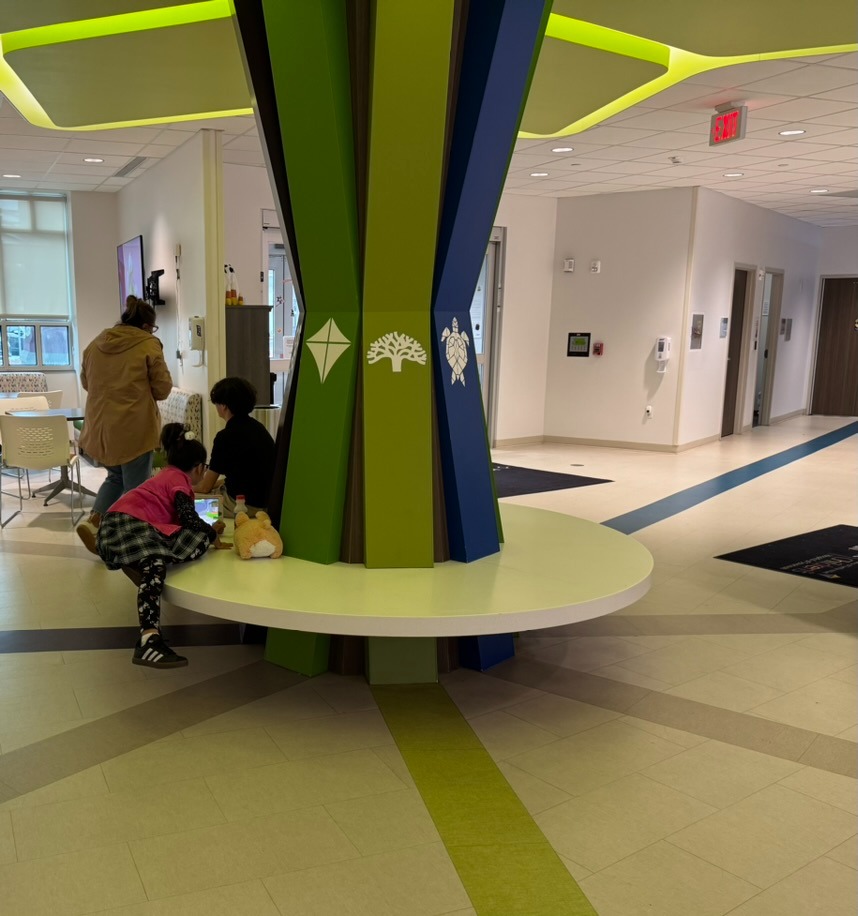
The best hospital signage I’ve ever seen.

I was recently part of a survey team that visited Savannah Children’s Hospital and I have to share how patients and families find their way in their hospital! 

There is a “tree” in the entrance that defines the color scheme for the entire hospital (green = surgery, brown = diagnostic imaging, blue = ER/ICUs…etc ). There are also symbols associated with each color. 

(the family gave me permission to take this photo)

Then you follow the path!

Every corridor has tiles that confirm you are still going in the right direction based on the colors.

We often forget that 21% of adults in the US are illiterate, which means they won’t be able to read signs pointing them to different areas in the hospital (or any building for that matter). In addition to being incredibly effective, this attention to design is also an act of kindness. 

Still thinking about Game 7 of the World Series…

I have never seen a game like it and probably never will again…  

(From the Irish Examiner, posted on Bluesky)