Fast Easy Exercise: The Daily Fitness Solution

I went in search of an exercise equivalent for “fast easy recipes” and came up with a good find.   The Daily Fitness Solution provides 20 minute workouts that don’t require a gym or equipment.  It’s written by Reinhard Engels, who works in bioinformatics visualization at MIT.  So, as you might expect, his program is logical, simple and without hype.

gse_multipart64696

The workout program is more than reasonable, with rest days built in (which could be swapped with a workout day if you are on call)  No matter how busy you are, you can probably find 20 minutes!

I also liked his approach to weight loss – the  The No “S” diet:

The No S Diet, also known as the “Grandma Diet,” the “Why Didn’t I Think of that Diet,” and the “No $ Diet” is a program of systematic moderation I invented for myself that I imagine might work for similarly minded people.

No funny science or calorie accounting involved, just a few simple and mnemonic tricks for giving your willpower the upper hand.

There are just three rules and one exception:

  • No Snacks
  • No Sweets
  • No Seconds

Except (sometimes) on days that start with “S”

That’s it.

How could something this simple possibly work? Precisely because it’s simple — or rather, following the Einsteinian dictum, “as simple as possible, but not simpler.”

#HealthyHabit – Get Stronger

One of my New Year’s resolutions was to come up with monthly “resolutions” for myself and for anyone who follows this blog.  Cooking Light magazine (which is one of my favorite sources of recipes and ideas for healthy living) had the same idea, so I am shamelessly borrowing their healthy habits!

Cooking Light’s 12 Healthy Habits

It’s a lot easier to commit to 30 days of a new habit than a full year.  So this month’s goal is to get stronger.  How to get stronger is something that is taught in medical school.  Whether it’s strengthening cardiac muscle to improve cardiac function or building striated muscle to improve strength it’s the same concept – Getting stronger requires a progressive and repetitive load on the muscle that forces it to adapt.

Why it’s important to lift weights

  1. Weight control.  If you are interested in losing weight or controlling your weight, you probably have been told to do more cardio.  Although cardio is important, adding weight training will greatly improve your odds of losing or maintaining weight.  The math is simple.  Fat doesn’t burn very many calories but muscle does.  If you build muscle, you increase your lean mass and, therefore, you burn more calories just sitting around (and a lot more if you are working).   In addition, strength training has an “after burn” that helps; your basal metabolic rate stays elevated for about 1-2 hours after the workout (for an additional ~100 calories worth of calories burned)
  2. Injury prevention.  There are good data that show joints are protected when you build muscle mass.  Most occupational injuries for doctors are related to the joint injury – usually spine, hips or knees.  Strengthening your muscles will increase your stamina and decrease your risk of injury.
  3. Bone health.  Critical for women, but important for men, too. You can prevent osteoporosis with strength training.
  4. You’ll look great. Women worry about looking “big” – but don’t.  You’ll get strong and lean without building bulk.
  5. You’ll feel better. Working out, in general, improves your mood.  But, there is something (literally) empowering about getting strong.


weights-curl-guy

Beginner or experienced gym rat – here’s what you need to know

  1. Warm up first! Get on the bike, walk fast, just do something to increase your heart rate and warm up your muscles.  5-10 minutes is usually enough…. but don’t skip this important step!
  2. Target specific muscle groups. The goal is to get strong in a balanced way.  Don’t neglect one muscle group in favor of another.  In general, strength workouts are divided into back, chest, shoulders, legs (quads and hamstrings) and abs, but you can get even more specific if you want.  Here is a great list of exercises for each muscle group (and a good anatomy review!):  Exercise Directory from ExRx.net
  3. Pick the right weight. It doesn’t matter if you use machines or free weights.  What is important is to pick weights that are heavy enough.  The goal is to be able to move the weight 10-12 times – but struggle with the last rep or two.  If it’s not hard to finish the set, increase the weight.  You’ll also have to increase the weights as you get stronger.
  4. Maintain your form. If you lift weights that are too heavy, you will “lose form”.  This is classically the guy (sorry, it’s usually a guy) who is trying to bench press too much and ends up arching his back to be able to lift the weight.   The problem is that “losing form” means using accessory muscles to lift the weight instead of just the ones you are trying to train.  This is how injuries happen.  Don’t do it!
  5. Do sets of repetitions (reps). Lift the weight 10-12 times (one “set”), rest, then repeat the set. Three sets of 10-12 reps should be your goal.  There is a good physiologic reason that this works , especially for beginners.  Once your muscles get used to it, though, you may want to change to different patterns.
  6. Lift weights every week. Getting every major muscle group once a week is important.  Twice a week is better.  More than twice a week can lead to injury, unless you are getting enough rest days between workouts.  The ideal goal is to work out every muscle group twice a week.  If you want to split your workouts to do more days (but less time per day) that’s fine.
  7. Rest between workouts. Don’t work out the same muscle group two days in a row.

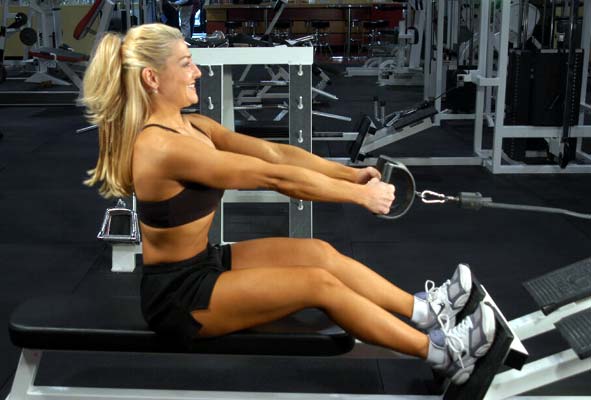
weights-seatedrow

How to get started

If you’ve never lifted weights before, or have limited experience it can be intimidating.  This is particularly true for women, who often feel that it’s just easier to hit the cardio machines than deal with the “foreign language” of the weight room.  But – it’s really important to do this, and – I promise – it’s not rocket science.  Here’s how to start:

  1. Buy a book or go on line.  Learn one or two exercises at a time from these sources then go to the gym.  Start with light weights on purpose so you can concentrate on correct form.  As you learn, add more variety.
  2. Pay for a trainer.  If you can afford a weekly trainer, that’s fantastic – you just hired a combination of teacher and motivation!  For most students and residents, it’s more realistic to pay for just one or two sessions to set up a training program and teach you good form.  Most gyms have trainers, which is probably the easiest way to go, but you can find independent trainers in your area who will meet you at a gym or your house to do the same thing.  You can also ask a friend or colleague who is a seasoned veteran to help you.
  3. Buy weights for your home.  A set of weights is actually pretty cheap.  Add a balance ball or a bench and  you can do a lot of this training at home.

Alternatives to weights

  1. Resistance bands. Resistance bands are probably best used to supplement weight training with machines or free weights, but they can be used as your primary training tool.  These are great for when you are on call (assuming you have 15 minutes at some point for a quick workout) or when you are travelling. They come in a variety of shapes and sizes.  When you buy a set, the exercise program is usually included or you can find examples on line.
  2. Your body. The Marine Corps (and a lot of trainers) know that you can use your own body weight to build muscle mass.   Some great examples are pull ups and  push ups, among others.

weights-Bodylastics-Resistance-Bands1

What To Do This Summer

This week approximately 16,000 US medical students are going to receive their diplomas and become physicians. There are also about 16,000 college graduates who will start medical school later this summer or early in the fall.  Congratulations to you all!

Nearly all of you have a well-deserved month (or two)  to rest and get ready for the next step in your training.  So, I thought it might be helpful to pass on a few words of advice on how to spend your time this summer.

Photo credit


Do NOT study!

  • If you are starting your residency and you think it might help relieve your (normal) anxiety, here is what to do:  Buy one of the major textbooks and use it to get excited about what you are going to learn.   If you want to, plan how you are going to study for the year.   Skim the book if you really have to do something to feel less anxious, but don’t spend hours studying.
  • If you are getting ready to start medical school – step away from the books!  Seriously, there is nothing you can do that will make it any easier, so just enjoy your time off!

Photo credit


Take a vacation (or two or three…)

  • Visit family and friends – take a road trip and connect with people you haven’t seen in a while
  • Hang out on a beach, go for some great hikes, read some great novels
  • Sleep late, eat well, and just rest

Photo credit


Develop (or strengthen) an exercise habit

  • Use this summer to develop a daily exercise routine that you can take into your new (and crazy) schedule.  Overall, your goal for the summer should be to develop a balanced exercise program (cardio, strength training and flexibility).  If you’ve never done any strength training, hire a trainer and learn about it.  Your goal should be at least 30 minutes of cardio 4-5 times/week, 2-3 strength training sessions/week and stretching every day. If you develop a balanced exercise routine this summer, it will be much, much easier to continue this once you start medical school or your internship. Commit to doing at least 30 minutes of exercise a day this summer.
  • Running is one of the best (and most convenient) cardio exercises for medical students and residents (because it’s cheap, efficient and effective)  Use this summer to become a runner. If you hate running, find another good cardio exercise habit to develop instead – but pick one!
  • If you don’t own a bicycle, think about getting one that you can use to commute to school or the hospital.

Photo credit


If you don’t know how to cook, learn.

  • Unless you want to gain a lot of weight, have poor energy and feel bad, you are really going to have to cook for yourself (or at least plan for good food cooked by someone else).  You won’t be able to eat what you need, particularly as an intern, unless you bring the food with you.
  • Learn some basic skills to cook simple things.  If you have good cooks in your family, have them teach you.
  • If you don’t have family members who can teach you, find cooking classes near you and sign up.  Many high end grocery stores and gourmet stores offer classes for beginners – look on line for classes near you.

Photo credit

Bicycle Commuting

I recently came across a great post on commuting to work on your bicycle called “Zen Your Commute”.  I’ve ridden my bike to work in the past, and I’m getting inspired to start again. Using your bike to commute to school, the clinic or the hospital is a great way to add a little exercise to your day and has other benefits, too.

Reasons to think about riding your bike to work.

1.    You’ll stay (or become) thinner

2.     No gas money

3.     No issues with parking

4.     You’ll be more fit

5.     Good social time if you can ride with a friend

6.     It’s great “clearing your head” time that helps with the transition between work and personal life

Getting the right bike

Ok, when was the last time you got a new bike?

When you were 10?

Do you remember how exciting it was?

It still is – there is something amazing about treating yourself to a new bike!  (Or asking for one for your birthday or a special holiday).

There are a wide variety of bicycles – and all of them can be used for commuting to work.  There are bikes designed specifically for commuting, but most people find that a hybrid bike is the most practical choice.  The key is to go to a good store, talk to knowledgeable salespeople and friends who ride –  and try a variety of bikes.

Changing clothes.

Most of us can’t wear bike clothes to work, and don’t want to wear work clothes on our bike.  (If you wear scrubs all the time, it might work…).  One strategy is to take a week’s worth of clothes to the hospital/clinic/office on the weekend.  A second strategy is to use a packing “system” (also great for your suitcase) to arrive at work with wrinkle free clothes. Eagle Creek’s “Pack-It Folders” are probably the best known example of these systems, but you can shop around for others.  If you want to spend the money, there are bike suit carriers for business clothes that you can buy.

Another issue is how to clean up when you get to work.  Unlike business commuters, we have the advantage of call rooms.  You’ll nearly always be able to find a shower you can use in the hospital.  (If you are a medical student, you can ask the upper levels to help with this).

Carrying your stuff.

We all have “stuff” to take to work… which can be a challenge on a bicycle.   Everyone has seen bike messenger bags… but they probably aren’t the right choice for this purpose.  They don’t have much room and the high center of gravity isn’t ideal for safety.  Ditto for back packs. Plus, when it’s warm, you end up with a back soaked in sweat if you carry your stuff in a messenger bag or backpack.

The best way to carry stuff on your bike is a pannier or carrier basket on the back of your bike.  You’ll need to have a rear rack in either case.  Panniers are usually a pair of soft, waterproof bags that clip onto the rack.  An alternative is rigid wire carrier baskets.

Don’t lose your bike!  One of the things you need to carry is a good bike lock.

Being safe

Safety is key when you are commuting on a bike.  At a minimum, you need

  • A good helmet
  • A bright headlight
  • Flashing red lights (plural)
  • A reflective vest

Another key concept is picking the right route.  It’s not necessarily – in fact it’s not usually – the shortest route.  You may be better going through a neighborhood or a little out of your way to find the safest route.  Google maps has now added bike routes. If you live far from school/work, think about driving part way (or using public transportation) and then riding the rest of the way.  You can also bicycle to a park and ride location and then take the bus/train.  Most cities have bike clubs, bike shops or city sponsored information about cycling routes.  A quick internet search and/or conversation with others who commute to work on a bike will lead to a lot of information!

Even if you pick the right route, you may encounter dangers from stupid (or just mean) drivers.  Knowing how to protect yourself from the most common dangers is important.

Healthy Habit: Get Moving!

One of my New Year’s resolutions was to come up with monthly “resolutions” for myself and for anyone who follows this blog.  Cooking Light magazine (which is one of my favorite sources of recipes and ideas for healthy living) had the same idea, so I am shamelessly borrowing their healthy habits!

Cooking Light’s 12 Healthy Habits

It’s a lot easier to commit to 30 days of a new habit than a full year.  So this month’s goal is to maintain or improve fitness by increasing activity.

It may seem daunting to stay in shape or even improve your fitness level when you are swamped with studying or work in the hospital.  It’s not easy, but it is absolutely doable.  The best way to start is to pick one or two of the following ideas and make them a resolution for this month.  Pick goals that are “SMART” (Specific, Measurable, Attainable, Realistic and Timely) and then just do it! Consistency is the most important part of setting this goal – so pick something that you know you can do on a regular basis.

Some ideas to consider:

  • Take the stairs at work instead of the elevator
  • Commute to school or the hospital on your feet or on a bicycle
  • Park as far away from school or work as is reasonable and walk the rest of the way
  • Plan ahead for 10 minutes of exercise while you are on call and take what you need
  • Wear a pedometer and get 10,000 steps/day
  • Do push-ups every morning before you go to work
  • Find a cardio exercise that isn’t boring for you and do it 30 minutes 3x/week
  • Run.  It’s easy, it’s cheap and it’s the most effective exercise for busy people!
  • Hire a trainer for one workout a week (or ask for this as a present)
  • Play golf, tennis, racquetball – any game that gets you moving!
  • Find a spin class or other organized exercise class to attend once a week
  • Organize a basketball or ultimate Frisbee game with your friends once a week
  • Shoot for a total minute goal/week of exercise (start with 100?) and keep track
  • Whatever you decide to do, PLAN – make it an appointment on your calendar, put it on your daily scut list, get your clothes out the night before – do whatever it takes to make it happen!

Exercise Balls

Here’s a great post from a medical student on exercise balls.  I’ve added some links at the end of the post if you are interested in learning more. 9 Of The Best Stability Ball Exercises You’re Probably Not Doing


First of all, I wanted to tell you how much I’ve enjoyed your blog. I started reading it about 7 months ago when a friend suggested it. I especially appreciate the recipes and notes on working out (great running post !!!!).

While it’s not a major topic, I did want to suggest you might do a post about exercise balls. I’m going to rave a bit, but that’s the gist of this comment. I got one last year when I noticed that while I was able to stay aerobically fit with an efficient running routine, I was too busy to do consistent weight-lifting and ab exercise.

The exercise ball has been AMAZING – I use it as a study chair to keep myself awake if I’m especially restless or sleepy (it works!) and I take 3-5 minute “ab breaks” fairly often when I’m studying to work my abs and refocus. The results have far exceeded my expectations. It’s more effective (for me) because it adds consistency to ab workouts, which I’ve found especially critical to seeing any improvement at all. My back also tends to stiffen up a lot when I study for hours on end and switching to sitting on the ball alleviates that tension/stiffness, as it forces me to engage “core” muscles.

There are countless free online tutorials for different exercise ball workouts (abs, arms, back, etc) for those interested in getting creative.

Given your post on push ups, I might add that I use the ball for push-ups as well to get emphasis on those core stabilization muscles. Also, these are CHEAP (less than $20 from plenty of sites found through Amazon).

Katy Bowman

Choosing and Using an Exercise Ball from about.com

Core exercises with a fitness ball from mayoclinic.com

10 Reasons to Use an Exercise Ball as Your Chair

How to Spend Your Day Off

“I know I should study for the Absite this weekend, but I haven’t had a real day off in over a month”.

Here’s the scenario. It’s Friday evening. You’ll be back at work on Sunday. You’re sleep deprived because you are a resident.  You haven’t spent any quality time with your significant other, friends or family because you haven’t had any real time off. Next week has plenty of call and it would really help if you planned out good food for the week and cooked something.  And, by the way, you have the inservice exam coming up, so you really should study.

There is no one answer how to balance these things. Everyone will be a little different in what is most important to them, and different weeks will be different, too. But, there are some basic concepts to think about that might help you plan how to spend your time off.

  • Sleep is actually a high priority even though it feels like you are giving up social time.  Whether it’s visiting friends, studying or just goofing off, you won’t get the benefit of your time off if you are completely exhausted. If you are sleep deprived, try going to sleep really early (8 or so) the night before your day off and see if it doesn’t make a big difference.
  • Good food is important. Be efficient, but be conscious about what and when you eat. Use a little of your down time to think about your week, plan what you are going to eat, and go shopping. Find a good recipe for something easy to make and make a big batch for the week. Or at least buy good quality frozen food that serves the same purpose.
  • Get some exercise, but be realistic. A serious workout can use up a big hunk of a day off. For some, that’s great – the hours will be more than worth it. For others, don’t beat yourself up. It’s far better to figure out how to do 30 minutes 3 or 4 times a week than to be a “weekend warrior” for 4 hours on your day off.
  • Don’t plan for huge blocks of study time on your day off. You’ll wear out your neural pathways and you just won’t remember what you are trying to learn. Like exercise, a little every day is much, much more effective than a big block on the weekend. Plan now for the big test months from now… pace yourself!  (If you’ve just started studying for the Absite later this month – go for it. But, as soon as the exam is over, map out a way to study for next year so you don’t do the same thing again.)
  • Absolutely use a significant part of your day off to socialize with your family or friends. It’s very isolating to live in the hospital and these hours are critically important.
  • Once you think about what’s important to you, and make a decision about your day – enjoy it! The worst way to spend a day off is to spend the time worrying that you should be doing something else. There’s a reason that almost every religion in the world has the concept of “Sabbath”. Human beings need real down time once a week to refuel.  It’s not “wasted” time, it’s essential time.

New Year’s Resolutions

Why not take advantage of the first of the year to follow the tradition of making changes?  It’s a good opportunity to take stock of where you are and where you’d like to be a year from now.  Here’s some ideas to think about if you are planning to make some New Year’s Resolutions.

Eat real food. You may not be able to follow all of Michael Pollan’s rules all the time, but you should at least know about them.  Make a resolution that fits your life, but start with a) decreasing processed foods and b) increasing fruits and vegetables.  If you aren’t familiar with the principles of good nutrition, resolve to learn more by reading textbooks, information on line or books like In Defense of Food by Michael Pollan, Food Matters by Mark Bittman, or Eat, Drink, and Be Healthy: The Harvard Medical School Guide to Healthy Eating.

Eat breakfast. There are a lot of reasons this is a good thing to do!  This is an easy resolution for the new year.

Lose weight to a healthy BMI. If you are in the group of people (like many of us) who struggle with weight this is a hard task!  Do not “diet” – it’s doomed to failure.  Instead, find small changes you can make on a consistent basis that will decrease your calories by 250-500 calories a day.  For example, if you drink soft drinks (150 calories each), eat a bagel in the OR lounge  (300-400 calories), or eat at McDonalds on call (1000-1500 calories), change to diet sodas, cereal and bringing a sandwich from home.  If you think having the support of an on-line or real group would help, consider Weight Watchers or Spark People.

Exercise (almost) every day. Consistency is more important than quantity, so find something you like to do and “Just do it!”  It’s not easy to fit exercise into a busy schedule, but deciding to try is the first step!.  Another strategy is to increase your activity at work, especially on days you can’t actually work out.

Love what you do. You can decide to be a “romantic scholar”– to find enjoyment in difficult work and awe in learning.  It’s really easy to get caught up in how hard this work is and forget how amazing what we do is… and what a privilege it is to do it.  Make up your mind to cultivate a sense of awe about your work.  Keep a notebook, and write down what you learn from and about your patients.  Read more than you are asked to read, learn more than you are expected to learn – not to be a “gunner” but because you love medicine.

Nurture relationships with family and friends.  It’s easy to get caught up in the hours and hours we spend learning and practicing medicine.  Resolve to spend one night a week as a “date night” with your significant other, call close friends on a regular basis, keep in touch with relatives you don’t see very often.

Develop ways to deal with stress. Learn how to meditate and start a practice.  Spend time playing a musical instrument (or learning how to play).   Take yoga classes.  Join a church, synagogue or other religious community. Get a massage once a month.  Develop an exercise program which is one of the best ways to decrease stress (another reason to make this a New Year’s resolution!).

Tackle your debt.  Financial issues just add more stress to an already stressful time.  Assess where you are financially and develop a plan for dealing with the debt that all medical students and residents have to deal with.

If you need help with a personal issue, make an appointment. If you drink too much, use legal or illegal drugs inappropriately, suffer from depression, or have significant anxiety, please call and make an appointment with a health care professional.

Best wishes to all for a New Year filled with joy, health, success and happiness!

Writing an “Exercise Prescription”

According to exercise physiologist Michael Hewitt, PhD, health can be viewed as a four-legged stool.  The four legs are physical activity, optimal nutrition, stress management and sleep.  If any one of them is missing, the stool will wobble.  If two are missing, it will fall.  For practicing physicians and trainees, sleep is often the hardest of the four to manage.  Stress is next – it is part of our job, but can be reduced with with meditation and exercise.  Paying attention to what you eat (especially on call) and cooking your own food will help improve your nutrition.  The fourth “leg” may be the most important (and most neglected) aspect of physician health – physical activity.

It doesn’t matter how healthy (or not) you are  – if you add more physical activity to your week you will improve your health.  We all learn this in medical school – exercise helps prevent and treat a wide variety of chronic diseases like diabetes, hypertension, myocardial ischemia, arthritis… the list goes on and on.  Exercise is medicine! The message is clear, we should be increasing our own physical activity and “prescribing” activity for our patients.

Photo credit

Dr. Hewitt suggests that it’s not that hard to write an actual prescription for exercise.  First, decide what “dose” is needed – disease prevention, basic health level, enhanced fitness level, or performance level and then – literally – write a prescription that includes each of the 5 components of exercise.

Here is what the prescriptions would look like (below).  You can actually write them on prescription pads for your patients. (Don’t forget to write one for yourself… this is a really good exception to the rule that we shouldn’t write prescriptions for ourselves or our families.)

Disease Prevention

Cardiovascular Exercise: Accumulate 30-60 minutes of physical activity most days

Strength Training: Include weight-bearing activity most days

Flexibility: Maintain range of motion by bending and stretching in daily activities

Body Composition: Men <25% body fat, Women <38% body fat

Balance and Agility:

Basic Health Level

Cardiovascular Exercise: Play or large muscle repetitive activity 20+ minutes 3 times a week

Strength Training: Leg press or squat,chest press, lat pull down or row 1-2 sets 2x/week with enough weight to challenge your muscles

Flexibility: 2-4 limitation-specific stretches after activity, hold 20-30 seconds

Body Composition: Men <25% body fat, Women <38% body fat

Balance and Agility: “Act like a child” – balance line, “step on a crack”, brush teeth standing on one foot

Enhanced Fitness Level

Cardiovascular Exercise: Play or aerobic activity 40-60+minutes 4-6 times per week

Strength Training:  Balanced whole-body machine or free weight program, 2-3 sets, 3x/week to “functional failure”

Flexibility: 6-10+ whole-body stretches after activity, 1-2 reps

Body Composition: Men: 12-20% body fat, Women 20-30% body fat

Balance and Agility: Recreational sports:  tennis, bicycle, tai chi, dancing, stability ball training

Performance Level

Cardiovascular Exercise: Add interval training and/or competition

Strength Training: Add muscle endurance or power training, add pilates work, add ascending or descending pyramids

Felixibility: Add yoga, pilates, facilitated stretching with a partner

Body Composition: Men 8-15% body fat, Women 17-25% body fat

Balance and Agility: High level sports: ski, skate, surf, yoga, martial arts

Other resources:

How to Write an Exercise Prescription – Uniformed Services University of Health Sciences

Measuring body fat (caliper and tape measure calculators)

Easy Ways to Increase Activity at Work

The Institute of Medicine recommends 60 minutes of vigorous exercise everyday to maintain optimal health. The scientific evidence is clear – we would all be healthier if we did real exercise for an hour a day.  But – as Dr. Richard Forgos says in his commentary on the subject  – “An hour a day? You’ve got to be kidding!”  I agree – It’s next to impossible for most physicians, students and residents to find an hour to exercise every day.  (Which is really more like 1½ or 2 hours if you plan to go somewhere like a gym).

That being said, any amount of exercise you can add to what you are (or aren’t) doing now will improve your health, help you control your weight, and improve your mood.  When you can, try to schedule a real workout.  When you can’t, focus on easy ways to add small amounts of activity into your normal day:

Take the stairs.  For one week, make yourself take the stairs every time you change floors.  You’ll see an improvement in your huffing and puffing by the end of the week, and you’ll be convinced that this is real exercise!  When I was a resident, one of our legendary attendings climbed a new mountain every summer during his vacation.  The only training he ever did was to take the stairs in the hospital.  (He looked great after 10 flights of stairs… the interns were suffering.)  At a minimum make a 2 or 3 floor rule i.e. take the stairs if you are going up 2 or 3 floors.  You should always take the stairs if you are going down!

Commute on your feet. If you live close enough (and it’s safe), walk or bike to work.  If you have to drive, park farther away than you usually do so you have to walk a little farther.

Wear a pedometer. Find out how many steps is an “average” day for you and set a new goal.  Shoot for a minimum of 10,000 steps a day.

Don’t stroll on rounds.  A lot of people who give advice about increasing activity talk about “walk meetings”.  We have walk meetings all the time!  (We call them rounds.)  If you are in charge of rounds, set the standard by walking quickly between areas and taking the stairs.

Drink a lot of water and then use restrooms on a different floor. No one drinks enough water at work, so this helps meet that need.  The obvious consequence of drinking enough water can lead to more walking!

Stand when you are talking on the telephone or writing in a chart. This sounds trivial, but it actually adds a lot to overall activity.  If you are somewhere you won’t be embarrassed, add some squats or lunges while you are talking.

Have active post-call “team meetings”. Instead of meeting for a “beverage” at a restaurant (or other establishment), go play Frisbee in the park (beverages allowed).  (Picture from http://en.wikipedia.org/wiki/Flying_disc)

10 simple ways to increase your physical activity – obesitypanacea.com

Increasing daily activity – American Heart Association

Exercise at work – about.com