On October 19th I used this blog to “post” slides during a talk (the two images and one table below) which everyone then accessed via their phones. I was speaking on a panel sponsored by the RAS (Resident and Associate Society at the Clinical Congress of the American College of Surgeons.) The overarching topic was “Sustaining a Career in Surgery” and, as usual, I learned more than the members of the audience… particularly by pondering two specific questions that were asked…
What does it mean when we talk about career sustainability?
When we talk about sustaining a career, most people frame that as how to keep going, how to not burnout, be injured, or worse. I’ve used the term “sustainability” a lot in my work as an educator, mentor, and leader in surgeon well-being… In fact, eight years ago I published an article entitled “Sustaining a Career in Surgery”. But this panel gave me the opportunity to think deeply about what we mean by “sustain”.
Here’s the definition of “sustain” from Merriam Webster Online: 1: capable of being sustained 2 aof, relating to, or being a method of harvesting or using a resource so that the resource is not depleted or permanently damaged b: of or relating to a lifestyle involving the use of sustainable methods
Read it again and realize… YOU are the resource this refers to… “a method of using a resource so that the resource is not depleted or permanently damaged.”
The goal is clear… we need to find ways to practice medicine that don’t deplete or permanently damage (physically, emotionally, and spiritually) those who strive to heal others.
Are sustainability and satisfaction the same thing?
To answer this second important question I referred to the image above – because Maslow’s hierarchy of needs answers this question and adds something very important.
Sustainability (not depleting or permanently damaging us) is about Maslow’s “basic needs”.
Satisfaction comes from meeting our psychological needs i.e belonging, feeling loved, feeling we are doing something that matters.
And then there is one more layer which Maslow called “Self-actualization”. This is what we really strive for and yet it is virtually never considered a metric we should measure (or at least talk about) when we discuss well-being.
Shapiro DE, Duquette C, Abbott LM, Babineau T, Pearl A, Haidet P. Beyond Burnout: A Physician Wellness Hierarchy Designed to Prioritize Interventions at the Systems Level. Am J Med. 2019 May;132(5):556-563. doi: 10.1016/j.amjmed.2018.11.028. Epub 2018 Dec 13. PMID: 30553832.
If you haven’t read the article by Shapiro et. al, I highly recommend you do, because they translate Maslow’s ideas into the world of medicine. At the top of our professional hierarchy of needs, how we become “self-actualized” is our goal to “heal patients and contribute”.
Which let me to a different question, but one I think is crucial for us as individuals and for those who run the healthcare systems we work in…
According to Tait Shanafelt, we are currently in the era of physician well-being he calls “Well-Being 1.0”, an era “characterized by knowledge and awareness.”1 After the awakening that began around 2005, we know more about healer well-being and the consequences of healer distress, and there have (sometimes) been changes made in our workplaces.
So why, 20 years later, does it feel like we haven’t made much progress?
Dr. Shanafelt proposes progress will accelerate when we are able to move into the next era of physician wellness, “Well-being 2.0”, which will be characterized by “…a mindset of physician-administrator partnership to create practical and sustainable solutions [with] acceptance that physicians are subject to the same human limitations that affect all human beings, with attention to appropriate staffing.”1
But there is a big problem.
Physicians and administrators aren’t partners.
What does it mean to be partners?
The word “partner” comes from the Latin partitio. It includes the idea of dividing (partitioning) and sharing that which is divided. Whether it is our partner at home, our clinical partners at work, or our dance partners, a partnership is always defined by a common goal, equal standing for the partners, honest communication, and true collaboration. You can’t be a partner with someone who has all the power and who sees their mission differently from yours. I know there are exceptions, but most physicians (and other healers) do not feel they are in a partnership with the leaders of their organizations.
It wasn’t always this way.
The change is due to a complex set of variables, the most important of which is how the “business” of medicine has evolved. The marketization of medicine began a mere 40 years ago and has evolved into today’s medical-industrial complex which Ricardo Nuila calls “Medicine Inc.”2 Prior to Medicine Inc, physicians and administrators were partners with a shared goal and a classic division of labor; Physicians (and other healers) provided the care, and administrators were stewards of the resources needed for that care. All this changed when medicine became a commodity, when marketization (taking medicine to the market for shareholders) and then corporatization of medicine became the norm.
Let’s be clear. This is not some big conspiracy. The administrators who work for Medicine, Inc. are “doing what business does” as a friend of mine said to me recently. They work for systems designed to create profit for shareholders. Within the constraints of regulations and blatant violations of ethical mandates, profit is their primary objective. But it’s not the primary objective of the physicians they “manage”. And it’s this perception – that the organizations that employ us put profit before people – that is almost uniformly recognized as the most important root cause of physician (and all other healer) distress.
The system is broken, and it is breaking us
The data on healer distress is appalling. At the tip of the iceberg are the statistics we hear quoted in every discussion on healer well-being, the data that makes us almost physically ill – the deaths and near deaths of our colleagues. When you add in the other causes of physical, psychological, emotional and spiritual suffering, it’s no wonder we feel broken.
It’s not surprising that so many people are leaving medicine.
But there is another way.
As tired and burned out as we are, there are people who need us now and will need us in the future. We have to find ways to show up and keep showing up for them while we work to change the system, by sequentially moving one previously unmovable problem at a time.
Be a healthy lever of change
Give me a lever long enough and a fulcrum on which to place it, and I shall move the world. Archimedes
In Wellness 1.0 we became aware of the issues. As we attempted to move into Wellness 2.0 we discovered a major barrier to change. We aren’t partners with administration…and they hold most of the power.
I’m convinced we are going to have to more or less skip Well-being 2.0. But, even as we recognize that the leaders of Medicine, Inc don’t see the world through the same lens as we do, we must not fall into the trap of “us and them” when it comes to working together. Both sides have to keep listening. We need to keep our doors open and conversations going. I suspect, if we did the studies, we would find significant distress and burnout among healthcare administrators, too. Just knowing this may help us encounter difficult moments (and difficult people) more effectively.
If we are to be healthy levers of change (a concept I learned from Dr. Wendy Lau) we need a new way to think about this.
We need a grass-roots revolution.
We need “Well-Being 3.0”, an entirely different approach composed of three actions every healer will be called to adopt:
Practice compassion.
See clearly and speak the truth; Learn to say “That’s not normal.”
Decide who you work for.
Practice Compassion
Compassion is the first major tool we need to create change for our patients and ourselves.
Compassion is related to but quite different from sympathy and empathy, a difference that is important to understand. The words sympathy and empathy arise from the same Greek root – pathos which means “suffering”. When we feel sympathy we feel sorry for someone. When we feel empathy we feel the suffering with them.
Compassion, on the other hand wells up in us when we are moved to do something to relieve their suffering. The distinction is important. Empathy that is not transformed into compassion can be harmful. As Joan Halifax teaches, “Healthy emotional empathy makes for a more caring world. It can nurture social connection, concern, and insight. But unregulated emotional empathy can be the source of distress and burnout; it can also lead to withdrawal and moral apathy.” 3 Fortunately, we can learn how to practice compassion, and (Good news!!!) compassion does not and cannot lead to distress.
The best way to learn and practice compassion is with Joan Halifax’s powerful pneumonic “GRACE”. This five step practice is described in more detail in Wendy Lau’s book, Inner Practice of Medicine: Guide to Becoming True Stewards of Health, which I recommend to everyone in medicine.4
The G of GRACE – Gathering attention.
“…compassion cannot arise when our attention is not present.” 4
It’s human nature to think about the last patient you saw and the test you forgot to order as you walk into the next patient’s room on rounds. The first step of this five step process addresses our innate tendency to be “distracted, dispersed or divided.” “Gather your attention” means consciously deciding to be present, here and now. That’s all. (Easier said than done, but that’s why it’s a practice)
The R of GRACE – Recalling Your Intention
“Then when you next find yourself standing in the hallway before seeing your next patient, first take a breath in to gather your attention and a breath out to drop your attention into your body, feeling your feet on the ground (G of GRACE). Then ask yourself, “Why am I doing this? What is my intention for this next appointment? Why am I here?.” 4
The second step is to take a moment to remember that you aren’t rounding or seeing a patient in clinic to write a note in the electronic medical record or order a test. You are seeing them for all the reasons you chose medicine in the first place – to heal when you can and relieve suffering when you can’t. Once you have gathered your attention, take a moment to remember why you are here.
The A of GRACE – Attuning to Self and then to the Other
“Yet what is required for a more compassionate and humanistic approach is not to deny our emotional experience, but to learn to process it effectively.” 4
We are embodied people, but we live in our heads. In this third step pay attention to what emotions and stresses you are bringing to the encounter (and where you are feeling them) so they can be acknowledged and processed. Then, and only then, turn to the human being in front of you who is there for your care and attune to their emotions and stresses.
The C of GRACE – Considering What Will Serve
“The C of GRACE builds on a foundation of openness and curiosity to inquire into “What will really serve?” It also engages our expertise, integrity, and sensing into the alignment (or misalignment) of our values, commitments, choices, action, and memories.” 4
We’ve all had the patient with a minor complaint that didn’t make sense… until we found out that they had been thrown out of their apartment and what they really needed was some time with the social worker. Sometimes the obvious is not the answer to what the patient really needs.
The E of GRACE – Engaging and then Ending
Engaging is the easy part. After deciding what we need to do to serve the person in front of us, we do it. “Ending” is not as easy since it is not a concept we discuss or have been taught. Dr. Lau proposes four steps to end the encounter:
See how it feels to let go now.
What needs to be done?
Acknowledge the work you have done.
Cultivate a sense of gratitude for yourself and the patient.”4
In other words, ending the encounter is a form of debriefing where you review what you did, and what still remains to be done, all while feeling gratitude for the patient and yourself.
“That’s not normal”
“They are going to cut my clinic visits from 15 to 12 minutes. It’s impossible for me to see patients in 12 minutes, but there is nothing I can do.”
Oh yes, there is.
Name it.
Turn to the colleague next to you and say out loud, “That’s not normal.” If you are alone, at least say it to yourself… preferable out loud but if not, at least in your thoughts.
It’s not normal to not see a dentist for three years.
It’s not normal to rush a visit with a tearful and frightened patient because your clinic is so overbooked.
It’s not normal to have more than 10 years of professional training to spend hours at home typing and clicking buttons in the EMR.
It’s not normal to stay up all night and then work a full day the next day.
It’s not normal to pronounce a child in the ED, hold their weeping mother briefly, and then run to clinic because you’ve just been paged for the fifth time that you are late.
Decide who you work for.
The third step is for all of us – individually and collectively – to consciously and deliberately decide who we work for, remembering that who employs us is not necessarily who we work for.
We are employed by the systems who pay us.
We work for our patients and our trainees.
Be part of the 17%
We can do this.
It doesn’t take a majority of people to change in order to shift a culture, a business, or a way of thinking. Sociologists have shown us that there is a classic “tipping point” for the beliefs and behaviors of a group that is somewhere around 17%. For example, when 17% of the people around you bought smartphones is probably when you decided you needed one (unless you were an early adopter). If 17% of your group thinks the new call schedule is great, there probably won’t be much dissent. This is part of our psychology and part of how groups function.
All of this to say… If only 17% of us practice compassion, bear witness when what we are asked to do is outside of the norm, and remember who we really work for, Medicine will change. To paraphrase Margaret Mead, “Never doubt that a small group of thoughtful committed healers can change Medicine. In fact, it’s the only thing that ever has.”
I was asked to be on a panel not long ago where we were asked to answer this question: “What does it mean to transcend politics in medicine?”
There is no way to answer this question without considering some definitions. Specifically, what do we mean when we say “politics” and what does it mean to “transcend” something?
The word “politics” comes from the ancient Greek word politiká which meant “affairs of the city”. There is a science that studies politics which means there are many definitions of “politics” that might help us. My favorite, and the one I think is most pertinent to medicine, comes from Harold Lasswell who defined politics as “who gets what, when, and how.”
The second word to think about is transcend, which Merriam Webster defines as “rising above or going beyond the limits of” something, or to “triumph over the the negative or restrictive aspects of” something. But for me, the essence of “transcend” is found in the ancient Latin roots of the word – trans, which means “across” and “scandere” which means to climb. Transcend means to climb across.
So how do we “transcend politics”?
The first, and obvious answer based on the meanings of the words is that we “climb across” the idea of “who gets what, when, and how” as defining what it means to be a healer (or to run a system devoted to healing).
But maybe that misses the point.
Instead of “transcending” politics, I wonder if it isn’t more appropriate to dive into politics, to accept the responsibility and work of helping define “who gets what, when, and how” guided by principles that put people over profit. Maybe redefining our foundational beliefs, the reasons we seek to heal, is actually the best way to “rise above” the current crisis in medicine we are experiencing.
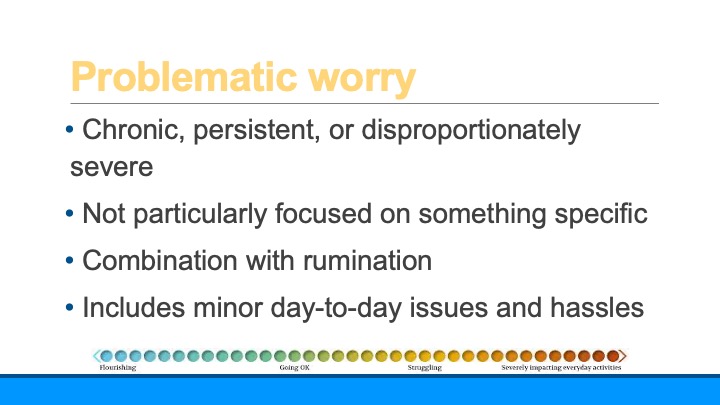
I had the honor of speaking at the American College of Surgeons this week on a panel about stressors clinicians have control over i.e. can modify. I was assigned a topic I had not really thought about before – which meant I learned a lot! After the talk, there were many people who came up to me and asked if they could have my slides… so here they are!
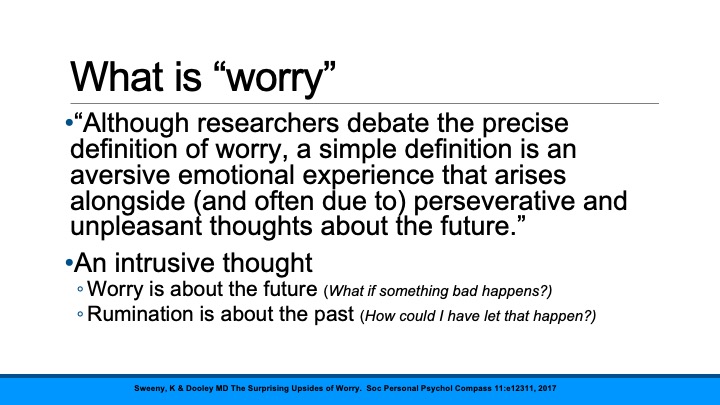
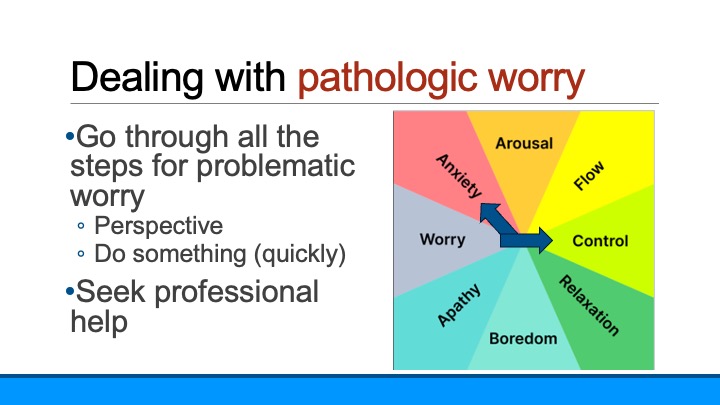
This is a really important concept… worry is an intrusive thought, which means it just pops in your head. And it’s unpleasant, so you worry about worrying!
Another important point here – worrying is always about something in the future (as opposed to rumination, which is always about the past)
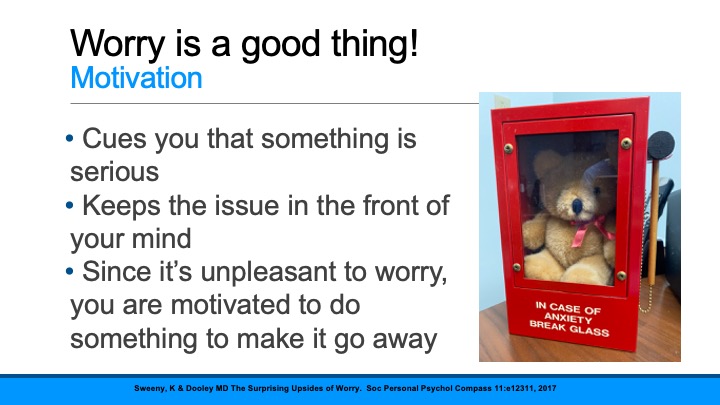
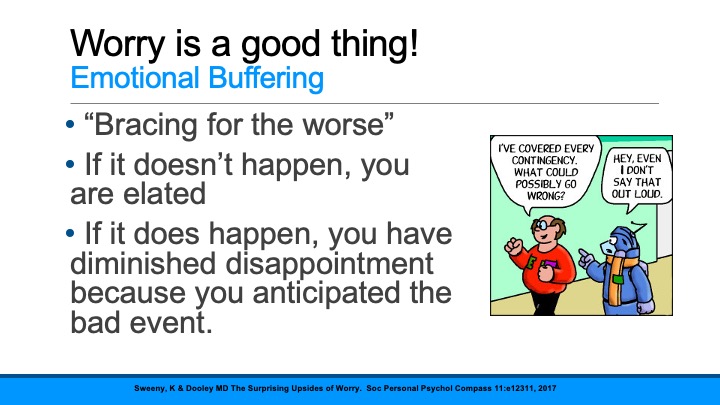
These are the two main ways worrying helps us – motivation and emotional buffering. The motivation part is pretty obvious. Emotional buffering is also obvious, but I didn’t have a name for it before. Take for example worrying that you will fail a test. If you end up getting a good grade on the test it is somehow even more exciting… but, if you do poorly your disappointment is somehow buffered.
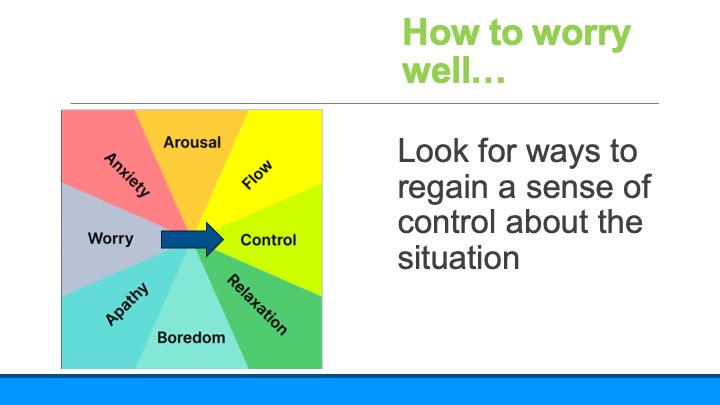
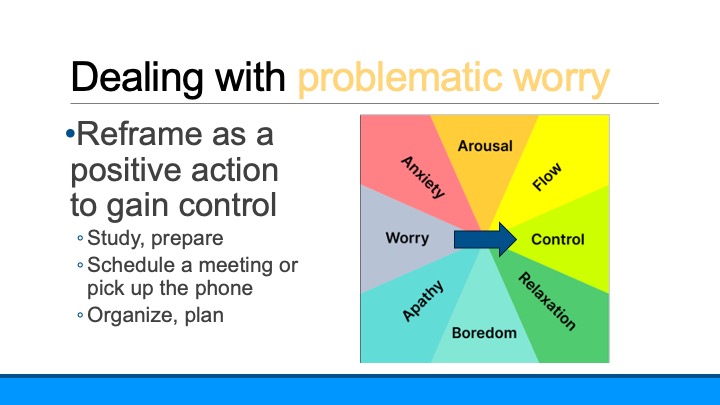
In terms of emotions, control is the opposite of worrying. Take the test I mentioned above. If you are worried you will fail it, the way to deal with that is to regain a sense of control. For example, using smart notes to optimize learning during your rotations, using this plan to ace your in-servce exam, or this plan to get ready for exams during basic sciences.
This principle holds true for ALL clinicians – no matter how long your have been in practice.
And then I tackled the next question… what to do when worry begins to spiral.
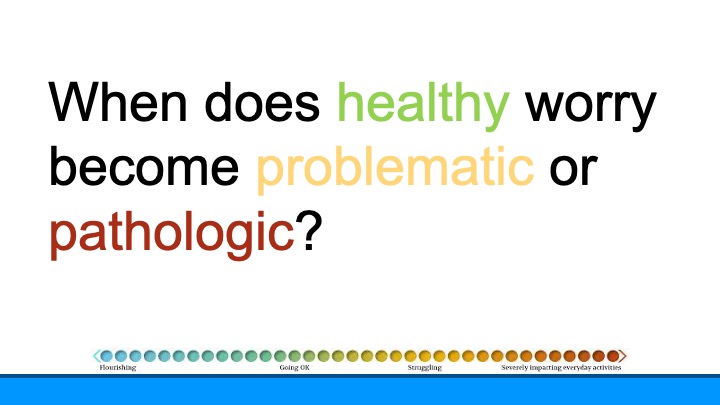
I introduced this validated tool to see if your worrying has crossed the line to problematic or pathologic.
And pointed out that if worry is causing you to suffer, it’s a problem.
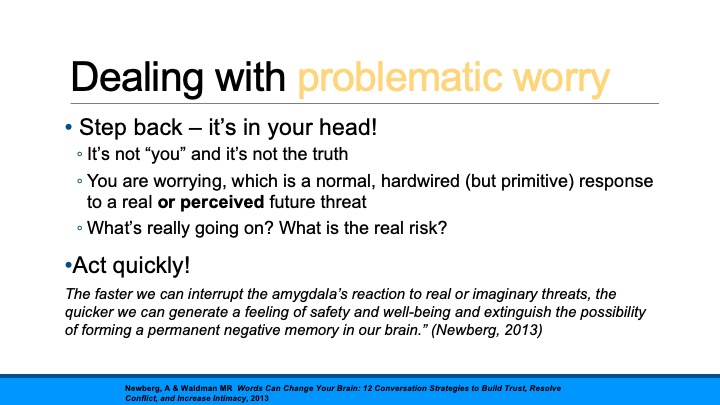
The way to deal with problematic worry is to try to return it to the kind of worrying that helps us, which we can do with any action to control what we are worried about. Worried about a test? Make a plan for how and when to study. Worried about a relationship? Plan to meet or pick up the phone to talk. Again – no matter what your are worried about – do something to create a plan to address the worry.
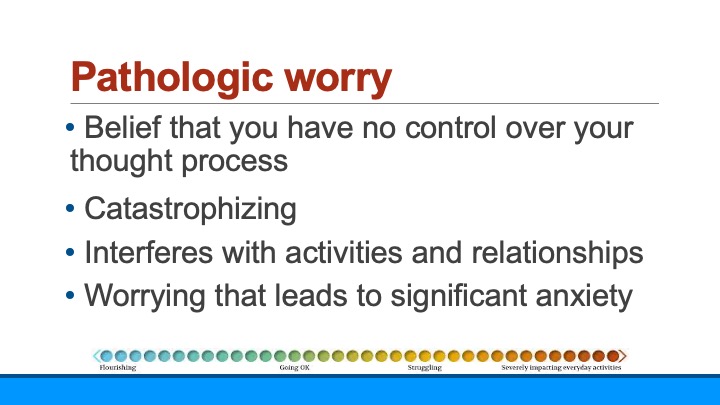
But despite our best efforts, the spiral of worry can land us in a bad place. If you find you have anything on this list (or if you are really suffering), it’s pathologic worry.
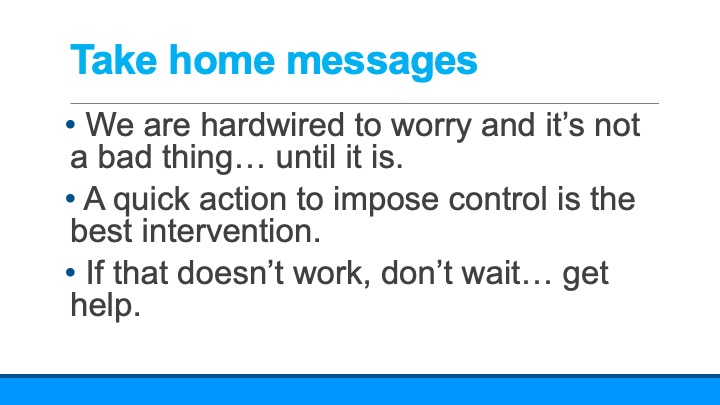
It’s super important that you act – quickly. This is your amygdala trying to hijack your brain! (Remember flight-flight-freeze?) If you don’t derail it quickly, it will continue to spiral and land you in a world of anxiety. In other words, follow all the steps for problematic worry – but if it doesn’t work, don’t wait. Get help.
New interns and their more seasoned senior residents are asked this almost every day. So let’s talk about this for a minute and what that question really means…
What you are being asked to do.
The hospital requires a signature on a consent form (always printed with very small font and several pages long). This part of the consent process that has a long history guided primarily by legal counsel for hospitals and, yes, you need to get the signature. But…
There are five things that must be present for informed consent. If any of them is missing, it’s not informed consent.
The patient must have the capacity and ability to understand. (No intoxication, translation when needed, etc).
The patient must actually understand. (This means you have to confirm they understood with a conversation – Can they explain it to another family member? Do they have questions?)
The person performing the procedure (or their designee) must describe the procedure and must discuss alternatives, risks (and how likely they are) and the expected benefits (and how likely they are).
The patient has to agree without coercion. (If you aren’t sure about this, don’t proceed)
There are questions that every intern would like to ask about this process but can’t/won’t. Here are a few that come to mind…
What if you’ve never performed (or even seen) the procedure yourself? It’s hard to get truly informed consent if you aren’t competent in doing the procedure. But – you know (intellectually) the alternatives, the potential risks and benefits, and the “big picture” of the procedure. Particularly for complicated procedures, you can assume that the attending has discussed these (and therefore is the person who actually got the consent!). Here’s a way to make this easy… “Hello, I’m Dr [xxx}. I know that Dr. Attending has already talked to you about your surgery. I’m here to go over the alternatives, risks and benefits again – to make sure you don’t have any questions I can take back to Dr. Attending for you.”
p.s. If you are “Dr. Attending” in this scenario, you are the one who is ultimately responsible for the informed consent (and liable if it’s not done properly).
Is it important to get the consent just before the procedure? No, in fact it makes it legally more sound and much more efficient to document informed consent when you first see the patient. For elective or semi-elective surgery, it takes no time at all for “Dr. Attending” to put this phrase (or one like it) in their clinic (or ED) note: The procedure including alternatives, risks, and benefits was discussed with the patient, all questions were answered, and informed consent was obtained. This documentation often holds more water than the signed form (at least according to most attorneys I’ve talked to). Best yet – do both. Get the consent form signed at the same time! It’s easy to scan into the medical record to be there for the day of surgery, which is a win-win for almost everyone involved.
What if It feels like you are scaring the patient/family when you review the list of the possible complications? First of all, that’s a normal feeling. But we have to learn to handle the anxiety that is always part of this process. In addition to trying to be really calm and supportive, here’s how I handle that: “When we decide about doing surgery, we always ask which is riskier… to do it or not do it. For you, we’ve decided together that it’s risker not to do the surgery… which is why you are here. But because there are risks, I want to make sure you understand them and we can talk about them before the operation.”
What if they don’t speak English but the family says they can translate for you? It’s not informed consent unless it’s translated into their language by a professional medical translator. Imagine the shoe on the other foot. What if your best friend the artist was travelling in a country where none of the doctors or nurses spoke English and they needed surgery? They would be terrified and so would any family member who was with them (even – or maybe especially – if they were being asked to translate). Don’t cut this corner. Please.
Isn’t this blog post oversimplified?
Yes!
Informed consent is a fascinating and rapidly changing area of medical ethics. I hope I’ve hit the critical highpoints and addressed a few unspoken questions many trainees have, but it’s unquestionably a “30,000-foot view”.
p.s. If you have more questions, even ones that seem naïve, please comment on this post or email me (if you don’t want them to be public).
It has been said that the Inuit people have a hundred words for snow. When you live in a dangerous environment, it’s important to learn the variations of snow to survive. But, when you look into the origin of the “hundred words for snow”, it turns out it’s not exactly true – Inuits don’t have more words for snow than other languages…Their detailed understanding of snow is a lived, not spoken vocabulary.
The same is true for those who spend nights awake working in a hospital. We, too, have a lived vocabulary that includes hundreds of subtle variations of fatigue, even though we don’t have words to describe them. (The closest I’ve come to being able to describe this fatigue is in “sleep equivalents”, specific events or things that makes you feel like you have had more sleep than you actually did. For example, a shower after being up all night can give you the equivalent of anywhere from 20 to 60 minutes of sleep depending on how tired you are. Brushing your teeth after a hard night of call is usually 5-10 minute sleep equivalent. A good strong cup of coffee can be as much as 45 minutes of sleep equivalent – although it’s important to titrate it so you don’t end up with anxious jitters instead of just being awake.)
Knowing how to manage this level of fatigue it is part of medical training. (Don’t get me wrong… I’m not advocating that trainees must get tired on a regular basis to “learn how to manage it”) Learning to successfully manage the fatigue of long days and nights on call hinges on two things and both have to do with deliberate choices.
Learning not to trust your first instinct if you are sleep deprived is the first important lesson. Even if it’s a drug you know well, or the chest x-ray looks ok, stop and be deliberate. Consciously review the data, look at the options and, for really important decisions, ask someone to look at the situation with you.
The second lesson in managing fatigue is maybe even more important. The bone deep fatigue of medical training is not solely the result of sleep deprivation. When you stay up all night you also lose the liminal spaces of waking and falling asleep, the threshold between night and day. In scientific terms, this means there is a major disruption of your circadian rhythms. But it’s more than just physiology. The drowsy moments between sleep and being awake take place in the liminal spaces of dawn and dusk. We lose more than orientation to daylight when we lose this liminal space. The Irish poet and priest John O’Donoghue, teaches that liminal spaces are moments and places where the spiritual touches the finite. By losing the profoundly important rhythm of rest – including these liminal spaces – we end up physiologically, psychologically, and spiritually unmoored.
You have to be deliberate here, too. By trial-and-error work to find the things that ground you, the things that help you recover in a deeper way than just catching up on the sleep. Make lists of anything and everything that helps you recover from call for the times you are too tired to remember or choose. Look at those lists before you leave for your call day and choose something to do for yourself when you leave the hospital the next day. It might be going to the gym for a light workout, having a great cup of coffee in a cafe, a slow, grateful walk outside, playing with a pet, a hug from a loved one…or finding a way to “play” outside.
May the sacrifice of time and sleep you make for others come back to you as joy … and may you find deep rest in knowing you make a difference in so many lives.
What if I told you there’s a system that makes it easy to remember the things that you need to remember for exams, but also creates links that make it easy to study and understand the network of knowledge that you really need to learn to heal?
And what if you could start using this system beginning on the first day of medical school…or at the beginning of your PGY2 year… or wherever you are on this journey now?
Mine is labeled “card file”. You can always rename it. Maybe start with “My digital brain”?
If you just can’t stand it, you can create sub folders based on an anatomic filing system (e.g. Appendix, Colon, Heart, etc) but trust me – no sub-sub folders!
*I like Google Drive because it’s very flexible and you can access it from any computer and your phone. There are other ways to store digital data that can work as well, like Evernote, OneNote, etc.
Keep a notebook in your pocket, use paper out of the printer, use a white board, or dictate directly into Google drive… but just take notes!
This practice is a leap for most of us, but it not only leads to phenomenal learning, it fundamentally transforms how you interact with your day. There is power in a practice that makes you more present in your day. Every encounter, every lecture, every article you read becomes a potential adventure, a source for new insight and growth.
There are only two rules
Rule 1: One concept per note.
Rule 2: Write the note only one time – don’t rewrite or retype notes. (If its’ a paper note, take a photo, or create a pdf to file in your google drive.)
What kind of notes will go into this system?
Lectures. You know how to do this from other classes! Just because we call it “Grand Rounds” or “Path-Rad conference” doesn’t mean it’s not a class. Take notes!
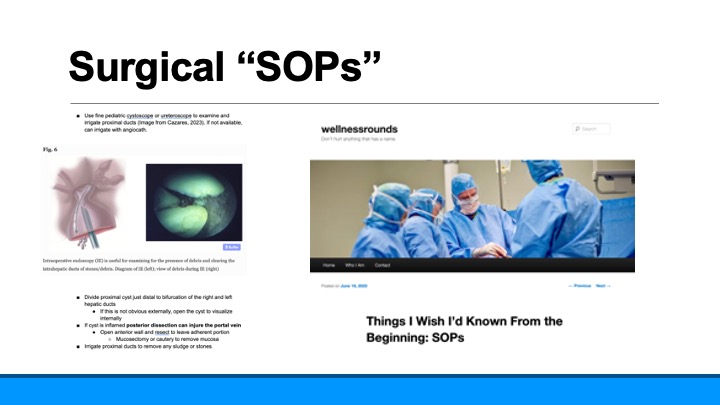
SOP (Standard Operating Procedure). This one is key if you are in a procedural specialty. Keep a single “note” for each procedure and update it with new information as you scrub with new attendings. Put in links to good videos, photos from textbooks and anatomy books. Anything that will help you review what you know and have learned before you do the procedure again.
Milestones. The first time you….listened to a murmur, talked to a patient about their prognosis, did a Whipple.
Questions, thoughts… “Why isn’t there a way to diagnose malrotation that needs surgery (vs.nonrotation) with diagnostic imaging?”
What you learned from patients. Make it your goal to learn something from every patient you take care of. Write it down. Make sure it’s HIPAA compliant – no patient identifiers that someone else could decipher.
Sounds. Yes, you can digitally store recordings!
Summary Notes. One page summaries of complex ideas
Unanswered questions. Ideas for possible publications, future investigations, etc.
There are so many details in medicine that we often lose track of the big picture. That takes thinking, creating one page summaries of complex topics, and noticing connections.
Maybe it would be easier to show you rather than tell you. Let’s say you are in a lecture about how to read a chest x-ray. In your notebook (or on your computer) you are taking notes… lots of notes… how to tell what’s a pneumonia vs atelectasis, what different lung tumors look like, how to tell if the mediastinum is too wide. As a result, 2 years from now when you see a patient with a lung mass, you will be able to search your drive for “lung cancer” and these specific notes will come up.
But as you sit and think about this lecture, you’ll realize that in addition to the details, there were more general concepts that were important, too. For example, how important it is to systematically review every diagnostic image so you don’t miss the lytic lesion in the bone that was behind the big mass in the chest. (Link to my favorite study describing how this happens)
So you create a digital note that describes, in your words, how important it is to have a system to look at images. Which makes you remember that this is very similar to how we always follow a system to do a history and physical. So you search in your drive for the card you made about how to do an H&P and you link them, using the “insert link” command. And, as you look at your H&P card, you notice that you had already linked it to cards you made about Basic Life Support (BLS) and ACLS (Advanced Cardiac Life Support), two certificates you were required to obtain, both based on a system to not miss important steps in resuscitating patients. And suddenly you are interested in why systems like this make it so much easier, so you do a quick search and find a fascinating article on memory and learning (as opposed to memorizing).
One of my residents this morning thanked me for teaching her how to adjust the lights in the OR before a case. In fact, she said that since she had started this new practice that she hasn’t had to re-position the lights once while operating. There are so many minor details about the art of medicine that aren’t in books, so many things that make our lives easier…and that we wish someone had taught us earlier!
Both lights should be positioned in the mid-line of the operative field – which means usually the mid-line of the table.
One of them should point straight down into the operative field. The second light should be either at the head or foot of the bed pointing into the field at an angle. If there are more than two, use them however it seems best.
Most importantly – You should position the lights BEFORE the procedure. Adjusting them after you start is always more difficult.
Operating Room Lights… Down the Historical Rabbit Hole
4500 BCE – Oil lamps
3000 BCE – Candles
1802 – Incandescent light invented by Humphrey Davy.
1850s – Operating rooms were built in the southeast corner on the top floor of hospitals to take advantage of natural sunlight. There were also four mirrors in the corners of the operating room to reflect sunlight toward the operating room table. (Wikipedia, Surgical Lighting).
1920 – The scialytic (which means “dispersing or dispelling shadows”) light invented by Professor Verain in 1920 was the first design to direct light around the head of the surgeon. This allowed operating rooms to be moved from the top floor of hospitals. (Ersek, 1972)
“The light must be sufficient in quantity, must be directed into the proper places, and must be of such a quality that the pathological conditions are recognizable. Also the light cannot produce glare, which will serve to blind the surgeon, just as the high headlights of an oncoming automobile may incapacitate an automobile operator; and it is just as dangerous.” (Beck, 1971)
There are four factors to consider in optimizing illumination (reference)
Luminance = reflected light. Too much = glare = eye strain.
Volume. This refers to the need to have light in more than one plane, which is important because we operate in three dimensions (which is why there are always two lights). This is also why surgeons wear headlights or use lighted retractors.
Shadow management. This is why the position of the lights is important!
Temperature. Was much more of an issue before LED lights.
Positioning the lights before an operation will help you see more clearly. This simple act can also become a ritual and a reminder of why you are there… to heal.