Yellow Hospital Socks: Gold Humanism Essary Award Winner

The following is the 2012 First Prize winning essay in the Arnold P. Gold Foundation Annual Essay Contest, written by Carmelle Tsai, a Baylor College of Medicine student.  It’s my pleasure to share it with you – and congratulations to Carmelle!


There is nothing normal about being a physician, or training to become one.

On the second day of medical school, I cut open a dead man’s body. Soon thereafter, I found myself in the lab many times over, pulling various body parts out of drawers and staring at them for hours. Alone. Sometimes until midnight.

I have stood in a trauma operating room, wearing a gown splattered with a dying person’s blood. I have seen, heard, and smelled things I never thought could come from the human body. I have stuck tubes and needles into other people’s flesh. I have put a gloved finger into someone else’s rectum more times than I care to count.

It’s just. Not. Normal.

It’s horrendous, grotesque—plain weird, some of the stuff we do. But it’s all in the noble name of medicine, of saving lives, of healing. I know that. We all know that. We even think it sounds heroic. So to soften the somewhat uncouthly nature of what we do, we give procedures benign names and talk about them gently, as if doing so could somehow preserve the dignity of the human beings involved. We kindly write on the chart “Below the Knee Amputation,” and we gently explain that we will be doing a “simple procedure” to remove your cyst.

And yet once in a while, I just want to scream: “It’s NOT OKAY! It’s NOT NORMAL! There is NOTHING NORMAL about using SAWING OFF a poor old woman’s leg!!!” It’s like something inside of me cries out just for us to call it what it is, and to quit tiptoeing around, pretending that what we do is dignified.

Before I entered medicine, I always knew I wanted to heal my patients compassionately by listening, holding their hands, and being present with them. But what I did not understand was how I would learn to steward medicine by healing patients and myself through some less-than-likely moments.

I was wheeling Mrs. N into the operating room. She was a sweet, middle-aged woman with a husband and three kids. The anesthesiology team and I worked together to be compassionate and kind as we prepped her for surgery.

Though things were chaotic the moment we burst into the OR and were greeted by a barrage of shiny machines and people, we all set swiftly into motion. As we did, we paid attention to Mrs. N’s comfort as best we could. My resident smiled as he told her about his own kids. The nurses thoughtfully brought her a pillow. I held her hand as the arterial line was being placed.

“Y’all are so sweet,” she said with a tinge of Southern drawl.

I smiled at her through my surgical mask as I gave her oxygen. Soon, Mrs. N was asleep. As the resident began to place her central line, I walked around the monitors, tucked in her blanket, and adjusted the sock on her left foot that had gotten twisted around in the pre-surgery shuffle.

As I gave her foot a reassuring pat, I caught myself thinking, “What? You’re ridiculous, Carmelle. She’s asleep. She can’t tell that it’s cold and she’s not awake to be annoyed that her sock is on funny.” For a moment I felt foolish. I mean, really?

My resident looked at me and raised an eyebrow. I shrugged.

In a few moments, a surgeon would be cracking open Mrs. N’s chest. Then we would put her heart on bypass. Then her entire aortic valve would be replaced. A turned-around sock hardly seemed like a big deal. Plus, the groggy and awful dry-heaving that would precede her extubation, and the pain from having her insides all cut, moved around, and put back together would surely distract her from the ugly yellow hospital socks. And I was right. Later when I saw Mrs. N post-op, I wasn’t even sure if she was wearing socks.

I pondered about Mrs. N and her socks on the way home that day. It reminded me of my first day of anatomy. Before we were about to unzip the bag and remove our cadaver, I made all my teammates stop and just breathe for a moment. I wasn’t really sure why—again, what does it matter, right? The man was already dead and his body had been in formaldehyde for months.

But I realized it did matter. I understand now that my humanity is why I do these things. It is not for the dead man, for Mrs. N, or for anyone else. It is for me. And because it matters to me, in some roundabout way, it matters to Mrs. N, and to all my patients. Because in medicine I am meant not only to heal, but to be healed.

And that, I have found, is what it truly means be a steward. It is to invest in my patients by being humbled enough to recognize that they offer me something too. As much as medicine gives physical healing, and the holding of hands and compassionate silence give emotional healing, it is part of my own healing to maintain that same humanity in the moments that patients neither see nor experience.

I am not any less broken just because I know more about the human body. Just because my normal involves everything that most people think is crazy or disgusting does not mean that I am any different. I also don’t like being cold. I don’t like wearing my socks backwards. I am scared of foreign situations. I am in need of healing.

And so if reminding myself that what seems cruel and abnormal is still compassionate means that I will kindly refer to sawing someone’s leg off as a “below the knee amputation” or tuck in the blankets on a sleeping patient, damn right I’m going to do it. There is no way we can steward medicine if we cannot allow ourselves to be healed, too. Yellow hospital socks and all.


10 Things to Know Before You Start Your First Job


I was asked to speak at the monthly Texas Children’s Hospital Department of Surgery fellows’ conference this week. The surgery fellows at TCH have finished their training in Anesthesiology, Cardiac Surgery, General Surgery, Gynecology, Plastic Surgery, Ophthalmology, Orthopedic Surgery, Otolaryngology, Neurosurgery or Urology, and are now doing one to two more years specializing in the care of children.  At a minimum, they are in their 5th or 6th year of postgraduate training.  Because of the length of some of the programs (and extra research experience) some of them are in their 9th or 10th year of postgraduate training.   They are an amazing group of surgeons at an exciting time in their careers.  Picking a topic wasn’t easy.

After thinking about it, I decided to put together a talk on the 10 things I wish someone had told me before I started my first job as an attending.  There are potentially more, but here is what I came up with as a place to start:

  1. Your idea of “success” will change during your career.
  2. Time management starts with knowing what’s coming
  3. Pay yourself first
  4. Learn from every patient
  5. Join and be active in professional organizations
  6. Meet regularly with (many) mentors
  7. Be positive
  8. Do what’s right for the patient.
  9. Look cool doing it.
  10. Don’t hurt anything that has a name.

As we discussed these topics, I realized that some of these ideas would also be of interest to medical students, other residents and physicians early in their practice.  So, I’ve decided to take these on as a series of posts.  More to follow!

Texas Children’s Hospital

“12 Rules for Doctor’s Survival”

I don’t often borrow unedited material from other people, but I was so impressed with these 12 Rules For Doctor’s Survival from Jill Tomlinson that I felt they should be shared.

Rule 1: Do not take responsibility for things you cannot control.

Rule 2: Take care of yourself or you can’t take care of anyone else.

Rule 3: Trouble is easier to prevent than to fix.

Rule 4: When you get upset, tune into what is going on with you and go through the Three Step Process.
1. What am I feeling?
2. What do I want?
3. What can I do about it?

Rule 5: If the answer to Rule 4, Step 3 is “Nothing”, apply Rule 1.

Rule 6: Ask for support when you need it – give people permission to feel what they feel.

Rule 7: In a bad situation you have four options:
1. Leave it
2. Change it
3. Accept it
4. Reframe it

Rule 8: If you never make mistakes, you’re not learning anything.

Rule 9: When a situation turns out badly look at where the choice points were, then decide what you would do differently next time.

Rule 10: At any given time you can only make decisions based on the information you have.

Rule 11: Life is not fair – or a contest.

Rule 12: You have to start where the patient is at.

White Coat Ceremony – “Thoughts from the White Coat Pocket”

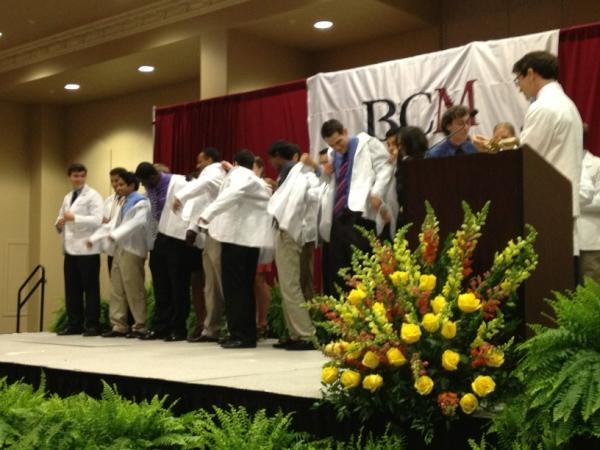
The White Coat Ceremony marks the beginning of the journey into medicine for first year medical students.  In addition to the moment when second year students put the white coats on their new colleague, this night is also used to recognize role models. This year’s Ben and Margaret Love Foundation Bobby Alford Award for Academic Clinical Professionalism, given to the faculty who best demonstrated exemplary professionalism was awarded to Dr. Cynthia Peacock.  We also ask both students and faculty to address the new class.  The following is the speech given by Jenny Walsh, a 4th year student, to her new colleagues and their families.

White-Coat

My dear new fellow students, I welcome you as friends and colleagues.  Welcome to Baylor College of Medicine.  Family and friends, welcome.  Thank you for the essential support you give.   Welcome to the fastest, most amazing, most enlightening, most discouraging, most invigorating, most exhausting, and most challenging years of your life so far.  Welcome to a profession that hears and keeps the most intimate secrets, understands parts of the human body and human experience that most people will never know, and advises on some of the most profound decisions that people will ever make.

We mark the beginning of this life-altering process with a ceremony, as a symbol to you that today everything changes.  Today, jump in to this new life and learn to apply the mountains of seemingly arcane bits of knowledge you will be given.  Dr. Kretzer will tell you about a tiny protein hanging on the outside of a platelet.  It will look like an insignificant squiggle, but a mother’s body can create antibodies to this protein that can destroy her unborn child’s platelets, possibly leading to hemorrhage, devastating disability, or even death.  That squiggle matters to somebody, as do thousands of other details that will bombard you.  Learn them for your patients.

Most of the changes you will make in the next four years will be imperceptible to you.  You will wonder how you can possibly go to clinics as the MS2 neophyte that you are, until you talk to someone who somehow does not understand how vaccines work or what asthma is, how dialysis works, or why they don’t need antibiotics for a viral infection, and you will see that you have grown and that you already have something to offer.  Then you’ll meet a patient who can recite the minutest details about Stevens-Johnson Syndrome, and you will recognize you still have much to learn.

To family and friends, you have front row seats to the remarkable journey your loved one is taking.  You may remember them learning how to talk and walk.  Today, they are medical toddlers, learning thousands of new words, and how to walk in doctor shoes.  Toddler years are tough.  If they fall down, help them get back up.  If they scream and cry—it’s probably because they feel tired and very small.  Love them.  They will make it, especially with your support.

Right now, it feels like dress up, with a grown up Fischer-Price doctor kit—the crisp white coat, shiny new stethoscope, otoscope, reflex hammer, and a badge on a retractable badge clip.  Wait until Thanksgiving dinner, when they regale you with stories of their cadaver.  Or wait until third year when they’re quiet at gatherings, though they may mention during dessert that they performed much of a vasectomy.  Don’t worry.  It’s just a phase.  A lot of their new experiences will have significant portions protected by HIPAA or will be inappropriate for mixed company especially while people are eating.  They may be out of practice talking at all, as they’ve been studying 12 hours a day for a board exam.

As you watch this process unfold, remember that your amazing student is now in a top tiered medical school, surrounded by equally amazing peers, facing a demanding curriculum.  They belong here, but they may feel for possibly the first time in their life that they are not good enough.  I assure you, they are good enough.  Please reassure them in those inevitable dark moments of self-doubt that they are feeling how everyone else feels.  It’s ok to feel intimidated, but they are here because all of us believe that they will make fantastic doctors.

Now my dear fellow students, we give you a white coat as a passport, a mantle of responsibility, a signal to the world that you are here to learn and to serve.  You may just be walking through a hospital, but someone will ask you where out-patient imaging is.  On your first day in the ER, someone will tell you their drug history or that they have HIV simply because you asked.  You may have never seen childbirth before, but someone will not only let you watch, they will let you catch their baby.  During your first  surgery, you may get to drive the camera in someone’s abdomen, or help stitch up the skin afterward.  You may be the one who finally explains to a diabetic patient how uncontrolled blood sugar will harm their eyes, their nerves, and their blood vessels, and make it harder for their wounds to heal.  You will be admitted to bedsides when patients are their most vulnerable.  Your kind words, your gentle touch, your observations, your willingness to listen, your thoughtful questions, and your growing knowledge can make a difference to a patient, even as a student.  Because of this access, which comes from the medical student role in which you are now entrusted, learn all you can.  Deserve this trust.  You can do it.  We will help.  Thank you.

Attending Medical Conferences

When you first start going to professional meetings, it’s easy to feel a little awkward.  If you are a student or resident, you will hopefully be with a faculty who will be able to act as a guide for you.  But, if the attending doesn’t make it (or isn’t really helpful) you may find yourself on your own… so I thought some guidance might help.

Go to the meeting. 

This might seem a little obvious, but if your department or school is paying for you to attend a meeting, you should attend the meeting.  If it’s your own money… you should still attend the meeting. This is part of being a professional. Your peers have put a lot of work into their presentations.  Put yourself in their shoes – and stay to hear their talks. Stay engaged during the sessions.  Don’t be the person in the back row surfing the web on a smart phone during the entire conference. Listen actively and ask questions.  If you ask good questions, people will notice and it will reflect well on you.  However, be gracious.  Always thank the speaker for what they said, and don’t be antagonistic when you ask your question.  That will be noticed, too, and not in a positive way.

Look like a professional.

No matter where you are in your training or practice, you will be making a first impression on people who may play a role in one or more of your future position(s). Start off with a suit and tie (or the equivalent for women) the first day.  If you are a woman, make sure you dress as if you are going to an interview – not a party.  If everyone else shows up in jeans the first day, move to more casual wear… starting the second day.  Don’t dress down too much – even if everyone else is doing it.  It’s never wrong to look professional at a professional meeting.

Take advantage of the social events.

Even though it is tempting to sneak off with a couple of our friends and skip the evening reception, don’t do it.  The social events are where you meet the important people in the field.  If you have time, do a little homework about who is attending the meeting and where they are from – just to be able to start a conversation.  Most of the “celebrities” in the field are delighted to talk to people in training, so don’t be intimidated.  You’ll also meet peers at your level at these meetings who will become lifelong colleagues and friends. Introduce yourself to people you don’t know!  If you are invited to dinner or if there is a formal banquet associated with the meeting, you’ll feel awkward if you don’t know the basic rules (like what to do if there is more than two forks).   If you aren’t familiar with formal dinner etiquette, here’s a great site to learn what to do:  Dining Etiquette Guide.

Be fiscally responsible.

Just because someone else is paying shouldn’t mean you pick the most expensive restaurant and order the most expensive items. If you come in under budget people will notice. If you turn in receipts over budget, they will really notice. Save all your receipts, and turn them within a few days of returning.  It’s always a nice touch to thank the people who paid for you to attend the meeting, either in person or with a note.

Reading maketh a full man; conference a ready man; and writing an exact man  –  Francis Bacon

Attending Professional Meetings for Beginners (a previous post on Wellness Rounds)

Handy hints for attending national meetings from KevinMD.com

How to Succeed in Clinical Rotations

Next week will be the start of clinical rotations for students at Baylor College of Medicine.  It’s an exciting time, but a big transition!  After seeing this a few times, I thought the following advice on how to approach clinical rotations might help.


Don’t sit in the back of the plane.

The basic sciences are important to learn the vocabulary and grammar of medicine.  Clinical rotations are different – it’s where you learn to speak the language.  There are tricks for learning clinical medicine but fundamentally it’s about realizing you are still in school and not just observing.

If you use the analogy of learning to fly, there’s a simple concept that summarizes learning on the wards: You cannot learn to fly a plane by sitting in the back.  In basic sciences you are studying the book on how to fly the plane.  In your clinical rotations you are in the plane, watching and learning from the pilot.  Which means you have to be in the cockpit.

In every situation you encounter in the hospital, imagine that you are “flying the plane.”  When the resident starts to write the admission orders say “Do you mind if I write them and you show me how?”  On your surgery rotation, get to the holding area early and ask the anesthesia resident if he/she will explain how to intubate, show you how to intubate, or even let you try.  When you are writing an admission H&P on a baby in the ER, imagine you are the only doctor who will be seeing that patient.  Let the adrenaline of that thought guide you to the computer to look up more about the condition, how to treat it and what you would do if you were the only person making the decisions.

Yes, you need to be pushy and, yes, sometimes it will backfire.  Be reasonable, but stay engaged. If it’s not an appropriate time to be assertive, stay in the game mentally by asking yourself what they will do next, what you would do if you were making the decisions, or what complication might occur from the decisions being made.  Write down questions you will ask after the smoke clears if it’s not appropriate to ask during a stressful situation.


Know what you are expected to learn before you start.

If learning objectives for the rotation are done well, they are very helpful, but many people don’t take the time to do them well (or don’t know how to do them).  For the rest of your professional life, you are going to have to define your own learning objectives.  So, in a way, learning how to do this early – during your core rotations – is also part of the skill set you need to know.  (Word of advice, though – even if they are very poorly written, you need to read any objectives you are given and make sure you accomplish them.)

To define your learning objectives for the rotation, start with a basic textbook.  Textbooks are written for residents and practicing physicians so don’t get overwhelmed – You will NOT be responsible for learning all the details in the textbook!

The strategy:

1.     Make a list of the topics covered in a general textbook for the field.  There are usually 2-3 good textbooks for every specialty.  Ask other students or residents which one(s) they recommend.  You will probably rotate on sub-specialty services during your core rotation, but don’t get bogged down in looking in sub-specialty textbooks.  Stay with the general textbook.

2.     Plan to skim and make notes on every major topic.  These should be “big picture” notes, not every detail.  If there are 60 chapters in the book and your rotation is 2 months long, you should be shooting for one chapter a day.  Keep track and make sure you get them all covered during the rotation (not after).  When you are done with the rotation, these notes should be all you will need to review for the shelf exam. These notes will also be incredibly helpful when you are studying for your Step 2 exam.

3.     Don’t read the chapters in order – read them as you see patients (see below). But, make sure that all the chapters are covered since it’s unlikely you will see patients with every disease in the book.


Practice being professional.

It’s really important to be professional and to be seen as professional in all your interactions.  First of all, it’s the right thing to do.  Secondly, a bad interaction with a nurse on the floor can lead to a poor evaluation by your attending.  Make learning how to behave as a professional one of your learning objectives.  Learn from those around you.  Which residents and attendings are the most professional?  Why?  When you see bad behavior (and you will), think about it – what would you have done differently?


Learn from every single patient you see.

Use every patient to learn about their specific disease.  Even if it’s the 30th patient with hypertenion you’ve seen you’ll still learn something new.  (or use it to learn about a different problem they have instead)

The strategy:

1.     Keep a notebook with an entry for every patient you see.  You can use 3×5 cards, if you prefer.  In fact, many hospitals have 3×5 cards with the patient info available in the patient’s chart for docs to take. (don’t lose them or leave them lying around though – which is a violation of HIPPA!)

2.     Make yourself read something about every patient you see.  If you haven’t read the textbook chapter on the subject, that’s where you start.  If you have read the textbook, review your notes and read something new (UpToDate, PubMed, or a journal article for example)

3.     Make yourself write down a minimum of 3 things you learned from the patient in your notebook (or on your 3×5 card).


Be the doctor for patients that are assigned to you.

You will be assigned patients to follow during your rotations.  When this happens, make up your mind that you are going to “wear the white coat”.   What if you were the only doctor taking care of Mr. Smith after his surgery?  In addition to reading (see above), ask the residents to help you write all the orders.  Write a daily note and make sure your notes are at the level of the residents (ask them to review and critique your notes).  When a drug is prescribed, know the dose you are giving, the effects of the drug and the potential side effects.  When a x-ray is ordered, be the first person to actually see the image and know the result (and make sure you call the resident as soon as you do!).  Don’t get any information second hand – make sure you see the results and the images yourself.  At any point in time, if the attending asks, you should be able to present your patient as though you are his/her only doctor, which means how they presented, their past history, social issues, test results, procedures performed and how they are doing now.


Prepare for conferences.

Every service has at least one or two weekly teaching conferences.  In most cases, the topic (or cases) are known before the conference.  Ask your residents or attendings the day before the conference for the topics and/or cases that are going to be discussed.  Use the strategy outlined above to prepare e.g. consider these “vicarious” patients and learn from them as if they were a patient assigned to you.


Come early, stay late and keep moving.

Taking care of patients in the hospital is a team sport.  The best medical students become part of the team early and are taught more just because of the relationships that are developed.  It’s human nature and it’s just the way it works.  Don’t brown nose, don’t show off…. just show up.   If there are labs to look up before morning rounds, be there 10 minutes early and look them up for the residents. If you don’t know the answer to a question the best response is “I don’t know, but I’ll find out!” If there is scut work to be done that you can help with, volunteer to help before you go home. Trying to show off on rounds will backfire. It’s particularly important not to try to one-up your residents.  You will have more time to read than the residents, so you may actually know more than they do about a specific topic.  But, if the attending asks a question and the resident gets it wrong, don’t correct them in front of the attending.  (Unless it’s a critical issue and you think the patient might suffer in which case you have to speak up!)  Whenever you can, set up the resident to succeed.  “A rising tide floats all boats” – if you help them look good, you will look good and the team will look good. Take breaks when you are tired but don’t sit in the lounge waiting for someone to come tell you what to do.  There are patients to see, conferences to attend, rounds to do, labs to look up… the hospital never sleeps!


Practice having a balanced life.

Compassion fatigue is a constant threat to practicing physicians.  Taking care of yourself, staying connected to family, friends and the outside work are all critical components of preventing compassion fatigue.  This, too, is a skill you need to learn during your rotations so you can carry it with you into your residency and your practice.  Use this time to develop strategies for how you will eat a healthy diet, including when you are on call, and find time to develop an exercise habit.


Wear the Right Shoes

Dressing correctly is part of professionalism, but shoes deserve a special note of their own.  The hospital is not a place to worry about how your feet look.  At the end of a long day, you’ll appreciate picking the right shoes to wear in the hospital.


Enjoy!  You are finally a “real” doctor!’’

Your experiences on your clinical rotations will be among the most special of your life. Buy a new journal and take time to jot down the funny and not-so funny occurrences of daily life in the hospital.  You will see some extraordinarily beautiful moments of human life. and some horrendous examples of what people can do to other people. We all learn to deal with these extremes by telling stories.  Make sure you find the right people and the right setting, but realize that this is an important way to cope with the transition you are making.

It’s a special world you are entering.   You’ll want to remember it by taking notes, recording stories and with pictures of your team and unique sights around the hospital. (No patients, though – remember HIPPA!)  Don’t forget to record your “firsts”… the first time you set a fracture or hear a murmur of aortic stenosis will be the only “first time” you have.

Congratulations! You are well on your way to the privilege and joy of practicing medicine. Enjoy the journey!


Blogging, Microblogging, and Time

I have become so enamored with Twitter that I have been writing less for this blog…. which got me thinking….

doctor-twitter

Both my Twitter account and this blog serve the same purpose – to  serve as a “tool kit” for medical students, residents and practicing docs.  But it’s really interesting how different they are in accomplishing this goal.

Twitter is the equivalent of  the “surgeon’s lounge” – comments about interesting things you’ve seen or heard, showing people something in the news, or short pieces of advice.   Writing for a blog is more like sitting down in a quiet space with a colleague to discuss a topic, work on a project or give advice.

There is one important aspect of Twitter that is particularly interesting for physicians. If there is serious breaking news, Twitter will probably hear it first.   A good example is how the CDC uses Twitter. It can also be used to update everyone in a medical school or hospital.  Another interesting use of Twitter for physicians is “tweeting” medical meetings.

There is a learning curve for all social media.  Twitter, in particular, can become a remarkable time waster with little benefit.  If you are a busy student, resident or physician and want to use Twitter efficiently, here are some ideas that might help

  • A busy resident told me that he uses Twitter only for the news.  He gave up reading the newspaper and watching CNN to follow them on Twitter.  He reads the headlines and uses the link to read only the articles that interest him .
  • It’s not Facebook.  Anyone who starts tweeting about where they are going to get coffee gets “unfollowed” immediately.  For busy professionals, Twitter is not the best way to connect with friends.  It is, however, a fantastic way to connect you to communities, causes, issues, etc.  The way this is done is with hashtags (markers for a common theme).   For example, people interested in medical education use #meded.

Healthcare hashtag project

Medical hashtages on hashtags.org

  • It’s not email.  You don’t have to read them all.  If you have a minute, skim what’s there, but don’t worry about the rest.  Twitter is supposed to be ephemeral.

If you aren’t on Twitter and want to get started here are a few links to help: Newbies guide to Twitter from cnet.com, Twitter 101 from twitter.com, Twitter tutorial

On last (but incredibly important) thought. Using Twitter (or any social media) is different if you are in medicine. Every company has guidelines about using social media.  In medicina, we have a standard for how we can discuss what we do that is different than the rest of society.   Here’s some rules that will keep you safe.

  • Do not (ever) discuss a patient, post a picture of a patient or put anything online that could identify a patient.  This is the law (HIPAA) and it is our ethical and professional obligation.
  • Do not give medical advice via social media.  If you are contacted by a patient that you are really worried about, the only thing you can do is tell them which office/hospital to go to or where to call.
  • Do not put negative comments about a colleague or institution on social media.  If you need to ventilate, find a friend and go out somewhere.  Think of social media as the “microphone in the elevator”.  Don’t put anything online that you wouldn’t want someone in the future to “overhear”.  Digital = permanent.

One of the best guides on the use of social media in medicine comes from Austrialia and New Zealand.  It has some very illustrative scenarios and is beautifully (and succinctly) written.  If you are in medicine and using social media, it’s well worth the time to read this document.

This Week’s Highlights from @drmlb

Twitter has become a wonderful way for me to send out a variety of ideas and links that I think are helpful (and/or interesting).  Here are this week’s highlights!  If you are new to Twitter RT means Retweet (just “forwarding” it as is) and MT means Modified Tweet (“forwarding” it with a comment).

  • “This is definitely a 15 minute video every medical student should see.” The art of the physical exam bit.ly/nnmaTN @drmlb
  • Comments one makes to colleagues: as important as the interview. Professionalism = doing the right thing when no one’s watching. RT @MedPedsDoctor
  • Beginner’s mind in medicine. How to keep what we do exciting! MT@KevinMD bit.ly/qle7SJ
  • One flight of stairs = 16 calories burned. One day on call = ?10 flights ?20 ?30)..it adds up! @drmlb
  • Epidemiologist with humor?!? This is a great talk about drug development. bit.ly/ovkPyS @drmlb
  • “…small things often adds up to produce a far greater impact than any of us realize.” Surgery through different eyes bit.ly/q5XUkh  @drmlb
  • “..those of us who spend our emotions at work are not the kind to view our work as “just a job.” MT@Kevin MD bit.ly/pRAbmm  @drmlb

The Physical Examination

Abraham Verghese is a personal hero for his thoughtful passion about medicine, his dedication to teaching and for his amazing ability as an author.  If you haven’t read his books, I recommend them all.  His novel Cutting for Stone is a truly remarkable work that, while telling a fabulous story, captures the wonderful moments (and trials) of being a physician..  Anyone will appreciate this novel; physicans will be enthralled.

Photo from a great NY Times article about Dr. Verghese

Dr. Verghese recently gave a TED talk about the physical exam that I believe everyone in medicine should see – especially medical students. From Sherlock Holmes, to the discovery of percussion, to how touching the patient is a ritual of healing … this is a remarkable lecture.  Take the time to watch it.  It will make you remember why what we do is such a blessing.

verghese-ted

Link to Dr. Verghese’s TED talk

Starting Medical School: Rules of the Road

In the next few weeks 17,000 college graduates will start the process of becoming lifelong students of medicine.   Medical school is a wonderful, but at times difficult experience.  Here are five “rules” that I hope will help with this exciting transition.


1. You can drink from a fire hydrant, but you’ll need to learn how.

The amount of information you are going to be exposed to in medical school is logarithmically more than you had to learn in college.  At Baylor (where I teach) we calculate that the first year of medical school is the undergraduate equivalent of 22 hours of course work per semester.  It really is like being asked to drink from a fire hydrant.   You are going to have to study more, study better and actually use the time in class to learn.  The first year or two of medical school may, at times, seem like an obstacle course you have to “get through” to get to the “real stuff”.  But these first two years are important; You are learning a new vocabulary… a new language.  If you don’t learn the breadth and depth of this new language, when it comes time to apply it to patient care you won’t be “fluent”.   By the way, sometime during the first month or two of medical school you will think that a) everyone here is smarter than I am, b) the admissions committee must have made a mistake and I’m not really supposed to be here and c) there is absolutely no way to read all of this material.  But, like everyone who has done this before you, will discover that a) you are just as smart as everyone else (sometimes in different ways, but equally effective) b) nobody made a mistake – you really are supposed to be here and c) you have to change the way you study, but you really can learn this much material.


2. Make your bed.

You wanted to become a doctor for a myriad of reasons, but one of them was surely because service to others is important for you.   Therefore, you are already primed to sacrifice a lot of your needs for other people.  Sacrifice is part of the culture of medicine.  But, it’s like a Starling curve… a little sacrifice makes you better, but too much makes you ineffective.  “Make your bed” is a simple rule (and action) which helps you remember that you need to take care of your environment, your fitness, your nutrition and your spiritual wellbeing as you are learning how to become a physician.


3. Act like a doctor – starting now.

We (all practicing physicians) see you as a doctor already.  I know this is a really hard concept for first year medical students, but it’s absolutely true.  You have started your apprenticeship and, unless you are one of the very, very few who change their mind, you will have an MD after your name in 4 years.  With all of the joys and privileges that come with this role, there are a few responsibilities to start thinking about as well.  Start thinking about your decisions, words and actions and how they might be interpreted by patients or colleagues.  It’s no longer acceptable to put anything you want on YouTube, Facebook, Twitter or other social media.  How you dress and act when you are in professional settings will be important.  You’ll learn more specific details about professional behavior from your professors and colleagues as your training progresses, but the core values of medical professionalism start when you enter the profession, which is now.


4. Kindness matters.

It is remarkable how our paths in medicine cross over and over again.  The person sitting next to you on the first day of medical school may be someone who will be an intern with you in 4 years or who will refer you patients 10 years from now.  You and your classmates will be going through classes together (like you did in college), but this is different.  You are starting your professional life together as well.  The camaraderie that results is a gift and is also very important personally and professionally.  Don’t blow off the class events.  Don’t stay home to study instead of going to class.  Go out of your way to meet everyone in your class and really get to know them.  Cultivate and nurture these important friendships.


5. Enjoy the journey

You are about to embark on a life changing (and fulfilling) journey.  This journey is a privilege and it is very, very special.  Take a few minutes everyday to write down the events of the day.  The first time you hear a murmur in a heart will be just that – the first time.  Take a minute to record what that was like.  You are going to have a lot to process as you start studying anatomy – more than just the names of the structure.  “Talking” about it in a journal is a great way to make the transition we all make in the anatomy lab.   There are also going to be some hilarious stories and events that you’ll forget if you don’t write them down.  When you look at them later, you’ll be glad you recorded them with words, photos, or drawings.


“Our study is man, as the subject of accidents or disease. Were he always, inside and outside, cast in the same mould, instead of differing from his fellow man as much in constitution and in his reaction to stimulus as in feature, we should ere this have reached some settled principles in our art.”

William Osler, from Teacher and Student, in Aequanimitas.