Wellness 3.0 – It’s Time for a Revolution

According to Tait Shanafelt, we are currently in the era of physician well-being he calls “Well-Being 1.0”, an era “characterized by knowledge and awareness.”1 After the awakening that began around 2005, we know more about healer well-being and the consequences of healer distress, and there have (sometimes) been changes made in our workplaces.

So why, 20 years later, does it feel like we haven’t made much progress? 

Dr. Shanafelt proposes progress will accelerate when we are able to move into the next era of physician wellness, “Well-being 2.0”, which will be characterized by “…a mindset of physician-administrator partnership to create practical and sustainable solutions [with] acceptance that physicians are subject to the same human limitations that affect all human beings, with attention to appropriate staffing.”1

But there is a big problem. 

Physicians and administrators aren’t partners.                           

What does it mean to be partners?

The word “partner” comes from the Latin partitio. It includes the idea of dividing (partitioning) and sharing that which is divided. Whether it is our partner at home, our clinical partners at work, or our dance partners, a partnership is always defined by a common goal, equal standing for the partners, honest communication, and true collaboration. You can’t be a partner with someone who has all the power and who sees their mission differently from yours. I know there are exceptions, but most physicians (and other healers) do not feel they are in a partnership with the leaders of their organizations.

It wasn’t always this way. 

The change is due to a complex set of variables, the most important of which is how the “business” of medicine has evolved. The marketization of medicine began a mere 40 years ago and has evolved into today’s medical-industrial complex which Ricardo Nuila calls “Medicine Inc.”2 Prior to Medicine Inc, physicians and administrators were partners with a shared goal and a classic division of labor; Physicians (and other healers) provided the care, and administrators were stewards of the resources needed for that care. All this changed when medicine became a commodity, when marketization (taking medicine to the market for shareholders) and then corporatization of medicine became the norm.

Let’s be clear. This is not some big conspiracy.  The administrators who work for Medicine, Inc. are “doing what business does” as a friend of mine said to me recently. They work for systems designed to create profit for shareholders. Within the constraints of regulations and blatant violations of ethical mandates, profit is their primary objective. But it’s not the primary objective of the physicians they “manage”. And it’s this perception – that the organizations that employ us put profit before people – that is almost uniformly recognized as the most important root cause of physician (and all other healer) distress.

The system is broken, and it is breaking us

The data on healer distress is appalling. At the tip of the iceberg are the statistics we hear quoted in every discussion on healer well-being, the data that makes us almost physically ill – the deaths and near deaths of our colleagues. When you add in the other causes of physical, psychological, emotional and spiritual suffering, it’s no wonder we feel broken.

It’s not surprising that so many people are leaving medicine.

But there is another way.

As tired and burned out as we are, there are people who need us now and will need us in the future. We have to find ways to show up and keep showing up for them while we work to change the system, by sequentially moving one previously unmovable problem at a time. 

Be a healthy lever of change

Give me a lever long enough and a fulcrum on which to place it, and I shall move the world. Archimedes

In Wellness 1.0 we became aware of the issues. As we attempted to move into Wellness 2.0 we discovered a major barrier to change. We aren’t partners with administration…and they hold most of the power. 

I’m convinced we are going to have to more or less skip Well-being 2.0. But, even as we recognize that the leaders of Medicine, Inc don’t see the world through the same lens as we do, we must not fall into the trap of “us and them” when it comes to working together. Both sides have to keep listening. We need to keep our doors open and conversations going. I suspect, if we did the studies, we would find significant distress and burnout among healthcare administrators, too. Just knowing this may help us encounter difficult moments (and difficult people) more effectively.

If we are to be healthy levers of change (a concept I learned from Dr. Wendy Lau) we need a new way to think about this.

We need a grass-roots revolution.

We need “Well-Being 3.0”, an entirely different approach composed of three actions every healer will be called to adopt: 

  1. Practice compassion.
  2. See clearly and speak the truth; Learn to say “That’s not normal.”
  3. Decide who you work for.

Practice Compassion

Compassion is the first major tool we need to create change for our patients and ourselves. 

Compassion is related to but quite different from sympathy and empathy, a difference that is important to understand. The words sympathy and empathy arise from the same Greek root – pathos which means “suffering”. When we feel sympathy we feel sorry for someone. When we feel empathy we feel the suffering with them.

Compassion, on the other hand wells up in us when we are moved to do something to relieve their suffering. The distinction is important. Empathy that is not transformed into compassion can be harmful. As Joan Halifax teaches, “Healthy emotional empathy makes for a more caring world. It can nurture social connection, concern, and insight. But unregulated emotional empathy can be the source of distress and burnout; it can also lead to withdrawal and moral apathy.” 3 Fortunately, we can learn how to practice compassion, and (Good news!!!) compassion does not and cannot lead to distress.

The best way to learn and practice compassion is with Joan Halifax’s powerful pneumonic “GRACE”. This five step practice is described in more detail in Wendy Lau’s book, Inner Practice of Medicine: Guide to Becoming True Stewards of Health, which I recommend to everyone in medicine. 4 

The G of GRACE – Gathering attention.

“…compassion cannot arise when our attention is not present.” 4

It’s human nature to think about the last patient you saw and the test you forgot to order as you walk into the next patient’s room on rounds. The first step of this five step process addresses our innate tendency to be “distracted, dispersed or divided.” “Gather your attention” means consciously deciding to be present, here and now. That’s all. (Easier said than done, but that’s why it’s a practice)

The R of GRACE – Recalling Your Intention

“Then when you next find yourself standing in the hallway before seeing your next patient, first take a breath in to gather your attention and a breath out to drop your attention into your body, feeling your feet on the ground (G of GRACE). Then ask yourself, “Why am I doing this? What is my intention for this next appointment? Why am I here?.” 4

The second step is to take a moment to remember that you aren’t rounding or seeing a patient in clinic to write a note in the electronic medical record or order a test. You are seeing them for all the reasons you chose medicine in the first place – to heal when you can and relieve suffering when you can’t. Once you have gathered your attention, take a moment to remember why you are here. 

The A of GRACE – Attuning to Self and then to the Other

“Yet what is required for a more compassionate and humanistic approach is not to deny our emotional experience, but to learn to process it effectively.” 4

We are embodied people, but we live in our heads. In this third step pay attention to what emotions and stresses you are bringing to the encounter (and where you are feeling them) so they can be acknowledged and processed. Then, and only then, turn to the human being in front of you who is there for your care and attune to their emotions and stresses. 

The C of GRACE – Considering What Will Serve 

“The C of GRACE builds on a foundation of openness and curiosity to inquire into “What will really serve?” It also engages our expertise, integrity, and sensing into the alignment (or misalignment) of our values, commitments, choices, action, and memories.” 4

We’ve all had the patient with a minor complaint that didn’t make sense… until we found out that they had been thrown out of their apartment and what they really needed was some time with the social worker. Sometimes the obvious is not the answer to what the patient really needs. 

The E of GRACE – Engaging and then Ending

Engaging is the easy part. After deciding what we need to do to serve the person in front of us, we do it. “Ending” is not as easy since it is not a concept we discuss or have been taught. Dr. Lau proposes four steps to end the encounter: 

  • See how it feels to let go now. 
  • What needs to be done? 
  • Acknowledge the work you have done. 
  • Cultivate a sense of gratitude for yourself and the patient.”4 

In other words, ending the encounter is a form of debriefing where you review what you did, and what still remains to be done, all while feeling gratitude for the patient and yourself.

“That’s not normal”

“They are going to cut my clinic visits from 15 to 12 minutes. It’s impossible for me to see patients in 12 minutes, but there is nothing I can do.”

Oh yes, there is. 

Name it. 

Turn to the colleague next to you and say out loud, “That’s not normal.” If you are alone, at least say it to yourself… preferable out loud but if not, at least in your thoughts. 

  • It’s not normal to not see a dentist for three years.
  • It’s not normal to rush a visit with a tearful and frightened patient because your clinic is so overbooked.
  • It’s not normal to have more than 10 years of professional training to spend hours at home typing and clicking buttons in the EMR.
  • It’s not normal to stay up all night and then work a full day the next day.
  • It’s not normal to pronounce a child in the ED, hold their weeping mother briefly, and then run to clinic because you’ve just been paged for the fifth time that you are late. 

Decide who you work for.

The third step is for all of us – individually and collectively – to consciously and deliberately decide who we work for, remembering that who employs us is not necessarily who we work for.  

We are employed by the systems who pay us. 

We work for our patients and our trainees.

Be part of the 17%

We can do this.

It doesn’t take a majority of people to change in order to shift a culture, a business, or a way of thinking. Sociologists have shown us that there is a classic “tipping point” for the beliefs and behaviors of a group that is somewhere around 17%. For example, when 17% of the people around you bought smartphones is probably when you decided you needed one (unless you were an early adopter). If 17% of your group thinks the new call schedule is great, there probably won’t be much dissent. This is part of our psychology and part of how groups function.

All of this to say…  If only 17% of us practice compassion, bear witness when what we are asked to do is outside of the norm, and remember who we really work for, Medicine will change. To paraphrase Margaret Mead, “Never doubt that a small group of thoughtful committed healers can change Medicine. In fact, it’s the only thing that ever has.” 

Let’s get to work.

1.   Shanafelt TD. Physician Well-being 2.0: Where Are We and Where Are We Going? Mayo Clinic Proceedings. 2021;96:2682–2693.

2.   Nuila R. The People’s Hospital: Hope and Peril in American Medicine. Scribner; 2023.

3.   Halifax J, Solnit R. Standing at the Edge: Finding Freedom Where Fear and Courage Meet. 1st edition. Flatiron Books; 2018.

4.   Lau W, Allenby S, Halifax J. Inner Practice of Medicine: Guide to Becoming True Stewards of Health. Mountains Walking LLC; 2023.
A Parable About Pausing

It was a Wednesday afternoon.  I was an intern on the pediatric surgery service at the busy county hospital.  I had arrived at work at 5am the previous day and we’d had a very busy night taking care of patients.I had not slept for 35 hours when the clerk in the clinic paged me. Struggling to keep my eyes open, I called the clinic. 

“There’s a mom here with her baby who missed their appointment this morning.”

I was furious. How dare she.  I was fuming, probably muttering to myself, as I walked down the dark stairwell to the clinic. I pulled out the chart and looked at it. 

A new patient. 

A long clinic visit. 

I was incredibly angry as I walked into the room.  I took a breath and pulled myself together to not be frankly rude as I said,  “I’m Dr. Brandt. I’m not sure why you are here now instead of 9am – which is when your appointment was?” 

She stood in front of me, holding the newborn I was about to see, two toddlers clinging to her legs, and looked at the floor. In a quiet voice she said, “We left our house at 6am. It took us three bus transfers to get here.”

It was my turn to look at the floor, humbled and ashamed. 

The Holy Family of the Streets by Kelly Lattimore

There is hardly a day that goes by that someone doesn’t push one or more of our buttons. Whether it’s a family who is angry (or late), an ER resident who calls and says “I know you are in a code, but we need a disposition…” or the nurse who is responding to an angry family and calls for the third time in an hour to see when you are coming…there are moments in our day that make us want to jump through the phone and strangle the person calling us. 

Don’t let anyone tell you you shouldn’t get mad. Anger and frustration are honest, human reactions to stressful situations and unreasonable requests. Yes, the person on the other end of the phone might be in a bad place… and it’s never wrong to give them a little grace… but sometimes they just don’t care or are being jerks.  But here’s the thing… it’s hard to control our emotional response to these moments but it’s not hard (if we practice) to control our reaction to those emotions. And as much as it’s the right thing to do, it’s also a practice that helps us. 

Viktor Frankl explains it like this:  “Between stimulus and response, there is a space. In that space is our power to choose our response. In our response lies our growth and our freedom.” 

So here’s your practice for today. Watch for the space between your emotional reaction to an unreasonable request and your response. The next time it happens, see if you can make that space bigger. And then choose a response that reflects who you are (and want to become). 

*If you don’t know the story of Viktor Frankl, its worth learning. He graduated from medical school in 1931 and, like so many German Jewish doctors, he and his family were arrested and sent to Nazi concentration camps. He survived, but his wife, parents, and brother did not. This is an experience that would break most of us beyond repair, but Viktor Frankl was able to find meaning and purpose in the midst of unthinkable horror. His most famous book is Man’s Search For Meaning, a book worth reading and rereading for all of us.

What if Burnout is More Like SIRS?

Burn-out is a syndrome conceptualized as resulting from chronic workplace stress that has not been successfully managed. It is characterized by three dimensions:

  • feelings of energy depletion or exhaustion;
  • increased mental distance from one’s job, or feelings of negativism or cynicism related to one’s job; and
  • reduced professional efficacy. (World Health Organization, 2019)

Something has never seemed right about this definition.  

It’s as though we said myocardial infarctions “result from stress that isn’t successfully managed” … without discussing coronary artery disease. 

Photo credit 

It took a very ill 10 year old child with perforated appendicitis and Systemic Inflammatory Response Syndrome (SIRS) to make me think about this differently.

As I often do, after my initial visit to the Emergency Room and while waiting for the operating room to get ready, I pulled up UpToDate and PubMed to make sure there wasn’t anything new that might help me take care of this child. As I read, a light bulb went off…

“SIRS is considered a clinical syndrome that is a form of dysregulated inflammation. It was previously defined as two or more abnormalities in temperature, heart rate, respiration, or white blood cell count [29]. SIRS may occur in several conditions related, or not, to infection. Noninfectious conditions classically associated with SIRS include autoimmune disorders, pancreatitis, vasculitis, thromboembolism, burns, or surgery.” (UpToDate, Sepsis syndromes in adults: Epidemiology, definitions, clinical presentation, diagnosis, and prognosis, accessed 7/4/2024)

Which led to an important question….

1. What if burnout is more like SIRS? 

If burnout were like SIRS, it could be caused by a variety of etiologies…

SIRS is most often caused by a serious infection. But it can also be caused by trauma (gunshot wounds, car accidents, burns), pancreatitis, burns, inhalation injuries, the “trauma” of major surgery of any kind, transfusion reactions…

What if the same were true for burnout?

What if there were multiple possibilities that could start the cascade from stress to distress?

…and should be understood as the end-stage presentation of a progressive process. 

In the case of SIRS from untreated infection, patients who present with seemingly mild symptoms like fever and tachycardia can rapidly progress to sepsis to septic shock to organ failure, and even death. 

What if thinking about burnout in the same way could help us understand the progression healers experience from distress to suffering to burnout?

2. The treatment would start with resuscitation (and rapid diagnosis).

Photo credit

Patients with SIRS are hospitalized and aggressively treated with oxygen, fluids, appropriate medications to stabilize blood pressure and antibiotics to treat possible infections. All of this takes place while appropriate exams are being done to find the source of the problem.

What if we approached burnout in a similar fashion?  What if, when we first noticed the symptoms ,we provided appropriate “resuscitation” and started looking for specific etiologies?  

3. The definitive treatment would be “source control”. 

For a patient with SIRS, once we make a diagnosis, we seek to eliminate the source of the SIRS. For appendicitis, we take out the appendix. For pneumonia, we prescribe appropriate antibiotics, and use supplemental oxygen and chest PT as needed.

“Source control” for burnout would be no different. Specific treatments would depend on identifying the specific issue(s) that started the cascade of distress and suffering.

4. Full recovery would require supportive care.  

Source control starts the process of healing, but healing is not something we do for or to a patient. In clinical medicine, we facilitate the patient’s ability to heal … and then we support them while they heal.

Burnout should be no different. 

I mentioned the need for a good “differential diagnosis” in order to identify the source of SIRS

Which leads to the next important question.

What’s the differential diagnosis for the causes of this syndrome? 

Photo credit

I’m sure there are others, but the major categories of insult and injury that I believe should be included in the differential diagnosis of healer distress and/or burnout include: 

  • Failure to recover from injury (physical, emotional, and spiritual). For example, pronouncing a child dead in the ER and then having to run to clinic because you are now late and patients there are getting angry.
  • Moral distress, injury, and outrage. Moral injury occurs when we know the right thing to do, but can’t do it. For example, not being able to perform an important elective surgery or prescribe a needed medication because it is denied by the patient’s insurance. 
  • Trivializing the sacred nature of healing. For example, the hours spent typing trivial information (for billing) into the EMR.
  • Secondary trauma from chronic exposure to suffering or specific traumatic events (like the death of a long-time patient or being sued)
  • Horizontal hostility. This is a concept I learned from Joan Halifax in her article The Precious Necessity of Compassion. Horizontal hostility, which is bullying by your peers, is often responsible for nurses leaving nursing, and occurs in all other areas of healthcare as well. 
  • The structural violence experienced by being marginalized at work and/or in society (racism, misogyny, homophobia, etc)

You’ll notice lack of self-care and insufficient resilience aren’t on this list. 

I believe that insufficient self-care is most often a symptom and never the cause of burnout. That being said, I don’t mean to imply that self-care isn’t important. (You can probably tell I think it’s important just by scanning through the other entries on this blog!)

I’ve come to understand that insufficient self-care should be seen as a “comorbidity” for those in the grip of distress, suffering and burnout…similar to how having diabetes makes it harder to recover from physical illness or injury. 

As for resilience… There are no human beings more resilient than those who choose to heal. The idea that insufficient resilience causes burnout is just not true. But it is true that this idea has been weaponized by the institutions who employ us to deflect from the real issue; We work in systems that create moral suffering for those who care for the ill and injured.

What should we call this model?

As I began to think more about using SIRS as a way to think about burnout, I realized I needed a name for this concept. I started with “PDS” for Physician Distress Syndrome, which I loved because PDS is my favorite suture. But a good friend, who works as a nurse practitioner, pointed out to me that this wasn’t just about physicians. Good point. She also said, “But you don’t have to change the acronym! You can call it “Provider Distress Syndrome”.

But I never use the word provider.

Everyone who works in healthcare in the United States (and to a lesser extent in the rest of the world) is affected by these issues. It’s too burdensome to list everyone when we are talking about this – but we need a word that describes all of us.

“Provider” is out.

“Clinician” works, but it is too narrow (and too cold).

The only word I’ve come up with so far that works is “Healer”. So for now, I’m using “Healer Distress Syndrome” to describe this model.

By the way, if you recognize yourself as being somewhere on the continuum from distress to suffering to burnout, you are not alone. Every healer I know is currently or has been there.

You matter.

Your work is sacred work.

We need you.

If you are suffering, please reach out to someone and/or seek professional help.

A gift for those who have graduated from medical school

Gaudeamus Igitur, by John Stone

For this is the day of joy
      which has been fourteen hundred and sixty days in coming
      and fourteen hundred and fifty-nine nights
For today in the breathing name of Brahms
      and the cat of Christopher Smart
      through the unbroken line of language and all the nouns
      stored in the angular gyrus
      today is a commencing
For this is the day you know too little
      against the day when you will know too much
For you will be invincible
      and vulnerable in the same breath
      which is the breath of your patients
For their breath is our breathing and our reason
For the patient will know the answer
      and you will ask him
      ask her
For the family may know the answer
For there may be no answer
      and you will know too little again
      or there will be an answer and you will know too much
      forever
For you will look smart and feel ignorant
      and the patient will not know which day it is for you
      and you will pretend to be smart out of ignorance
For you must fear ignorance more than cyanosis
For whole days will move in the direction of rain
For you will cry and there will be no one to talk to
      or no one but yourself
For you will be lonely
For you will be alone
For there is a difference
For there is no seriousness like joy
For there is no joy like seriousness
For the days will run together in gallops and the years
      go by as fast as the speed of thought
      which is faster than the speed of light
      or Superman
      or Superwoman
For you will not be Superman
For you will not be Superwoman
For you will not be Solomon
      but you will be asked the question nevertheless **
For after you learn what to do, how and when to do it
      the question will be whether
For there will be addictions: whiskey, tobacco, love
For they will be difficult to cure
For you yourself will pass the kidney stone of pain
      and be joyful
For this is the end of examinations
For this is the beginning of testing
For Death will give the final examination
      and everyone will pass
For the sun is always right on time
      and even that may be reason for a kind of joy
For there are all kinds of
      all degrees of joy
For love is the highest joy
For which reason the best hospital is a house of joy
      even with rooms of pain and loss
      exits of misunderstanding
For there is the mortar of faith
For it helps to believe
For Mozart can heal and no one knows where he is buried
For penicillin can heal
      and the word
      and the knife
For the placebo will work and you will think you know why
For the placebo will have side effects and you will know
      you do not know why
For none of these may heal
For joy is nothing if not mysterious
For your patients will test you for spleen
      and for the four humors
For they will know the answer
For they have the disease
For disease will peer up over the hedge
      of health, with only its eyes showing
For the T waves will be peaked and you will not know why
For there will be computers
For there will be hard data and they will be hard
      to understand
For the trivial will trap you and the important escape you
For the Committee will be unable to resolve the question
For there will be the arts
      and some will call them
      soft data
      whereas in fact they are the hard data
      by which our lives are lived
For everyone comes to the arts too late
For you can be trained to listen only for the oboe
      out of the whole orchestra
For you may need to strain to hear the voice of the patient
      in the thin reed of his crying
For you will learn to see most acutely out of
      the corner of your eye
      to hear best with your inner ear
For there are late signs and early signs
For the patient’s story will come to you
      like hunger, like thirst
For you will know the answer
      like second nature, like first
For the patient will live
      and you will try to understand
For you will be amazed
      or the patient will not live
      and you will try to understand
For you will be baffled
For you will try to explain both, either, to the family
For there will be laying on of hands
      and the letting go
For love is what death would always intend if it had the choice
For the fever will drop, the bone remold along
its lines of force
      the speech return
      the mind remember itself
For there will be days of joy
For there will be elevators of elation
      and you will walk triumphantly
      in purest joy
      along the halls of the hospital
      and say Yes to all the dark corners
      where no one is listening
For the heart will lead
For the head will explain
      but the final common pathway is the heart
      whatever kingdom may come
For what matters finally is how the human spirit is spent
For this is the day of joy
For this is the morning to rejoice
For this is the beginning
      Therefore, let us rejoice
      Gaudeamus igitur.


(* Therefore, let us rejoice)
(** 1 Kings 3:16-27)

Originally Published April 1, 1983 | JAMA. 1983;249(13):1741-1742.

Transcending Politics in Medicine

I was asked to be on a panel not long ago where we were asked to answer this question: “What does it mean to transcend politics in medicine?”

There is no way to answer this question without considering some definitions. Specifically,  what do we mean when we say “politics” and what does it mean to “transcend” something? 

The word “politics” comes from the ancient Greek word politiká which meant “affairs of the city”. There is a science that studies politics which means there are many definitions of “politics” that might help us. My favorite, and the one I think is most pertinent to medicine, comes from Harold Lasswell who defined politics as “who gets what, when, and how.”

The second word to think about is transcend, which Merriam Webster defines  as “rising above or going beyond the limits of” something, or to “triumph over the the negative or restrictive aspects of” something. But for me, the essence of “transcend” is found in the ancient Latin roots of the word – trans, which means “across” and “scandere” which means to climb. Transcend means to climb across. 

So how do we “transcend politics”? 

The first, and obvious answer based on the meanings of the words is that we “climb across” the idea of “who gets what, when, and how” as defining what it means to be a healer (or to run a system devoted to healing).

But maybe that misses the point. 

Instead of “transcending” politics, I wonder if it isn’t more appropriate to dive into politics, to accept the responsibility and work of helping define “who gets what, when, and how” guided by principles that put people over profit. Maybe redefining our foundational beliefs, the reasons we seek to heal, is actually the best way to “rise above” the current crisis in medicine we are experiencing.

What do you think?

Things I Wish I’d Known From the Beginning: Preventing Back Pain and Injury

When it comes to protecting your lower back as a surgeon it’s all about multifidus. 

So says Professor Takuya Shimizu, an orthopedic surgeon and professor of sports science at Chukyo University who I heard speak at the 124th meeting of the Japanese Surgery Society. 

I never learned about multifidus in anatomy class, and if you are a physician, I suspect you didn’t either. According to Wikipedia, “The multifidus (multifidus spinae : pl.: multifidi) muscle consists of a number of fleshy and tendinous fasciculi, which fill up the groove on either side of the spinous processes of the vertebrae, from the sacrum to the axis.”

I hope the experts forgive my “translation” of their expertise, but here is what I wish someone had told me about protecting my back (and decreasing back pain). 

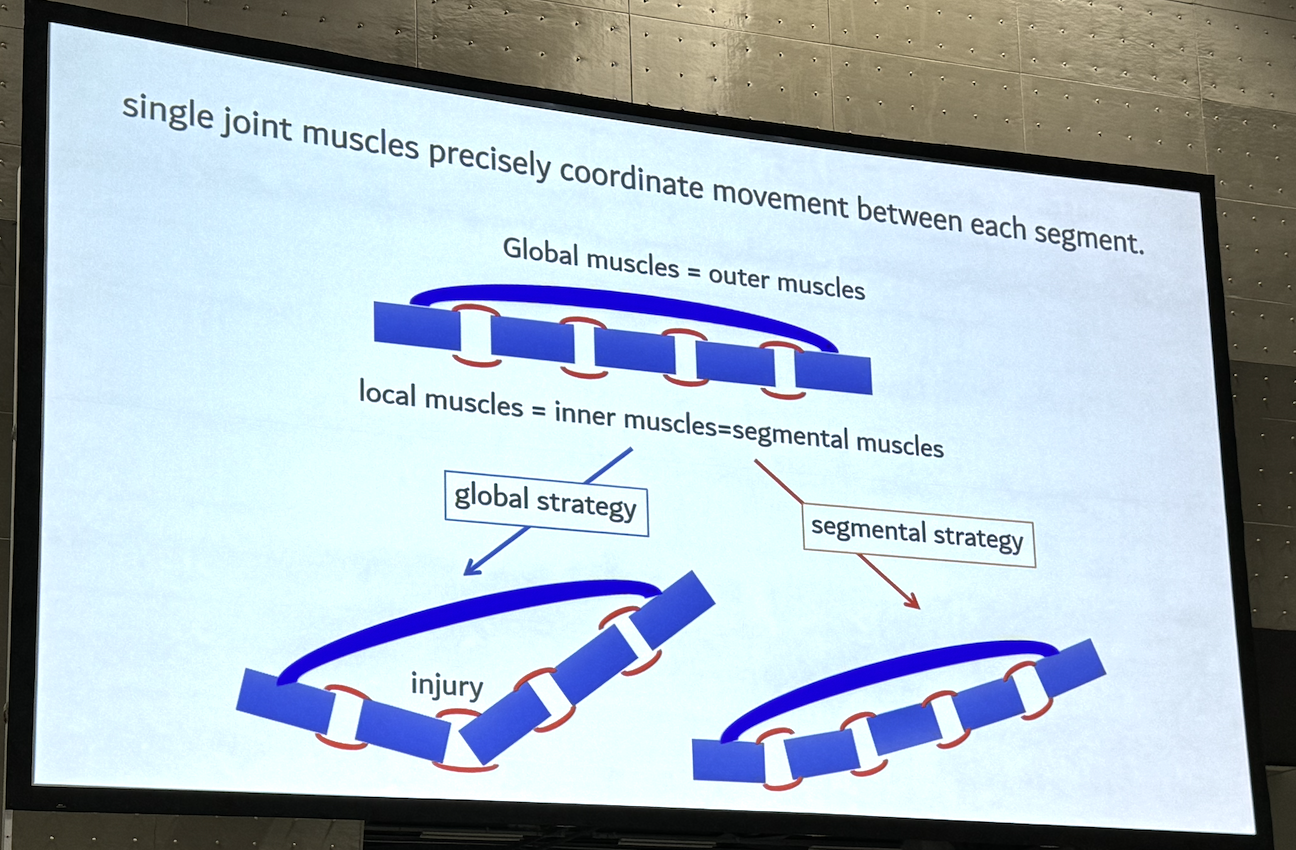
Anatomy. In the first year of medical school we learn about the large muscles that flex and extend the lower back – rectus abdominis anteriorly and the erector spinae posteriorly. Deep to these muscles are the muscles that stabilize the segments of the lumbar spine, and multifidus, for surgeons, is probably the most important of these muscles. 

This is the slide from Dr. Shimizu that explained this in a way I could really understand. The “global” muscle in his slide is the rectus abdominis which we contract when we lean forward to operate or examine patients. If you have weak segmental muscles (i.e. the multifidus), a disproportionate force will be transmitted to the weakest point in the spine. For most people, that’s L5-S1. If you work to strengthen the multifidus (“segmental strategy”) the force generated with flexion will be distributed along all the vertebrae – which helps prevent pain and injury. 

How to strengthen the multifidus. 

“Walk like a model”… which is a conscious, three step process as explained by Dr. Shimizu. The goal should be to do this as often as you think of it (on rounds perhaps?) … and hopefully for 10,000 steps a day! (any amount helps, though)

There are also specific exercises you can do to strengthen the multifidus. The classic core exercises known as  “bird dog” and “superman” are among the most effective. (Dafkou, 2021). Others that help include side planks, quadruped leg lift, and one arm pushup on a counter or bench. There are many more, so if you want a complete list, just google “multifidus exercises”.

Another excellent option is Pilates, which has been shown to be effective in strengthening deep core muscles and reducing low back pain. (Eliks, 2019). Tai Chi, yoga and other similar practices are effective in strengthening core muscles as well. 

This amazing art is from the team at Codex Anatomicus… make sure you check out their website! 

p.s. If you are a physical therapist, sports medicine expert, or have other expertise in this area, please comment below to add your expertise!

p.p.s If your back really hurts, please go see a good physical therapist.

Things I Wish I’d Known From the Beginning: How to (really) keep a journal in medical school and residency

Most of us have the idea that keeping a journal involves a lot of time. For healers and healers in training that is one thing we don’t have… time. So here’s some realistic advice on how to approach journaling. Give it a try. I promise, it’s worth it. 

Day One app on phone, Apple MacBook, and Apple Watches

How

Here’s how to start. Download Day One on your phone and computer. Read the (very short) instructions. This app allows you to use your phone (and/or computer) to write or dictate on the fly, as well as when you have more time. It also lets you easily include photos, links, and audio files. I’m sure there are other apps that do similar things but this is one I know is fantastic (BTW I don’t have any connection to this company).

If you are worried about security, you won’t be honest in your journal – which is important. Make sure that, like this app, whatever technology you use has the security of face recognition and passwords. That being said – even though it should (and will) be very secure, keep HIPAA in mind. No names, photos, or anything that might directly identify a patient! 

Don’t worry about long entries. Use your journal as a “Captain’s log” – just a timestamp and a few words to jog your memory. Make an intentional effort to notice good things in addition to the things you struggle with. 

0845 OR crew dancing to YMCA before the patient arrived

1015 Boring rounds, but team is cool. Really bad dad joke from Joe. 

Similar to a “captain’s log”, your journal can also be a way to make “field notes” – as though you are an anthropologist studying yourself – it’s a remarkable way to sort out what is working for you and what needs to change. 

p.s. Save your journal as a password protected PDF on your computer and resave it frequently. #BackupsAreCritical

Why

Getting past deficit framing. Human beings “deficit frame” by default. Stated another way – we are programmed at a very primitive level to look for anything that might hurt us. As a result, we tend to remember bad things more than good things. Journaling helps keep the balance, and reminds us that we have the power to override our primitive responses to look for mystery, joy, and laughter in our days. It is also therapeutic – Journals let us look for patterns in things that distress us and give us the ability to “talk” these issues out. 

A diary for important events. As healers we learn constantly. There will only be one time something is a “first”…the first patient you examine as a medical student, the first murmur you hear, the first chest tube you put in. Write down what happened and how excited you were! Keeping a log/journal like this is also a wonderful way to realize how much progress you make as you advance in your training/practice.

Venting. As human beings, we need a (safe) place to vent. A password protected journal is perfect. Try freewriting – just let it rip without any editing or thought. Even better – vent on a separate piece of paper that you rip to shreds and throw away when you are done… then turn to your journal to describe what you said and did.

Some other thoughts

Gratitude. At the end of every day (or at 2am if you are awake on call), force yourself to write down three things from the day that gave you a sense of gratitude. There are good studies that show this is a powerful tool to ward off burnout and decrease depression and anxiety. It’s also a wonderful way to keep deficit framing at bay and remember why we do what we do. 

Mindfulness. This kind of journaling is also a great way to practice mindfulness. In addition to your “captain’s log”, look for moments where you are “between” things, and use these moments as a mindfulness tool. Just stop, take a couple of deep breaths and notice what’s around you. 

1620  In the airport, sitting in a food court.. There are a few families, a table with what I assume are work colleagues, an older gentleman with his hamburger (dinner?) who is taking a break from work. I wonder why someone his age is working? There must be a story. There are smiles everywhere. A TV behind me is discussing sports – specifically field kicks in football (which seems a little strange in basketball season?). 

Prompts. If you find yourself stuck, try using these questions. Consider writing them down in the morning and then set an intention to answer them at the end of the day. They will float in your subconscious during the day, leading you to look for stories, delight, surprises, and things that need healing.  

  1. What story from the day warrants telling?
  2. What delighted me today?
  3. What surprised me today?
  4. What needs healing today? 

The world is bursting with wonder, and yet it’s the rare productivity guru who seems to have considered the possibility that the ultimate point of all our frenetic doing might be to experience more of that wonder. 

Allison Fallon, The Power of Writing it Down: A Simple Habit to Unlock Your Brain and Reimagine Your Life  

Things I Wish I’d Known From the Beginning: How to Hack Eating Well

It is hard to eat well when you are a med student, resident or busy doc (also true for busy people not in medicine!). The key to eating well if you are busy is to have a strategy. You/ve developed strategies for studying to get where you are… so you have this skill set already! (Trust me, if you can learn how to take out a gallbladder or diagnose a complicated infection, you can learn to do this, too.)

As I’ve written before, here are the basic steps that you need to follow to eat well if you are “too busy to cook”:

  • Find recipes that sound good (but take less than 30 minutes to prepare)
  • Fill in a calendar with the plan for your meals (at work, on call, at home)
  • Make a shopping list
  • Shop once, then (mostly) follow your plan

For the last 6 years, I have used an app that make this process incredibly easy. Paprika is not free, but it’s money well spent. I recommend downloading both the phone app (which right now is $4.99) and the app for your computer ($24.99). Try the phone app first if you aren’t sure, but I think you’ll find the laptop version is more than worth the money.

The reason I think this app is perfect for healers, healers in training, and anyone who is super busy is because it takes the four steps listed above and puts them all into one place.  It not only makes it easy to choose recipes, plan your week and shop, it almost makes it fun. Here’s how:

Find recipes that sound good (but take less than 30 minutes to prepare)

Click on the browser tab to find new recipes and download the ones that work for you.  As you save recipes in the app, it becomes your own personal “cookbook” which is searchable by category, name, or ingredients.

Fill in a calendar with the plan for your meals (at work, on call, at home)

This was the first moment I knew this was a great app. All you do is drag and drop the recipes you want into the appropriate day. Wow.

Make a shopping list and go shopping.

This is when I was completely sold.  When you pull up the recipes you’ve chosen, there is a little “hat” icon at the top:

When  you click this icon EVERYTHING IN THE RECIPE appears in a shopping list.  Click what you need and repeat for the week’s recipes and voilà – your shopping list.

Because this app is on your computer and your phone, just take your phone with you to the grocery store.  As you pick up each item, click the box next to it to take it off the list. If you are sharing the app with your significant other or roommates, anyone can add to the grocery list or unclick things they have bought.

Try using this strategy (instead of eating the bagels, pizza, peanut butter and other “free” foods in the hospital) for a few weeks. I promise you’ll feel better, learn better, and have more energy to take good care of your patients.

(BTW – I have no ties whatsoever with the makers of this app!)

SHARE THIS:

LIKE THIS:

Loading…This entry was posted in Diet and tagged cooking, Diet, food, meals, nutrition, on call, recipes, vegetables by marylbrandt. Bookmark the permalink.

Leave a Reply

https://jetpack.wordpress.com/jetpack-comment/?blogid=52238385&postid=5960&comment_registration=0&require_name_email=1&stc_enabled=1&stb_enabled=1&show_avatars=1&avatar_default=identicon&greeting=Leave+a+Reply&jetpack_comments_nonce=99cf0ff8fa&greeting_reply=Leave+a+Reply+to+%25s&color_scheme=light&lang=en_US&jetpack_version=13.2-a.7&show_cookie_consent=10&has_cookie_consent=0&is_current_user_subscribed=0&token_key=%3Bnormal%3B&sig=b8eead7ccfe6ac534a3810d5e1a0e29b991f79e4#parent=https%3A%2F%2Fwellnessrounds.org%2F2018%2F01%2F21%2Fhate-cooking-but-want-to-eat-better-by-the-end-of-this-post-i-bet-you-buy-this-app%2F

Powered by WordPress.com.

How to Ace Your Clinical Rotations

I don’t know many other professions that organize their teaching the way we do in medicine. In medical school, we start off with 18-24 months in a classroom and then send our students out on “rotations”, a month or so at a time in different medical specialties. The number of months (and years) is different, but the concept is the same for all professional medical training. In some ways it’s an old-fashioned apprenticeship – with all the good and bad parts that come with that kind of learning.

No matter how easy or hard your rotations might be, here are four important strategies to help you learn more and enjoy the process while you do it:

Photo credit

1. Be mindful, deliberate and excited about learning.

This is probably the most important piece of advice I can give.  Clinical rotations are often a whirlwind of work and you can be swept away without realizing it. Residents can ignore you, people can be cranky, patients can be difficult… and in the midst of all this, you are expected to learn to be a doctor.  You have to stay in charge of that mission, no matter what is happening around you.

Take a little time to reflect on why you are doing this and what kind of person/doctor you want to become.  When times get tough (and they will) hold on to it.  If it helps you, come up with a slogan to repeat. If needed, write it on a piece of paper to keep in your wallet or on your wrist.

Photo credit

Learn to practice mindfulness.  Mindfulness will keep you grounded and decrease your (normal) anxiety. Mindfulness is not hard to learn, but it’s hard to master … which is the point of a “practice”. (e.g. the practice of medicine)

Learn to keep “beginner’s mind” (and write about it). The very first time you walk into an operating room it will seem like (almost) magic. It’s astounding, right? We have drugs to induce a painfree unconscious state… there are instruments that can delicately dissect out a nerve… I could go on, but you get the picture. When it’s new, it’s astounding. That sense of discovery can be nurtured even for things that have become more routine. This is a practice (yes, you have to practice this, too!) which will add joy to your learning… which, by the way, means you’ll learn more!

Get an app like Day One, a highly rated app for journaling. Use it for a brief notes to record “firsts” (first drainage of an abscess, first time you see a rare anomaly, etc). Take photos (HIPAA compliant!) to remember the places and events of your day. List at least one thing a day that delights you. (Trust me on this one… it helps!)

2. Understand what you are going to learn (the big picture)

On every rotation, you will be given a list of learning objectives.  By all means, study the things listed and make sure you know them (they will be on the test).  BUT… please realize that diseases don’t stay conveniently siloed in a single specialty so this is not learning “surgery”, it’s learning about how surgeons approach a specific disease you will see elsewhere, too. You also need to know that what is listed as learning objectives today may well be obsolete tomorrow  (if they aren’t already).

You have chosen a career that ethically demands life-long learning.  That means that one of the most important skills to learn is how to develop a system of learning that you can use in medical school, residency and later in practice.

Photo credit

3. Develop a system for lifelong learning now

Learning is iterative.  You will learn broad concepts on each rotation along with a “fly over” of the entire terrain of the specialty  You will need the information you learn on your surgery rotation on your medicine rotation when you are consulted on a patient with an ischemic leg who needs surgical treatment, or on your pediatrics rotation when your patient with a pneumonia develops an empyema.  If you choose surgery at your career, you will read and learn the same topics throughout your residency (and after) but with increasing depth.

For more details on how to set up your system, check out How to Ace the NBME Shelf Exams, In-Training Exams and Your Boards. Here’s a summary of the key points:

  • Remember it’s school.
  • Make a list of all the topics in the textbook.
  • Breathe deeply. You are not going to read every page in the textbook in addition to your assigned reading.
  • Create a schedule to SKIM every chapter
  • TAKE NOTES. All the time.
  • Figure out how to store your notes so you can find them in the future
  • Go through your daily notes in the evening and then store them in your system
  • Review, review, review

Photo credit

4. Take care of yourself.

Pay attention to ergonomics, diet, exercise and sleep.  Most importantly, take care of yourself emotionally and spiritually.  You can’t learn or serve others if your tank is empty.  Be intentional with this, too. If it helps, make a list every day of things you’ll plan to do, things that help you thrive.  Review it before you go to bed. Celebrate the things you did and don’t be hard on yourself for the ones you didn’t get to.

Don’t forget to take a “Sabbath” every week.  True time off is critical for recovery from this stressful work.

If it gets too hard, seek help.  It’s a sign of strength, not weakness, and most (if not all) of your fellow students, residents, and attendings have been there.

Being someone who goes to work every day to learn how to heal other people is one of the most amazing jobs on earth.  When the administrative issues or political conflicts get to you (and they will), just remember – you are learning to take care of another human life with the goal of relieving their suffering.  What could be more important than that?

Photo credit

“Let us never stop speaking the obvious…”

For those who try to heal the scourge of gun violence…


L’Anima Semplicetta


Dear Mr. St. John: Thank you

for thinking of me.  I am fine,

though I have no words

to say how it is here.  You ask

what you should do.  Set down

your poem about the man who’s blinded

by the smoke, while climbing up

the Mount of Purgatory and about

the “simple soul.”  Take back

the bullet from my brain.

Pick up my school-books and my hat

from the pavement.  Follow

the stray shot back.  When you get

to Marshall, take the gun from his hand.

And re-collect the smoke.  Tell him

I’ll come sometime, to loose

the knot of anger from his neck. But you

must keep on walking, to my school.  Climb up

its seven stone steps.  And on the fourth step, sit

and weigh the flattened bullet in your hand.

It is such a light, slight thing;

and it is not.  It is all the weight

of our whole world.  It is what

we make.  Now do something that will not

make sense: touch it to your lips —

this cold, dark coal — then set it just

beneath your tongue.  Of course

it leaves a bitter taste.  Let i

dissolve.  Let it become your bones.

Let it cloud your brain.  Let it impair

your speech.  And let your tongue,

at all the worst of times, suddenly

speak the obvious.  Let it never

stop speaking the obvious.  Yours, Ebony.


Richard St. John

from The Pure Inconstancy of Grace

(Truman State University Press, 2005)


Why I’m Thankful for #ThisIsOurLane

@ThisIsOurLane

Gun Violence Archive