“The basic premise of a delight practice (which I learned about in the essay collection “The Book of Delights” by Ross Gay) is simple: You make a point to notice things in your everyday life that delight you. This could be anything — a pretty flower, a smile you share with a stranger, the sight of a person playing a trumpet while riding a unicycle down a major Philadelphia thoroughfare (true story). Nothing is too small or absurd. Then whenever you notice something that delights you, you lift your arm, raise your index finger in the air and say, out loud and with enthusiasm, “Delight!” (Yes, even if you’re alone.) Ideally, you share your delights with another person.”
This is an embodied practice (because of the the motion of pointing up) and a practice that creates a “delight radar” as we begin to look for moments of delight during the day. Not surprisingly, as you notice more moments of delight, you feel grateful… and as your gratitude increases your life becomes lighter, happier, and more meaningful.
“This year, like all of them, will be filled with conflict and tragedy. But it will also be filled with delights. Resolve to notice them.”
p.s. I do limit myself to pointing up and just thinking “Delight!!!” if I’m in the middle of the grocery store 🙂
Ryder Carroll suggests that goals should be lighthouses, not rules. Instead of the usual New Year’s resolutions, this year set your goals as destinations… as “lighthouses” in the distance. Write them down and revisit them often (every journey needs a map).
“When goals are lighthouses, success is defined by simply showing up, by daily progress no matter how big or small…” Ryder Carroll
At least once a day think about how to move in the direction of your goal(s). If you veer off course, that’s part of the journey…. look up, find your lighthouse, and correct your course.
Potential New Year “Lighthouse” goals
Learn more about compassion and practice it
Be a better friend
Write genuine thank you notes to people who have helped you
Become stronger, faster, more fit
Eat real food for as many meals a week as possible
Find out more about who you are through meditation
Keep a “stop doing” list
Be better at your work through deliberate practice (practicing and learning the things you don’t like and aren’t good at)
Read things that bring you joy
Keep a journal, even if it’s just 3 things you are grateful for every day
Learn the names of as many people at work as you can
Most surgeons perform around 500 operations a year for the 30 to 40 years they are in practice. If you add the procedures we do during training, surgeons walk into an operating room with the intention to heal ~15,000-20,000 times during their professional lives. In addition, for every patient a surgeon treats with surgery, there are at least 10 to 20 they will have seen who don’t require surgery but do require care. So the lives impacted during a typical surgical career number well over 100,000 and, when you include their families and friends, probably approaches half a million people.
Nadia Bolz-Weber is a theologian and writer who shares her journey and her remarkable teaching in “The Corners” on Substack
She shakes my hand and says, “we’ve met – but I do not expect you to remember. I’ve waited 7 years to be able to tell you this: You shared your chicken with me that night and you have no idea what it meant.”
Not what I was expecting her to say.
She went on to tell me how that night, she was at a real low point in the middle of a very painful divorce. We were in the green room and she was supposed to introduce me and she was exhausted and hadn’t eaten all day. Apparently I looked up from my huge chicken dinner and was like, “I’m never gonna eat all of this, please help me out here” and it nearly made her cry.
I have literally no memory of this, but even if I did, I could never have known what it meant to her.
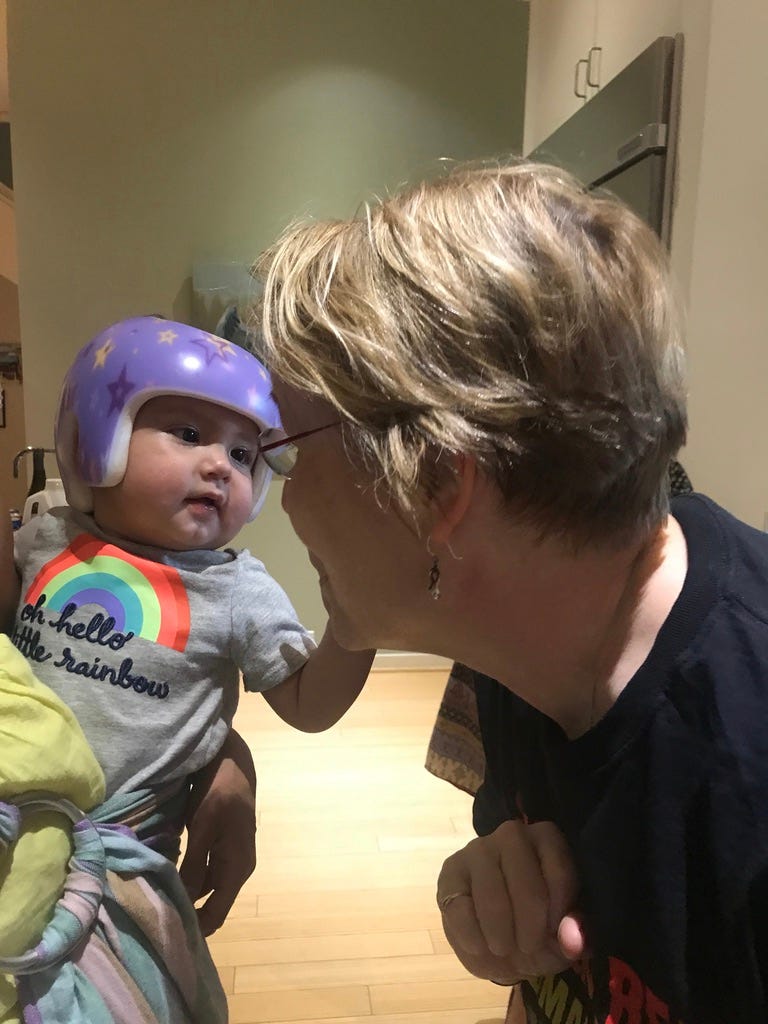
We’ve all had a moment when someone, often a stranger, arrives at a moment of need to share their chicken dinner… or say just the words that heal something we may or may not have known was broken. Whether or not we recognize it, these moments create a subtle but profound shift in the way we view the world and ourselves. And, unbeknownst to us, we deliver the same moments of healing and grace to others. These moments can be deliberate, but more often they are not… and are as simple as picking up a small child covered in bandages to give them a hug, complimenting a stranger’s smile, or bringing a cup of coffee to an exhausted colleague and asking them – really asking them – how they are.
I can’t do it as well as Nadia Bolz-Weber, but here’s my blessing for you….
May you find yourself stumbling into sacred moments (even though you don’t know what you are doing, and probably don’t recognize them). And may you be open enough to recognize, accept, and celebrate the grace of chicken dinners, smiles, and cups of coffee that heal your soul.
When I first started this blog, I really wanted to title it “Everything I wish someone had taught me about learning and practicing medicine when I was in training (and beyond)” … but that was a little wordy for the name of a website… hence “Wellness Rounds”.
Ten years is a long time for a blog. Teaching and thinking about how we live and move in the world (particularly as healers) is still a passion for me, but I have new tools and more time now that I have retired from the physical work of surgery (one never really stops being a surgeon, though… more on that later). I found myself agreeing with Neil Gaiman, as quoted recently on Cal Newport’s website – “I love blogging. I blog less now in the era of microblogging… I miss the days of just sort of feeling like you could create a community by talking in a sane and cheerful way to the world.”
He goes on to point out what all of us are experiencing – that more and more of us are leaving the world of microblogging on social media (Twitter, Bluesky, Facebook, etc) but feel a loss for the ways we have been connected by these platforms.
He then predicts the start of a new era of finding community online: “But it’s interesting because people are leaving (social media). You know, Twitter is over, yeah Twitter is done, Twitter’s… you stick a fork in, it’s definitely overdone. The new Twitters, like Threads and Blue sky… nothing is going to do what that thing once did. Facebook works but it doesn’t really work. So I think probably the era of blogging may return and maybe people will come and find you and find me again.”
Enter the idea of a commonplace book, POSSE, and reinventing how I communicate with my readers…
What is a commonplace book?
Wikipedia describes a commonplace book as “a way to compile knowledge, usually by writing information into books.” In physical form, it’s a notebook you use to write down quotes, ideas, often organized into subjects (which is what makes it different from a journal). It can also be a collection of index cards or other notes. One of the best examples of a modern approach to a commonplace book is the Bullet Journal (which is a simple approach to organizing information and tasks that so many people find helpful)
I knew in general about commonplace books, but hadn’t really thought about a website as an online commonplace book, until I read this post from Chris Aldrich: “Hello! I’m Chris. I use this website as my primary hub for online identity and communication. It’s also my online commonplace book.”
I have the extraordinary of gift of sitting with my father, Floyd Brandt, in hospice this week. His (beautiful) heart is failing, but his mind is still sharp, and his spirit is completely at peace. The following is his last lecture as a professor (to his graduate seminar in Business Ethics)
It gives me great joy to share it with you.
Retiring is a little like having your first child. There is nothing particularly unique about the exercise except it is a first time experience that requires no specific skills or expertise and arrives with an unknown outcome .
The initial inclination while preparing comments for a last class is to draw from all the literature and all of one’s experiences to craft some statement filled with lasting words capable of shaping the hearts and minds of students for their remaining years.
Shortly after entertaining such a prospect, it became immediately apparent that teaching has taught me that that while the words may be forthcoming, the impact is not likely to be so resounding. Given that reality, the best course of action is to make a few short comments and say good-bye.
The closing line from Stephen Sondheim’s song “Send in the Clowns” came to mind. “Isn’t it rich, isn’t it queer, losing my timing so late in my career.”
In these last few minutes of the last organized university class that I will teach, I would like to suggest to each of you:
Define what is important to you. Attempt to determine what you are worshiping, because without that understanding, you are adrift and likely to be pushed ever-which-way.
Come to terms with the finite and the infinite dimensions of your being. Until you come to terms with the end of your existence, you will find living in the present to be difficult.
Cultivate the disciplines necessary to contend with the vagaries of the world around you. Perhaps the most important are the disciplines of the mind and of the spirit. The first step is often that of finding a quiet place to meditate and contemplate.
Learn the significance of uncertainty, choosing, and evaluating and then celebrate them. The definition of who you are is largely a product of the questions you ask and the choices you make. It is difficult to learn that the choices made today are the offspring of choices made yesterday.
Experience the joy of thanksgiving. Recognize that joy and hope are rooted in faith in the belief that what you have and what you are is a gift. As much as possible expunge the demons of comparison and competition and accept that sweeping out the harpies circling round the “enthroned self” never ends.
But then how does one end a last class in ethics except to recall that ethics is obedience to the unenforceable; a product of what you ask of yourself and not what others ask of you.
I had the honor of speaking at the American College of Surgeons this week on a panel about stressors clinicians have control over i.e. can modify. I was assigned a topic I had not really thought about before – which meant I learned a lot! After the talk, there were many people who came up to me and asked if they could have my slides… so here they are!
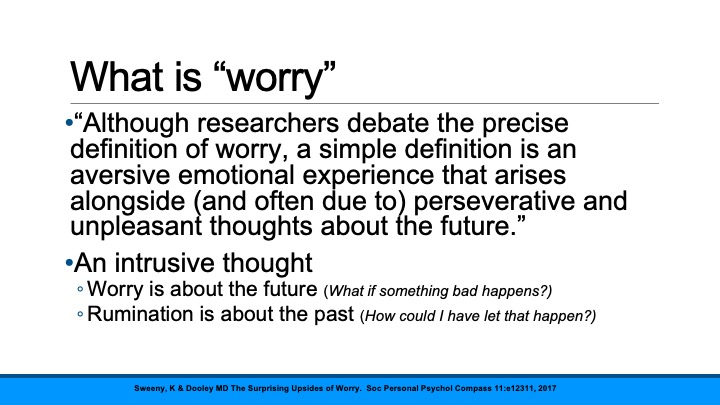
This is a really important concept… worry is an intrusive thought, which means it just pops in your head. And it’s unpleasant, so you worry about worrying!
Another important point here – worrying is always about something in the future (as opposed to rumination, which is always about the past)
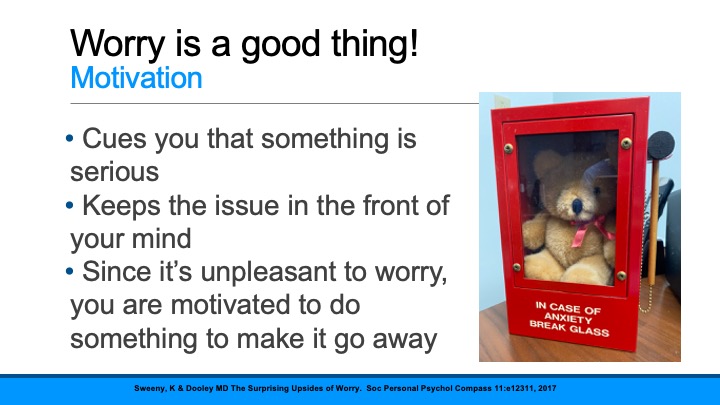
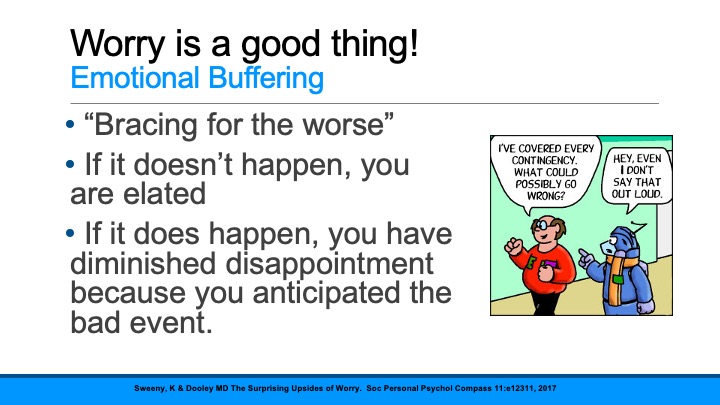
These are the two main ways worrying helps us – motivation and emotional buffering. The motivation part is pretty obvious. Emotional buffering is also obvious, but I didn’t have a name for it before. Take for example worrying that you will fail a test. If you end up getting a good grade on the test it is somehow even more exciting… but, if you do poorly your disappointment is somehow buffered.
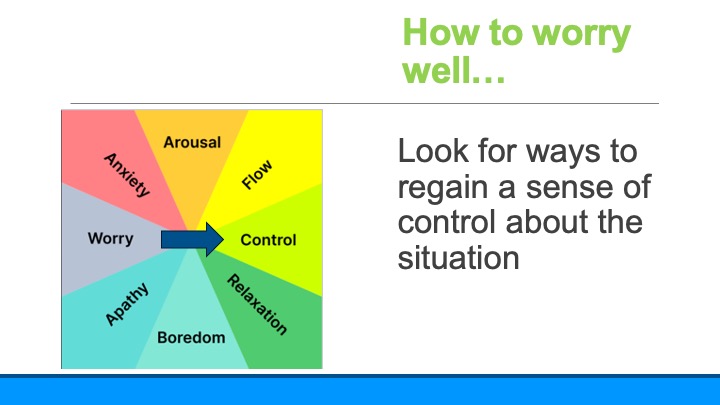
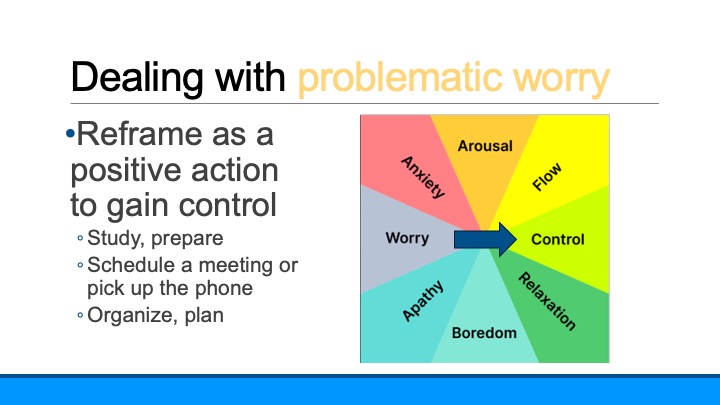
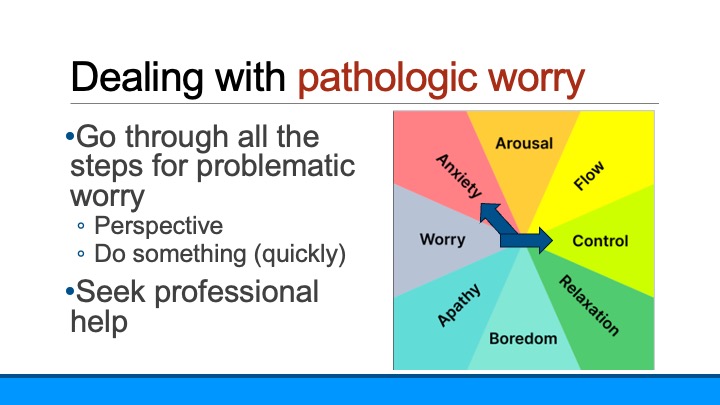
In terms of emotions, control is the opposite of worrying. Take the test I mentioned above. If you are worried you will fail it, the way to deal with that is to regain a sense of control. For example, using smart notes to optimize learning during your rotations, using this plan to ace your in-servce exam, or this plan to get ready for exams during basic sciences.
This principle holds true for ALL clinicians – no matter how long your have been in practice.
And then I tackled the next question… what to do when worry begins to spiral.
I introduced this validated tool to see if your worrying has crossed the line to problematic or pathologic.
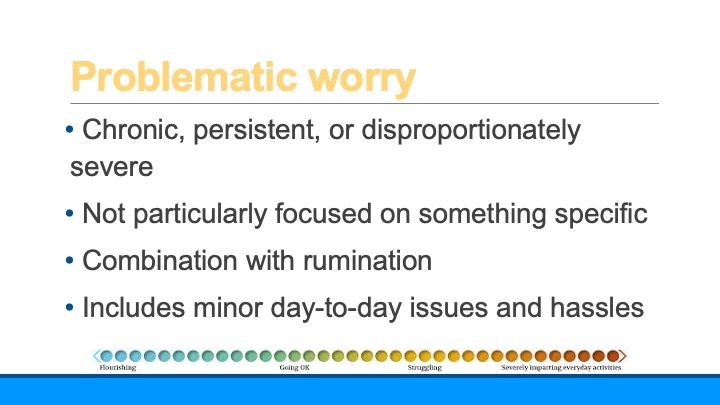
And pointed out that if worry is causing you to suffer, it’s a problem.
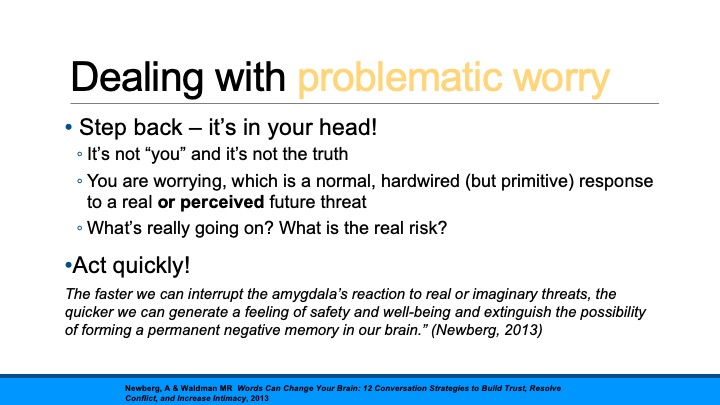
The way to deal with problematic worry is to try to return it to the kind of worrying that helps us, which we can do with any action to control what we are worried about. Worried about a test? Make a plan for how and when to study. Worried about a relationship? Plan to meet or pick up the phone to talk. Again – no matter what your are worried about – do something to create a plan to address the worry.
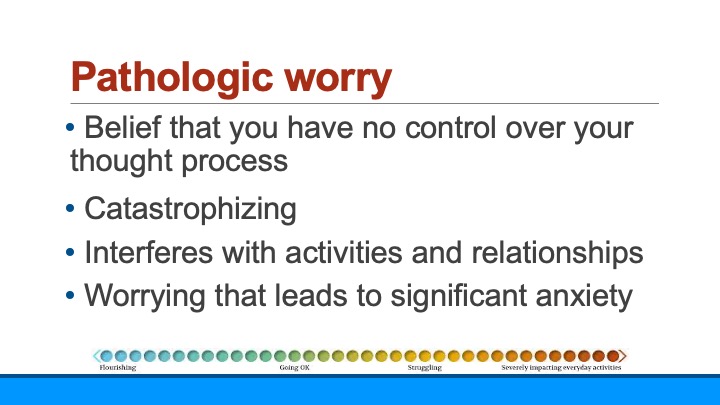
But despite our best efforts, the spiral of worry can land us in a bad place. If you find you have anything on this list (or if you are really suffering), it’s pathologic worry.
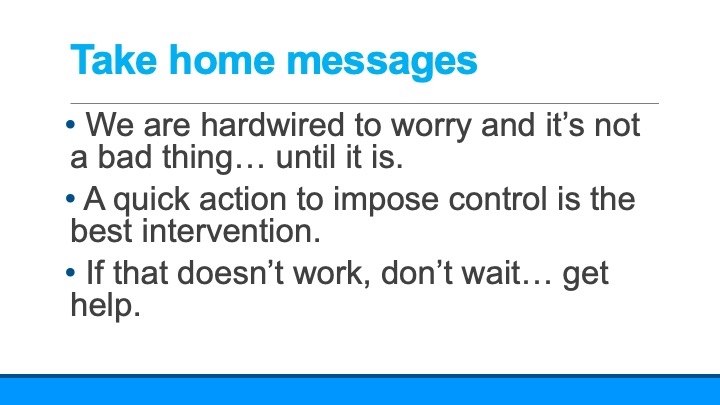
It’s super important that you act – quickly. This is your amygdala trying to hijack your brain! (Remember flight-flight-freeze?) If you don’t derail it quickly, it will continue to spiral and land you in a world of anxiety. In other words, follow all the steps for problematic worry – but if it doesn’t work, don’t wait. Get help.
It’s the beginning of the academic year in medical schools around the world, and that means there are thousands of students who feel they are suddenly being asked to drink from a fire hydrant. The information you are asked to learn in medical school is different in two really big ways – It’s voluminous and (unlike in undergraduate education) all of it is relevant (albeit to different degrees) to what you will be doing the rest of your life. Learning how to make the transition to this new kind of studying is one of the biggest tasks a new medical student has to accomplish.
The following is a guest post from Preston Tsang, a medical student at Tulane University School of Medicine. The main take home message?
You have to study how to study if you are going to succeed in medical school!
All of us arrive to medical school with a successful strategy for studying… which we then have to seriously revise. The incredible volume of material means you either rethink how to study, learn, and recall info from the beginning… or you are forced to do so when you stumble – after realizing the way you studied in college won’t cut it in medical school.
Every medical student quickly learns that standardized exams are a necessary objective measurement of how “well” you do in school … especially the mammoth exam called STEP 1. This exam (as you might guess) is the first of three “steps” to getting a license to practice medicine. But Step 1 in particular (and now Step 2) are also an important way residency programs assess the academic standing of students applying to their programs. #Pressure
Just like college, you need to study to pass the exams in each of your courses, but unlike college you need to prepare for Step 1 (which means everything you learn in basic sciences!). And BTW you also need to remember that you are not just studying to pass an exam or ace the Step exams. Learning (not just memorizing) this information is essential to being a good physician.
So how best approach this overwhelming task? Only one way – You need to study how to study if you want to succeed in medical school. Make some notes as you study how to study, create your own way… but to get you started, here are the key points I learned as I’ve gone through this process.
It’s all about active learning. Gone are the days of cramming, or just reading something three times to learn it. It’s all about active learning, and – fortunately – there are a lot of people who study this and have come up with methods to promote active learning. All of them involve taking notes to synthesize (not just list) the material and interacting with the material.1,2
Studying in groups helps! Asking each other questions and having to “teach” each other is a great example of active learning.1 Studies have shown being quizzed about material is superior to traditional learning and basically halves the time it takes to learn the material.5
Take notes, but not too many. Notes are key, but should reflect your synthesis of the information, not every detail. There are lots of studies (and stories) about people who spend hours and hours creating spectacular notes and then don’t have time to review them. Guess what… they don’t do that well.1 There’s lots of literature on note taking, with many different strategies. Add this to your “studying how to study” list!
Review, review, review. It seems obvious, but you don’t learn something on the first pass. There is science here, too! It’s takes 5-7 repetitions, spaced further and further apart, to really learn something. It doesn’t work as well if you review something 5 days in a row… it should be almost a logarithmic spacing to get best results.3,4,6
Flash cards (e.g. Anki) work great for details. Once you have the big picture summarized, go back and look for details that you need to know. Anki (and other similar apps) build in spaced repetition – they have you repeat things you don’t know well until you know them. Using this technique (i.e. using Anki) to learn a subject versus reviewing the material multiple times (i.e. re-reading notes) has been shown to improve learning.4
To enhance Anki flashcard learning even further, I discovered that there are certain structures to flashcards that make them more effective. In one study 80 students were randomized into two groups. One group used flash cards designed as a test (testcard) while the other half was randomized into flash cards using the more typical “studycard” format (see below). The group using the testcard format retained more of the information when tested. 7
UWorld has its place, but it’s not what you think. Despite what every upperclassman will tell you, your professors are right – you can’t learn medicine from multiple choice questions alone. But… once you have the concepts down, testing yourself and learning why you were right or wrong is a great form of active learning. More importantly, study questions are a great way to review (once you think you’ve learned the information) to find where you have gaps.
Don’t underestimate the power of mnemonics 2. Make them up and make them something you can’t repeat in public (a known strategy for successful mnemonics). Ask older students, residents, and even attendings for theirs.
So here is how to succeed at Step 1, based on what I’ve learned. When tackling a standardized exam with a vast amount of material, studies have proved the effectiveness of retesting, spaced repetition, and active learning. Start off with a solid base by learning initially from the notes you make in class and from class readings. Then, instead of just rereading the information, distill it down into summaries, draw diagrams, and create your own questions. On top of this find ways to promote active learning and retesting as you study like using practice questions or reviewing your Anki cards. This system of learning may not be best for every learner, but is a good place to start. Add to it with your own research into study techniques.
p.s. Don’t forget to build in (and schedule) time for self-care and sleep.1
1. Dattathreya P, Shillingford S. Identifying the Ineffective Study Strategies of First Year Medical School Students. MedSciEduc. 2017;27(2):295-307. doi:10.1007/s40670-017-0396-2
2. Roffler M, Sheehy R. Self-reported Learning and Study Strategies in First and Second Year Medical Students. MedSciEduc. 2022;32(2):329-335. doi:10.1007/s40670-022-01533-w
3. Ericsson KA, Chase WG, Faloon S. Acquisition of a Memory Skill. Science. 1980;208(4448):1181-1182. doi:10.1126/science.7375930
4. Larsen DP, Butler AC, Roediger HL. Repeated testing improves long-term retention relative to repeated study: a randomised controlled trial. Med Educ. 2009;43(12):1174-1181. doi:10.1111/j.1365-2923.2009.03518.x
5. Morris PE, Fritz CO, Jackson L, Nichol E, Roberts E. Strategies for learning proper names: expanding retrieval practice, meaning and imagery. Applied Cognitive Psychology. 2005;19(6):779-798. doi:10.1002/acp.1115
7. Schmidmaier R, Ebersbach R, Schiller M, Hege I, Holzer M, Fischer MR. Using electronic flashcards to promote learning in medical students: retesting versus restudying. Medical Education. 2011;45(11):1101-1110. doi:10.1111/j.1365-2923.2011.04043.x
And a few more things to help you on this journey!
New interns and their more seasoned senior residents are asked this almost every day. So let’s talk about this for a minute and what that question really means…
What you are being asked to do.
The hospital requires a signature on a consent form (always printed with very small font and several pages long). This part of the consent process that has a long history guided primarily by legal counsel for hospitals and, yes, you need to get the signature. But…
There are five things that must be present for informed consent. If any of them is missing, it’s not informed consent.
The patient must have the capacity and ability to understand. (No intoxication, translation when needed, etc).
The patient must actually understand. (This means you have to confirm they understood with a conversation – Can they explain it to another family member? Do they have questions?)
The person performing the procedure (or their designee) must describe the procedure and must discuss alternatives, risks (and how likely they are) and the expected benefits (and how likely they are).
The patient has to agree without coercion. (If you aren’t sure about this, don’t proceed)
There are questions that every intern would like to ask about this process but can’t/won’t. Here are a few that come to mind…
What if you’ve never performed (or even seen) the procedure yourself? It’s hard to get truly informed consent if you aren’t competent in doing the procedure. But – you know (intellectually) the alternatives, the potential risks and benefits, and the “big picture” of the procedure. Particularly for complicated procedures, you can assume that the attending has discussed these (and therefore is the person who actually got the consent!). Here’s a way to make this easy… “Hello, I’m Dr [xxx}. I know that Dr. Attending has already talked to you about your surgery. I’m here to go over the alternatives, risks and benefits again – to make sure you don’t have any questions I can take back to Dr. Attending for you.”
p.s. If you are “Dr. Attending” in this scenario, you are the one who is ultimately responsible for the informed consent (and liable if it’s not done properly).
Is it important to get the consent just before the procedure? No, in fact it makes it legally more sound and much more efficient to document informed consent when you first see the patient. For elective or semi-elective surgery, it takes no time at all for “Dr. Attending” to put this phrase (or one like it) in their clinic (or ED) note: The procedure including alternatives, risks, and benefits was discussed with the patient, all questions were answered, and informed consent was obtained. This documentation often holds more water than the signed form (at least according to most attorneys I’ve talked to). Best yet – do both. Get the consent form signed at the same time! It’s easy to scan into the medical record to be there for the day of surgery, which is a win-win for almost everyone involved.
What if It feels like you are scaring the patient/family when you review the list of the possible complications? First of all, that’s a normal feeling. But we have to learn to handle the anxiety that is always part of this process. In addition to trying to be really calm and supportive, here’s how I handle that: “When we decide about doing surgery, we always ask which is riskier… to do it or not do it. For you, we’ve decided together that it’s risker not to do the surgery… which is why you are here. But because there are risks, I want to make sure you understand them and we can talk about them before the operation.”
What if they don’t speak English but the family says they can translate for you? It’s not informed consent unless it’s translated into their language by a professional medical translator. Imagine the shoe on the other foot. What if your best friend the artist was travelling in a country where none of the doctors or nurses spoke English and they needed surgery? They would be terrified and so would any family member who was with them (even – or maybe especially – if they were being asked to translate). Don’t cut this corner. Please.
Isn’t this blog post oversimplified?
Yes!
Informed consent is a fascinating and rapidly changing area of medical ethics. I hope I’ve hit the critical highpoints and addressed a few unspoken questions many trainees have, but it’s unquestionably a “30,000-foot view”.
p.s. If you have more questions, even ones that seem naïve, please comment on this post or email me (if you don’t want them to be public).
No matter how many times a pilot has flown a specific airplane, 100% of the time before takeoff, they review the SOP (Standard Operating Procedures) for that plane.
A while ago I realized that I prepared for complicated surgical cases by reviewing the same set of things every time – how to prepare the patient for surgery, the pertinent anatomy, the steps of the operation, potential complications (and therefore how to try to avoid them i.e. what to include in my informed consent), and post-operative care.
The day I learned about SOPs for pilots a lightbulb went off.
What if I did the same thing?
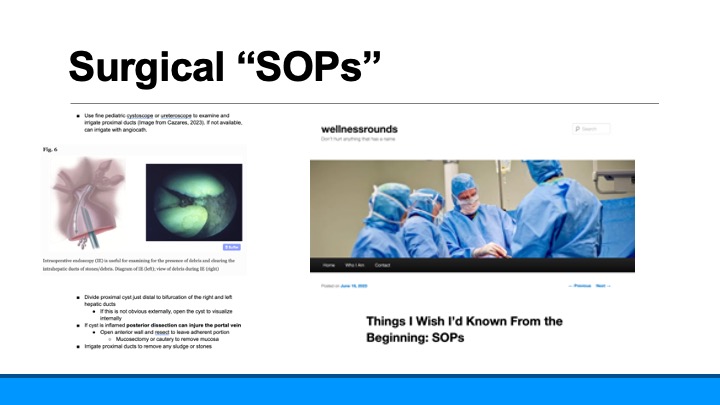
What if I took the books, articles, and websites I usually review, standardize the process, and create a single “living” document to review for every major procedure I do? It would be a document I could update as I got more experience – and as new findings and recommendations were published, too.
What I quickly realized was that the practice of creating, reviewing, and updating these surgical SOPs made me a better surgeon…and it made me a better educator. I could share my SOP for a specific case with the residents and students in advance – which let them prepare more efficiently for the case. I could also give the SOP to my anesthesia colleagues and the rest of the OR team to help them prepare, too.
The structure of my SOPs is more or less the same for any procedure and is demonstrated below with an example. Use it, modify it, or create your own… but if you are learning procedures as part of your medical training I strongly urge you to give this a try! The other piece of advice I would give you is to use a digital platform (like Google drive or EndNote) so you can access your SOPs from any computer and your phone. (Disclaimer: SOPs, like the one below, are only the starting point I use to prepare for a specific case. Since every patient is different, not everything below will apply to an individual patient.)
BTW – There is a decent time investment the first time, but after that it’s really a living document. Every time you have the privilege to scrub on the same case again, check PubMed, Google images, videos and update your SOP with what’s new before the case. After the case use it to make notes about different attending preferences and/or new information or techniques you learned from the case (but please be HIPAA compliant!).
Rituals have great power, but some more than others. For me, going to the Farmers Market has become a ritual that is almost as important as the food I buy there. So I spent some time this morning pondering why…
It’s outside. Sun, clouds, breeze. Sometimes a little cool, sometimes too hot… but always the season that matches the fruits and vegetables being sold that day.
There is music. And dancing… people dancing with children, children dancing alone, folks dancing in their wheelchairs.
Everyone is happy. Seriously. Not a dour face anywhere!
There is delight in the colors, odors, and tastes.. It’s beautiful… and that sensual beauty evokes all kinds of good emotions – delight, joy, and even awe.
It anchors you to the season. We don’t have peaches in January at the farmer’s market. So when they show up in May it’s a day of celebration! Eating what is being grown in the season keeps you somehow anchored to life around you and, according to some traditions, is better for your body. It’s certainly better for the planet, since this is food grown within miles of where it’s sold… not half way across the world.
You develop relationships with the people that grow your food. Lisa’s new tortoise gets a spectacular salad every day, so we chat about his salads and her goats. I get to practice my French with the Congolese farmers who grow their produce on an inner city farm developed to provide new refugees a place to farm. Some of the vendors know my name, most of them know and recognize me with a smile (even if they don’t know my name), and all of them are happy to share how to prepare their food and what’s happening on the farm.
And then there is the food. There is no question it’s often (but not universally!) more expensive to buy your food at the farmer’s market, but for the reasons above it’s worth it. But there is one other reason … which is probably the most important reason of all.
One of the very first times I went to a farmer’s market, I bought potatoes. I remember distinctly thinking that it would not be worth the extra money because “it’s just a potato”… but I did it anyway. Every potato I had ever bought in a store tasted the same as every other potato … so I didn’t expect these to be any different. Wow… I was SO wrong. A potato that has been pulled out of the ground the day before you cook it is absolutely amazing. A light went on. Fresh food raised in smaller quantities by people who are devoted to doing it tastes better. It just does.
There is most likely a farmer’s market near you if you live in a city, but if there isn’t you have a other options (The USDA Local Foods Directory is a wonderful way to find farmers markets, gardens, and local farms near you if you need help. )
CSAs (Community Supported Agriculture). Google “CSA’s near me” to find farms that make up boxes with small portions of anything they are harvesting that week to distribute to people who have signed up with them.
Community Gardens. If you love to garden (and you can spare a few hours every once in a while) you might want to actively participate – it’s also pretty soul soothing to dig in the dirt and grow your own tomatoes. But it’s also worth asking if you can buy any produce that isn’t otherwise promised.
A local farmer or neighbor who has a big garden. You don’t know unless you ask. Offering to buy some of their produce might end up being a win-win. They may have too much produce, need a little extra income, or both. And you end up with fresh produce and a relationship with the person who grows it!