“Oh, Lord, increase my bewilderment…”

We live in bewildering times.

Being bewildered is not something we enjoy, nor is it something we seek. Our usual reaction to being bewildered is to look for missing explanations, develop strategies, read something, talk to someone… in other words, do anything to find our way out. Wendy Johnson, in this wonderful dharma talk, teaches that instead of these reactions we should intentionally take on bewilderment as a “perfect ground” for practice. Instead of trying to escape the unpleasant feeling of being bewildered, she asks us to “walk into the fire” together, to pray as the Sufis pray, “Oh, Lord, increase my bewilderment.”

Valley of Bewilderment by Ayesha Gamiet

Increase my bewilderment?

Being bewildered means we have “lost our bearings”. The word comes from be- (thoroughly, utterly) and wilder (“lead astray, lure into the wilds”) and is closely related to “wilderness”. This sounds terrible! Why would we ever want to be more bewildered???

Not long ago a good friend of mine shared an important story with me. She had been responsible for hosting a prominent surgeon as visiting professor during her last year of training. (For everyone in academic medicine, this will be familiar. For those who aren’t, the visiting professor usually gives a lecture in the morning and spends the rest of the day(s) talking with colleagues, residents, and students.) It was the end of a very successful day and she was walking with him back to her car to take him to his hotel when he asked her, genuinely, how she was doing. She surprised herself and, as she explained to me, “I still can’t believe that I told him the truth.” She went on to describe what he already knew. She was, like so many healers, emotionally thin and spiritually empty after dealing with death, violence, politics in the hospital, and the moral distress of working in a system that seemed focused on profit, not people. He listened deeply, asking more questions to better understand, and then put his arm around her shoulder as he explained to her that she was “having a wilderness experience.”

In many of the world’s faith traditions, spending time in the wilderness is an important and deliberate time of struggle, a well known tool for growth that transforms you so that (importantly) you can then return to your ordinary life with new understanding and new resolve.

Maybe this is the take home message… The wilderness doesn’t have to be a physical place. To be bewildered is to find yourself in an emotional and spiritual wilderness, a wilderness with the same potential for transformation as 40 days in a physical desert… if you are able to understand that this, too, is a “perfect ground” for practice.

Photo source

Thank you!

We all stand on land celebrated and cared for by First People. What better day to learn more, listen more, and celebrate this sacred work?

Here’s where to start – Go to Native-Land.ca and enter your address to learn who the First People are where you live. Say a word of thanks for their presence, and then take the opportunity to learn a little more about them and their ancestors.

We all (and always) have things to be grateful for, and this day is one to spend in gratitude. But let’s also try to learn and maybe even teach our children a little more about why we celebrate this day in the United States.

One more note of gratitude…To all those who are on call today in hospitals or as first responders, thank you. We see you and are grateful.

Photo credit

“If the only prayer you say in your whole life is  “thank you,” that would suffice.” Meister Eckhart (c. 1230- c. 1328)

I’m Weary

Like many, this has been a tough week for me.

As a physician, I grieve for the possible loss of the ACA, the risk for so many children (and adults) if the science of vaccines is questioned… or worse, if healthcare policies are put in place based on politics and/or profit rather than science.

I could go on, but that’s enough. You get the idea.

Like all of you, I’ve been inundated with messages on social media and in the news describing the move away from so much that I hold sacred and dear.

I’m tired… and I’m weary.

So, today I’m giving myself a digital Sabbath… no news, no social media, nothing that amplifies despair, hatred, or othering any of my neighbors (and you are all my neighbors).

If you are struggling, try it. Turn it off for a day or two.

Turn on some music. Look for the helpers.

Onward.

A gift for those who have graduated from medical school

Gaudeamus Igitur, by John Stone

For this is the day of joy
      which has been fourteen hundred and sixty days in coming
      and fourteen hundred and fifty-nine nights
For today in the breathing name of Brahms
      and the cat of Christopher Smart
      through the unbroken line of language and all the nouns
      stored in the angular gyrus
      today is a commencing
For this is the day you know too little
      against the day when you will know too much
For you will be invincible
      and vulnerable in the same breath
      which is the breath of your patients
For their breath is our breathing and our reason
For the patient will know the answer
      and you will ask him
      ask her
For the family may know the answer
For there may be no answer
      and you will know too little again
      or there will be an answer and you will know too much
      forever
For you will look smart and feel ignorant
      and the patient will not know which day it is for you
      and you will pretend to be smart out of ignorance
For you must fear ignorance more than cyanosis
For whole days will move in the direction of rain
For you will cry and there will be no one to talk to
      or no one but yourself
For you will be lonely
For you will be alone
For there is a difference
For there is no seriousness like joy
For there is no joy like seriousness
For the days will run together in gallops and the years
      go by as fast as the speed of thought
      which is faster than the speed of light
      or Superman
      or Superwoman
For you will not be Superman
For you will not be Superwoman
For you will not be Solomon
      but you will be asked the question nevertheless **
For after you learn what to do, how and when to do it
      the question will be whether
For there will be addictions: whiskey, tobacco, love
For they will be difficult to cure
For you yourself will pass the kidney stone of pain
      and be joyful
For this is the end of examinations
For this is the beginning of testing
For Death will give the final examination
      and everyone will pass
For the sun is always right on time
      and even that may be reason for a kind of joy
For there are all kinds of
      all degrees of joy
For love is the highest joy
For which reason the best hospital is a house of joy
      even with rooms of pain and loss
      exits of misunderstanding
For there is the mortar of faith
For it helps to believe
For Mozart can heal and no one knows where he is buried
For penicillin can heal
      and the word
      and the knife
For the placebo will work and you will think you know why
For the placebo will have side effects and you will know
      you do not know why
For none of these may heal
For joy is nothing if not mysterious
For your patients will test you for spleen
      and for the four humors
For they will know the answer
For they have the disease
For disease will peer up over the hedge
      of health, with only its eyes showing
For the T waves will be peaked and you will not know why
For there will be computers
For there will be hard data and they will be hard
      to understand
For the trivial will trap you and the important escape you
For the Committee will be unable to resolve the question
For there will be the arts
      and some will call them
      soft data
      whereas in fact they are the hard data
      by which our lives are lived
For everyone comes to the arts too late
For you can be trained to listen only for the oboe
      out of the whole orchestra
For you may need to strain to hear the voice of the patient
      in the thin reed of his crying
For you will learn to see most acutely out of
      the corner of your eye
      to hear best with your inner ear
For there are late signs and early signs
For the patient’s story will come to you
      like hunger, like thirst
For you will know the answer
      like second nature, like first
For the patient will live
      and you will try to understand
For you will be amazed
      or the patient will not live
      and you will try to understand
For you will be baffled
For you will try to explain both, either, to the family
For there will be laying on of hands
      and the letting go
For love is what death would always intend if it had the choice
For the fever will drop, the bone remold along
its lines of force
      the speech return
      the mind remember itself
For there will be days of joy
For there will be elevators of elation
      and you will walk triumphantly
      in purest joy
      along the halls of the hospital
      and say Yes to all the dark corners
      where no one is listening
For the heart will lead
For the head will explain
      but the final common pathway is the heart
      whatever kingdom may come
For what matters finally is how the human spirit is spent
For this is the day of joy
For this is the morning to rejoice
For this is the beginning
      Therefore, let us rejoice
      Gaudeamus igitur.


(* Therefore, let us rejoice)
(** 1 Kings 3:16-27)

Originally Published April 1, 1983 | JAMA. 1983;249(13):1741-1742.

“Let us never stop speaking the obvious…”

For those who try to heal the scourge of gun violence…


L’Anima Semplicetta


Dear Mr. St. John: Thank you

for thinking of me.  I am fine,

though I have no words

to say how it is here.  You ask

what you should do.  Set down

your poem about the man who’s blinded

by the smoke, while climbing up

the Mount of Purgatory and about

the “simple soul.”  Take back

the bullet from my brain.

Pick up my school-books and my hat

from the pavement.  Follow

the stray shot back.  When you get

to Marshall, take the gun from his hand.

And re-collect the smoke.  Tell him

I’ll come sometime, to loose

the knot of anger from his neck. But you

must keep on walking, to my school.  Climb up

its seven stone steps.  And on the fourth step, sit

and weigh the flattened bullet in your hand.

It is such a light, slight thing;

and it is not.  It is all the weight

of our whole world.  It is what

we make.  Now do something that will not

make sense: touch it to your lips —

this cold, dark coal — then set it just

beneath your tongue.  Of course

it leaves a bitter taste.  Let i

dissolve.  Let it become your bones.

Let it cloud your brain.  Let it impair

your speech.  And let your tongue,

at all the worst of times, suddenly

speak the obvious.  Let it never

stop speaking the obvious.  Yours, Ebony.


Richard St. John

from The Pure Inconstancy of Grace

(Truman State University Press, 2005)


Why I’m Thankful for #ThisIsOurLane

@ThisIsOurLane

Gun Violence Archive


Delight!!!

For the last several days I’ve been using the practice described by Catherine Price in this New York Times article (and I’ve ordered The Book of Delights by Ross Gay, too!)

“The basic premise of a delight practice (which I learned about in the essay collection “The Book of Delights” by Ross Gay) is simple: You make a point to notice things in your everyday life that delight you. This could be anything — a pretty flower, a smile you share with a stranger, the sight of a person playing a trumpet while riding a unicycle down a major Philadelphia thoroughfare (true story). Nothing is too small or absurd. Then whenever you notice something that delights you, you lift your arm, raise your index finger in the air and say, out loud and with enthusiasm, “Delight!” (Yes, even if you’re alone.) Ideally, you share your delights with another person.”

This is an embodied practice (because of the the motion of pointing up) and a practice that creates a “delight radar” as we begin to look for moments of delight during the day. Not surprisingly, as you notice more moments of delight, you feel grateful… and as your gratitude increases your life becomes lighter, happier, and more meaningful.

“This year, like all of them, will be filled with conflict and tragedy. But it will also be filled with delights. Resolve to notice them.”

p.s. I do limit myself to pointing up and just thinking “Delight!!!” if I’m in the middle of the grocery store 🙂

Set New Year Destinations (instead of resolutions)

Photo credit

Ryder Carroll suggests that goals should be lighthouses, not rules. Instead of the usual New Year’s resolutions, this year set your goals as destinations… as “lighthouses” in the distance. Write them down and revisit them often (every journey needs a map).

“When goals are lighthouses, success is defined by simply showing up, by daily progress no matter how big or small…” Ryder Carroll

At least once a day think about how to move in the direction of your goal(s). If you veer off course, that’s part of the journey…. look up, find your lighthouse, and correct your course.  

Potential New Year “Lighthouse” goals

  • Learn more about compassion and practice it
  • Be a better friend
  • Write genuine thank you notes to people who have helped you
  • Become stronger, faster, more fit
  • Eat real food for as many meals a week as possible
  • Find out more about who you are through meditation
  • Keep a “stop doing” list
  • Be better at your work through deliberate practice (practicing and learning the things you don’t like and aren’t good at)
  • Read things that bring you joy
  • Keep a journal, even if it’s just 3 things you are grateful for every day
  • Learn the names of as many people at work as you can
  • Take the stairs as often as you can
  • Make your living spaces enjoyable spaces
  • Get good sleep as often as possible
  • Learn Spanish (or any new language)
  • Be on time
  • Remember people’s birthdays and send a card
  • Start the day with intention

This revised post was originally published here

Stumbling Into Grace

Most surgeons perform around 500 operations a year for the 30 to 40 years they are in practice. If you add the procedures we do during training, surgeons walk into an operating room with the intention to heal ~15,000-20,000 times during their professional lives. In addition, for every patient a surgeon treats with surgery, there are at least 10 to 20 they will have seen who don’t require surgery but do require care. So the lives impacted during a typical surgical career number well over 100,000 and, when you include their families and friends, probably approaches half a million people. 

Nadia Bolz-Weber is a theologian and writer who shares her journey and her remarkable teaching in “The Corners” on Substack 

Photo credit – and link to “The Corners”

In her post The Sacred Act of Having No Idea What We Are Doing: On Complimenting Strangers and Sharing our Chicken Dinners, she shared this story…

She shakes my hand and says, “we’ve met – but I do not expect you to remember. I’ve waited 7 years to be able to tell you this: You shared your chicken with me that night and you have no idea what it meant.”

Not what I was expecting her to say.

She went on to tell me how that night, she was at a real low point in the middle of a very painful divorce. We were in the green room and she was supposed to introduce me and she was exhausted and hadn’t eaten all day. Apparently I looked up from my huge chicken dinner and was like, “I’m never gonna eat all of this, please help me out here” and it nearly made her cry.

I have literally no memory of this, but even if I did, I could never have known what it meant to her. 

Photo credit

We’ve all had a moment when someone, often a stranger, arrives at a moment of need to share their chicken dinner… or say just the words that heal something we may or may not have known was broken. Whether or not we recognize it, these moments create a subtle but profound shift in the way we view the world and ourselves. And, unbeknownst to us, we deliver the same moments of healing and grace to others. These moments can be deliberate, but more often they are not… and are as simple as picking up a small child covered in bandages to give them a hug, complimenting a stranger’s smile, or bringing a cup of coffee to an exhausted colleague and asking them – really asking them – how they are. 

 I can’t do it as well as Nadia Bolz-Weber, but here’s my blessing for you…. 

May you find yourself stumbling into sacred moments (even though you don’t know what you are doing, and probably don’t recognize them). And may you be open enough to recognize, accept, and celebrate the grace of chicken dinners, smiles, and cups of coffee that heal your soul.  

Creating a community by talking in a sane and cheerful way to the world…

When I first started this blog, I really wanted to title it “Everything I wish someone had taught me about learning and practicing medicine when I was in training (and beyond)” … but that was a little wordy for the name of a website… hence “Wellness Rounds”.  

Ten years is a long time for a blog. Teaching and thinking about how we live and move in the world (particularly as healers) is still a passion for me, but I have new tools and more time now that I have retired from the physical work of surgery (one never really stops being a surgeon, though… more on that later).  I found myself agreeing with Neil Gaiman, as quoted recently on Cal Newport’s website – “I love blogging. I blog less now in the era of microblogging… I miss the days of just sort of feeling like you could create a community by talking in a sane and cheerful way to the world.”

He goes on to point out what all of us are experiencing – that more and more of us are leaving the world of microblogging on social media (Twitter, Bluesky, Facebook, etc) but feel a loss for the ways we have been connected by these platforms. 

He then predicts the start of a new era of finding community online: “But it’s interesting because people are leaving (social media). You know, Twitter is over, yeah Twitter is done, Twitter’s… you stick a fork in, it’s definitely overdone. The new Twitters, like Threads and Blue sky… nothing is going to do what that thing once did. Facebook works but it doesn’t really work. So I think probably the era of blogging may return and maybe people will come and find you and find me again.”

Enter the idea of a commonplace book, POSSE, and reinventing how I communicate with my readers…

What is a commonplace book? 

Wikipedia describes a commonplace book as “a way to compile knowledge, usually by writing information into books.” In physical form, it’s a notebook you use to write down quotes, ideas, often organized into subjects (which is what makes it different from a journal). It can also be a collection of index cards or other notes. One of the best examples of a modern approach to a commonplace book is the Bullet Journal (which is a simple approach to organizing information and tasks that so many people find helpful) 

I knew in general about commonplace books, but hadn’t really thought about a website as an online commonplace book, until I read this post from Chris Aldrich:  “Hello! I’m Chris. I use this website as my primary hub for online identity and communication. It’s also my online commonplace book.”

What is POSSE? 

As described by Chris Aldrich, POSSE is one of the concepts put forth by the IndieWeb movement, a new philosophy of online publishing that decentralizes the big platforms like Twitter, Instagram, etc by Publishing (on you) Own Site, and Syndicating Elsewhere (i.e. POSSE). 

In other words, post on your own website and then send it forth. 

I’m sold on the idea of the IndieWeb and love the idea of a digital commonplace book as a creative way to care and share.

p.s. I’m going to simultaneously post on Substack, if that’s easier for you to access.

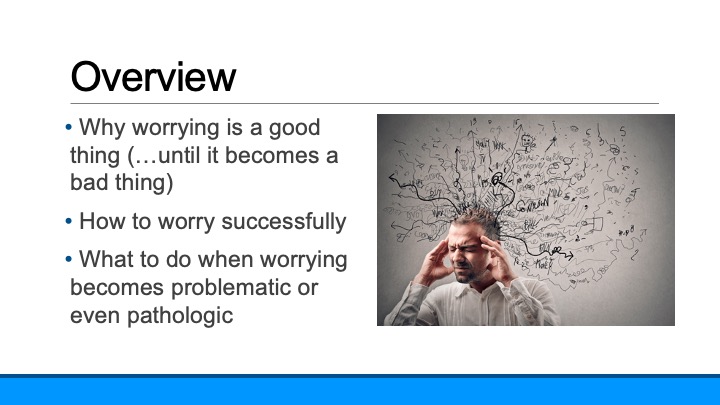
Why worrying is a good thing… until it becomes a bad thing.

I had the honor of speaking at the American College of Surgeons this week on a panel about stressors clinicians have control over i.e. can modify. I was assigned a topic I had not really thought about before – which meant I learned a lot! After the talk, there were many people who came up to me and asked if they could have my slides… so here they are!

Photo source

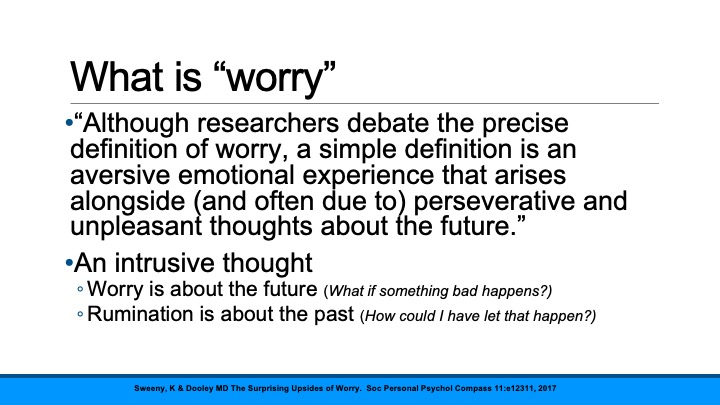
This is a really important concept… worry is an intrusive thought, which means it just pops in your head. And it’s unpleasant, so you worry about worrying!

Another important point here – worrying is always about something in the future (as opposed to rumination, which is always about the past)

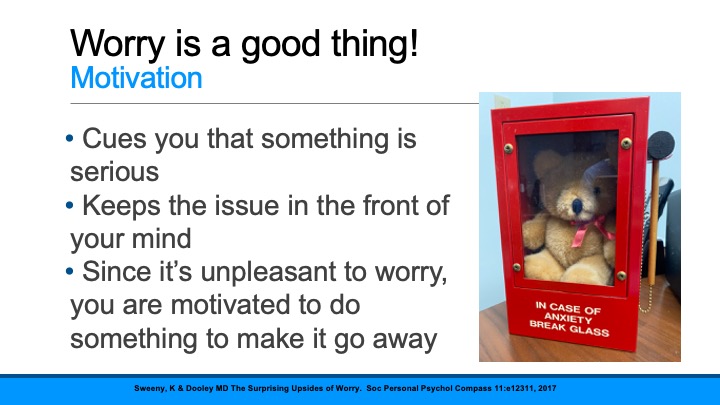
Image source

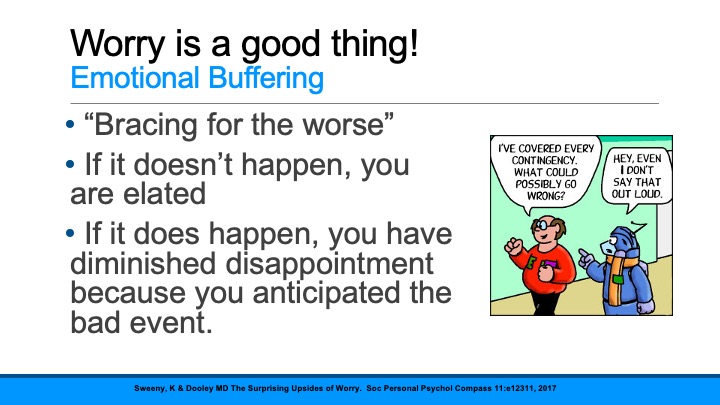
These are the two main ways worrying helps us – motivation and emotional buffering. The motivation part is pretty obvious. Emotional buffering is also obvious, but I didn’t have a name for it before. Take for example worrying that you will fail a test. If you end up getting a good grade on the test it is somehow even more exciting… but, if you do poorly your disappointment is somehow buffered.

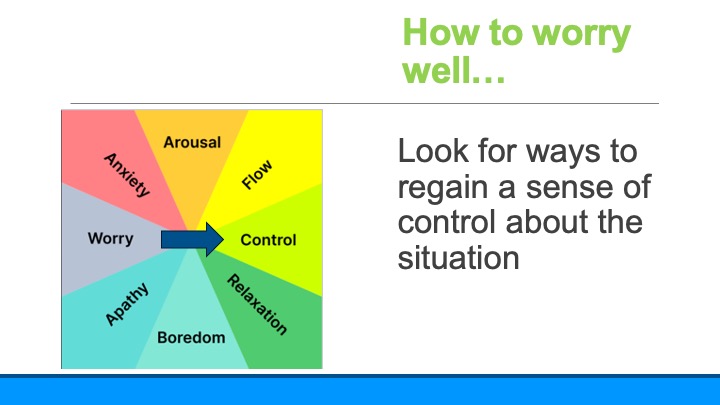
Image from Wikipedia, worry

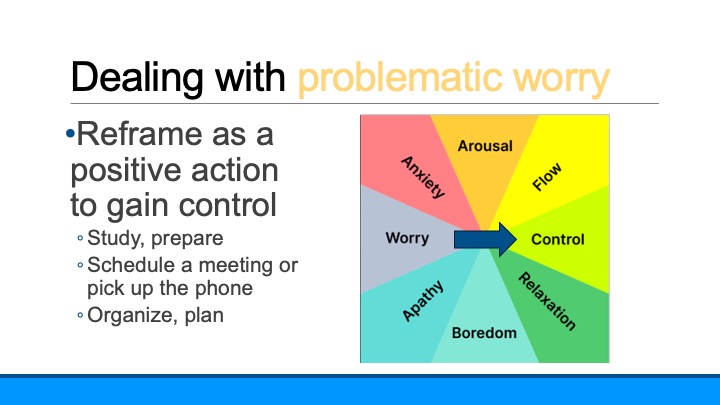
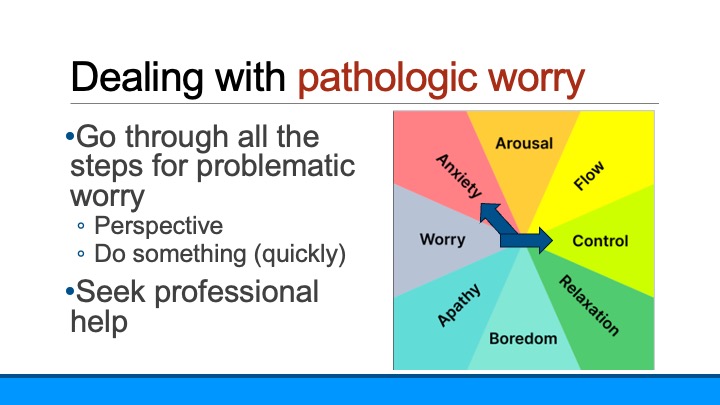
In terms of emotions, control is the opposite of worrying. Take the test I mentioned above. If you are worried you will fail it, the way to deal with that is to regain a sense of control. For example, using smart notes to optimize learning during your rotations, using this plan to ace your in-servce exam, or this plan to get ready for exams during basic sciences.

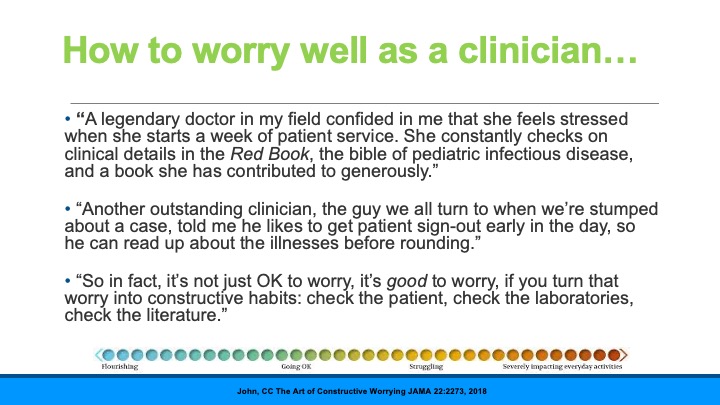
This principle holds true for ALL clinicians – no matter how long your have been in practice.

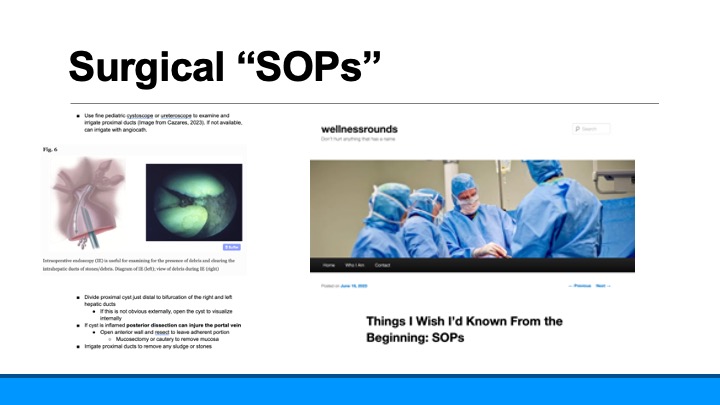
I shared one of my techniques to worry successfully, which is to create an “SOP” for every procedure I perform.

And then I tackled the next question… what to do when worry begins to spiral.

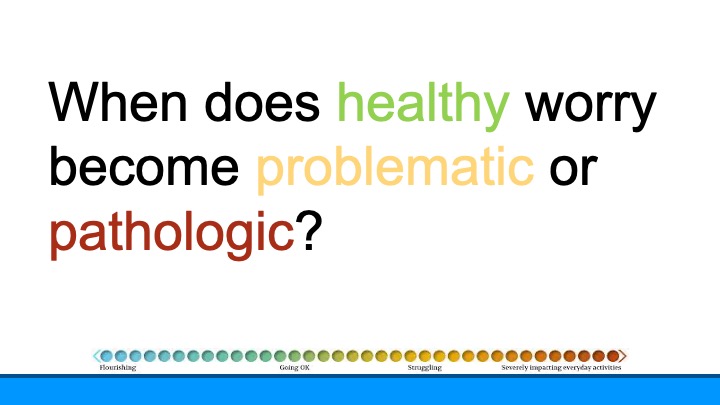
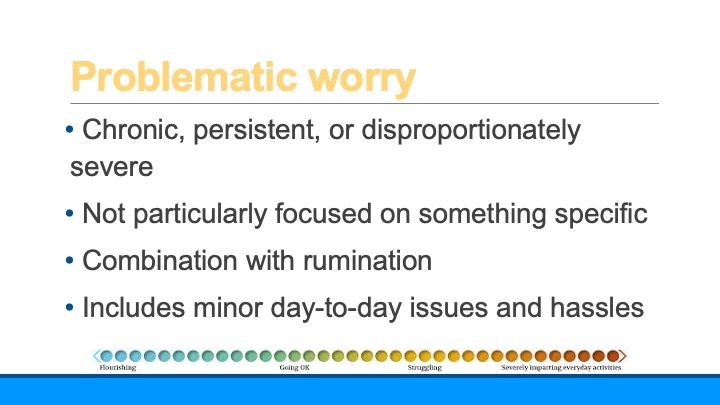
I introduced this validated tool to see if your worrying has crossed the line to problematic or pathologic.

And pointed out that if worry is causing you to suffer, it’s a problem.

The way to deal with problematic worry is to try to return it to the kind of worrying that helps us, which we can do with any action to control what we are worried about. Worried about a test? Make a plan for how and when to study. Worried about a relationship? Plan to meet or pick up the phone to talk. Again – no matter what your are worried about – do something to create a plan to address the worry.

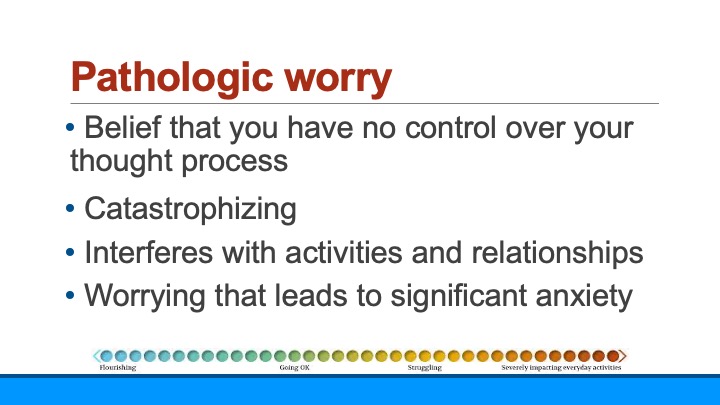
But despite our best efforts, the spiral of worry can land us in a bad place. If you find you have anything on this list (or if you are really suffering), it’s pathologic worry.

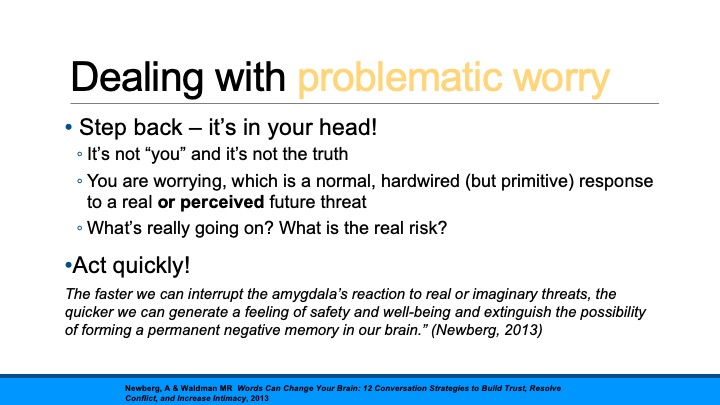
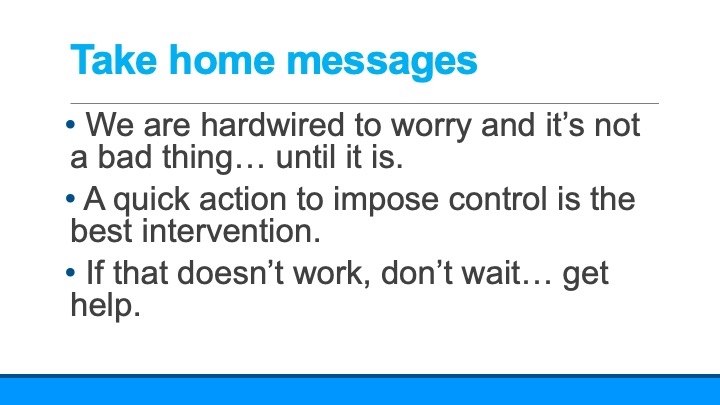
It’s super important that you act – quickly. This is your amygdala trying to hijack your brain! (Remember flight-flight-freeze?) If you don’t derail it quickly, it will continue to spiral and land you in a world of anxiety. In other words, follow all the steps for problematic worry – but if it doesn’t work, don’t wait. Get help.