Portable Devotion, “Socialization”, and How to Eat Well On Call.

Portable devotion

What a fascinating journey this morning as I travelled 1500 years back in time (via the internet) to this medieval portable altar. 

On my first roll of the digital dice on this website that randomly links to other websites, I arrived at a database of portable medieval altars, created by a historian whose research interest is “portable devotion”. Lots to think about here…

“Socializing” an idea

I suspect the word has been around for a while, but I learned that “socializing” has become part of “business speak” in medical centers and hospitals, as in… “Go socialize that idea with them first.”

It turns out this new vocabulary is just a new way of describing what great leaders have known all along…you don’t know what you don’t know. 

Source

“Socializing” a new idea starts with determining who might want to “veto” your new idea and then meeting with them, not to persuade them, but to learn from them. With each meeting you learn more which lets you refine the project and, at the same time, allows your organization to evolve with you. 

The best thing I learned is that the concept now referred to as “socializing” came from the Japanese concept of Nemawashi (根回し)… “Nemawashi literally translates as “turning the roots”, from ne (, “root”) and mawasu (回す, “to turn something, to put something around something else”). Its original meaning was literal: in preparation for transplanting a tree, one would carefully dig around a tree some time before transplanting, and trim the roots to encourage the growth of smaller roots that will help the tree become established in its new location.” (Wikipedia)

#CallFood

There are lots of people who spend nights in the hospital to care for others… physicians, nurses, techs, and many others. 

Especially for trainees who work long hours, eating well when you are on call is not easy. There are usually few (if any) options available in the hospital, and when you are exhausted it’s hard to prepare and bring your own food. 

But eating well is really important …. not just nutritionally, but emotionally as well. Here’s a link to the system I’ve found works the best, but deciding that Diet Coke, graham crackers, and cereal are not major food groups is the critical first step. 

p.s. I post recipes that meet the “pizza rule” (less time to cook than it takes to order a pizza) on Bluesky, Facebook, and Instagram with the hashtag #CallFood. 

p.p.s Here’s the recipe for my breakfast tacos (which are also the best 2am #CallFood you will ever have). 

You Need an Instant Pot

I love good recipes and cooking in traditional ways … but I’m absolutely convinced that busy students, trainees, practicing docs, other healers (and all busy people for that matter) should own Instant Pots.

Assuming you want to eat real food but you don’t have a lot of time to cook… here’s what you need to know:

With an Instant Pot you don’t have to follow the recipe.

I know, that’s blasphemy, especially for someone like me who loves to cook and learn new techniques, flavors, and foods. But trust me…

Just throw all the ingredients into the pot and cook it for the time it says.

Make your shopping list, make sure you have the right containers to freeze any leftovers (glass is more expensive, but worth it), cook when it’s convenient (so it’s ready when you are tired), and enjoy!  

A collage of food in a pot

AI-generated content may be incorrect.

Here’s some ideas to get you started…

Butter Chicken  – from  Kristine’s Kitchen “50 Healthy Instant Pot Recipes (Quick and Easy)”

Salmon and Rice Bowl – from  Food TV “20 Healthy Instant Pot Recipes You’ll Crave Year-Round”

Vegan Lasagna Soup – from Vegan Instant Pot/Pressure Cooker Recipes

Instant Pot Steel Cut Oats – from 20 Instant Pot Breakfast Recipes that Will Start Your Day on the Right Note

One more thing that will help…

Unlearn what your family taught you about using a dishwasher.

You don’t have to rinse or do anything else to your plates (or your Instant Pot) before it goes in the dishwasher – except scrape off hunks of food.

p.s.  if you have the time and interest, it’s probably 5% tastier to sauté things first i.e. follow the recipe… but I know the pressure you are under (no pun intended). The 5% isn’t worth it compared to having delicious, fast, healthy food.

p.p.s. If you know a really busy person, take note – this is one of the best birthday/holiday/special occasion gifts you could possibly give them!

Migration Meals Illustration: Pot of soup with people around it
Photo credit

You Need this Book So You Can Follow the “Pizza Rule”

No medical student, resident, physician (or any other healer) has much time to cook which is why I came up with the “pizza rule” i.e. you should only cook things that take less time than it takes to order a pizza.

I discovered a cookbook today written by one of my favorite cookbook authors that starts with this sentence… “Do you have 20 minutes to make a great meal?”

It’s an entire cookbook that follows the pizza rule!!!

Cooking real food for yourself, or in a group (i.e. 3-4 friends each cook a large batch of something every week and then split it to share) is not only healthier for you, it has a lot of other advantages, too. It’s hard not to be mindful when you cook which means you can make it a practice that helps calm and center you for the rest of your busy life. Cooking also means you are taking care of yourself, and that feeling of care goes a long way to soothe days where you don’t feel much care.

If you want to hack the process of cooking for yourself to make it easier, check out this post or this one.

p.s. The book is on sale right now on Amazon for $1.99

p.p.s Even if it’s not on sale, you should buy it.

p.p.p.s If you search for #callfood on my social media feeds (@drmlb) you’ll find other recipes that are delicious, healthy, and meet the requirements of the pizza rule.

Things I Wish I’d Known From the Beginning: How to Hack Eating Well

It is hard to eat well when you are a med student, resident or busy doc (also true for busy people not in medicine!). The key to eating well if you are busy is to have a strategy. You/ve developed strategies for studying to get where you are… so you have this skill set already! (Trust me, if you can learn how to take out a gallbladder or diagnose a complicated infection, you can learn to do this, too.)

As I’ve written before, here are the basic steps that you need to follow to eat well if you are “too busy to cook”:

  • Find recipes that sound good (but take less than 30 minutes to prepare)
  • Fill in a calendar with the plan for your meals (at work, on call, at home)
  • Make a shopping list
  • Shop once, then (mostly) follow your plan

For the last 6 years, I have used an app that make this process incredibly easy. Paprika is not free, but it’s money well spent. I recommend downloading both the phone app (which right now is $4.99) and the app for your computer ($24.99). Try the phone app first if you aren’t sure, but I think you’ll find the laptop version is more than worth the money.

The reason I think this app is perfect for healers, healers in training, and anyone who is super busy is because it takes the four steps listed above and puts them all into one place.  It not only makes it easy to choose recipes, plan your week and shop, it almost makes it fun. Here’s how:

Find recipes that sound good (but take less than 30 minutes to prepare)

Click on the browser tab to find new recipes and download the ones that work for you.  As you save recipes in the app, it becomes your own personal “cookbook” which is searchable by category, name, or ingredients.

Fill in a calendar with the plan for your meals (at work, on call, at home)

This was the first moment I knew this was a great app. All you do is drag and drop the recipes you want into the appropriate day. Wow.

Make a shopping list and go shopping.

This is when I was completely sold.  When you pull up the recipes you’ve chosen, there is a little “hat” icon at the top:

When  you click this icon EVERYTHING IN THE RECIPE appears in a shopping list.  Click what you need and repeat for the week’s recipes and voilà – your shopping list.

Because this app is on your computer and your phone, just take your phone with you to the grocery store.  As you pick up each item, click the box next to it to take it off the list. If you are sharing the app with your significant other or roommates, anyone can add to the grocery list or unclick things they have bought.

Try using this strategy (instead of eating the bagels, pizza, peanut butter and other “free” foods in the hospital) for a few weeks. I promise you’ll feel better, learn better, and have more energy to take good care of your patients.

(BTW – I have no ties whatsoever with the makers of this app!)

SHARE THIS:

LIKE THIS:

Loading…This entry was posted in Diet and tagged cookingDietfoodmealsnutritionon callrecipesvegetables by marylbrandt. Bookmark the permalink.

Leave a Reply

https://jetpack.wordpress.com/jetpack-comment/?blogid=52238385&postid=5960&comment_registration=0&require_name_email=1&stc_enabled=1&stb_enabled=1&show_avatars=1&avatar_default=identicon&greeting=Leave+a+Reply&jetpack_comments_nonce=99cf0ff8fa&greeting_reply=Leave+a+Reply+to+%25s&color_scheme=light&lang=en_US&jetpack_version=13.2-a.7&show_cookie_consent=10&has_cookie_consent=0&is_current_user_subscribed=0&token_key=%3Bnormal%3B&sig=b8eead7ccfe6ac534a3810d5e1a0e29b991f79e4#parent=https%3A%2F%2Fwellnessrounds.org%2F2018%2F01%2F21%2Fhate-cooking-but-want-to-eat-better-by-the-end-of-this-post-i-bet-you-buy-this-app%2F

Powered by WordPress.com.

The Healing Power of Farmers Markets

Rituals have great power, but some more than others. For me, going to the Farmers Market has become a ritual that is almost as important as the food I buy there. So I spent some time this morning pondering why…

It’s outside. Sun, clouds, breeze. Sometimes a little cool, sometimes too hot… but always the season that matches the fruits and vegetables being sold that day.  

There is music. And dancing… people dancing with children, children dancing alone, folks dancing in their wheelchairs.

Everyone is happy. Seriously. Not a dour face anywhere!

There is delight in the colors, odors, and tastes.. It’s beautiful… and that sensual beauty evokes all kinds of good emotions – delight, joy, and even awe. 

It anchors you to the season. We don’t have peaches in January at the farmer’s market. So when they show up in May it’s a day of celebration! Eating what is being grown in the season keeps you somehow anchored to life around you and, according to some traditions, is better for your body. It’s certainly better for the planet, since this is food grown within miles of where it’s sold… not half way across the world. 

You develop relationships with the people that grow your food. Lisa’s new tortoise gets a spectacular salad every day, so we chat about his salads and her goats. I get to practice my French with the Congolese farmers who grow their produce on an inner city farm developed to provide new refugees a place to farm. Some of the vendors know my name, most of them know and recognize me with a smile (even if they don’t know my name), and all of them are happy to share how to prepare their food and what’s happening on the farm.

And then there is the food. There is no question it’s often (but not universally!) more expensive to buy your food at the farmer’s market, but for the reasons above it’s worth it. But there is one other reason … which is probably the most important reason of all.

How to Harvest and Store Potatoes -- Harvest to Table
Photo credit

One of the very first times I went to a farmer’s market, I bought potatoes. I remember distinctly thinking that it would not be worth the extra money because “it’s just a potato”… but I did it anyway.  Every potato I had ever bought in a store tasted the same as every other potato … so I didn’t expect these to be any different. Wow… I was SO wrong. A potato that has been pulled out of the ground the day before you cook it is absolutely amazing. A light went on. Fresh food raised in smaller quantities by people who are devoted to doing it tastes better. It just does. 

Plant It Forward CSA shares ready to be picked up

There is most likely a farmer’s market near you if you live in a city, but if there isn’t you have a other options (The USDA Local Foods Directory is a wonderful way to find farmers markets, gardens, and local farms near you if you need help. )

CSAs (Community Supported Agriculture). Google “CSA’s near me” to find farms that make up boxes with small portions of anything they are harvesting that week to distribute to people who have signed up with them. 
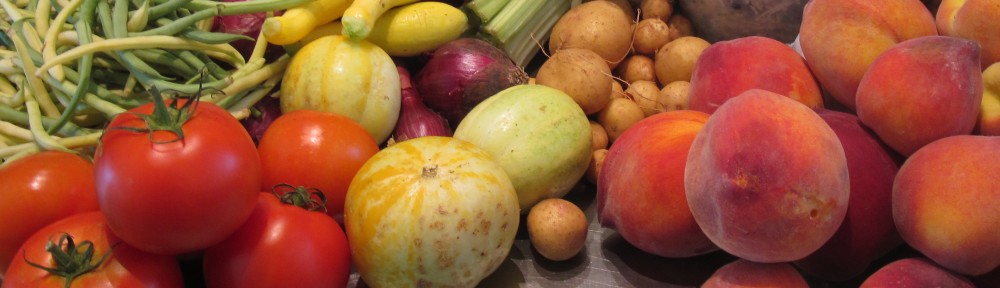
Community Gardens. If you love to garden (and you can spare a few hours every once in a while) you might want to actively participate – it’s also pretty soul soothing to dig in the dirt and grow your own tomatoes. But it’s also worth asking if you can buy any produce that isn’t otherwise promised. 

A local farmer or neighbor who has a big garden. You don’t know unless you ask. Offering to buy some of their produce might end up being a win-win. They may have too much produce, need a little extra income, or both. And you end up with fresh produce and a relationship with the person who grows it!

You’ll never buy stock again

This may be one of the easiest kitchen tricks I’ve learned in the last few years.  I haven’t bought any stock since I figured this out. It saves money, but more importantly, this stock tastes MUCH better than anything you can buy.

Step 1:  As you peel, chop, and otherwise use any vegetables for recipes or salads, save all the pieces you would normally throw away.

The vegetables that help the most with umami (and make your stock great) are the classic mirepox (carrots, celery and onion), garlic bits, and mushrooms.  There are a few vegetables you should avoid using for stock. Some vegetables will make the stock bitter or impart a strong, very specific taste that may not work in some recipes (e.g eggplant, turnips, cilantro, ginger). If you happen to be someone who buys Parmesan cheese with a rind, those rinds are wonderful in stocks. If you use fresh herbs when you cook, make sure you throw the stems in the stock. 
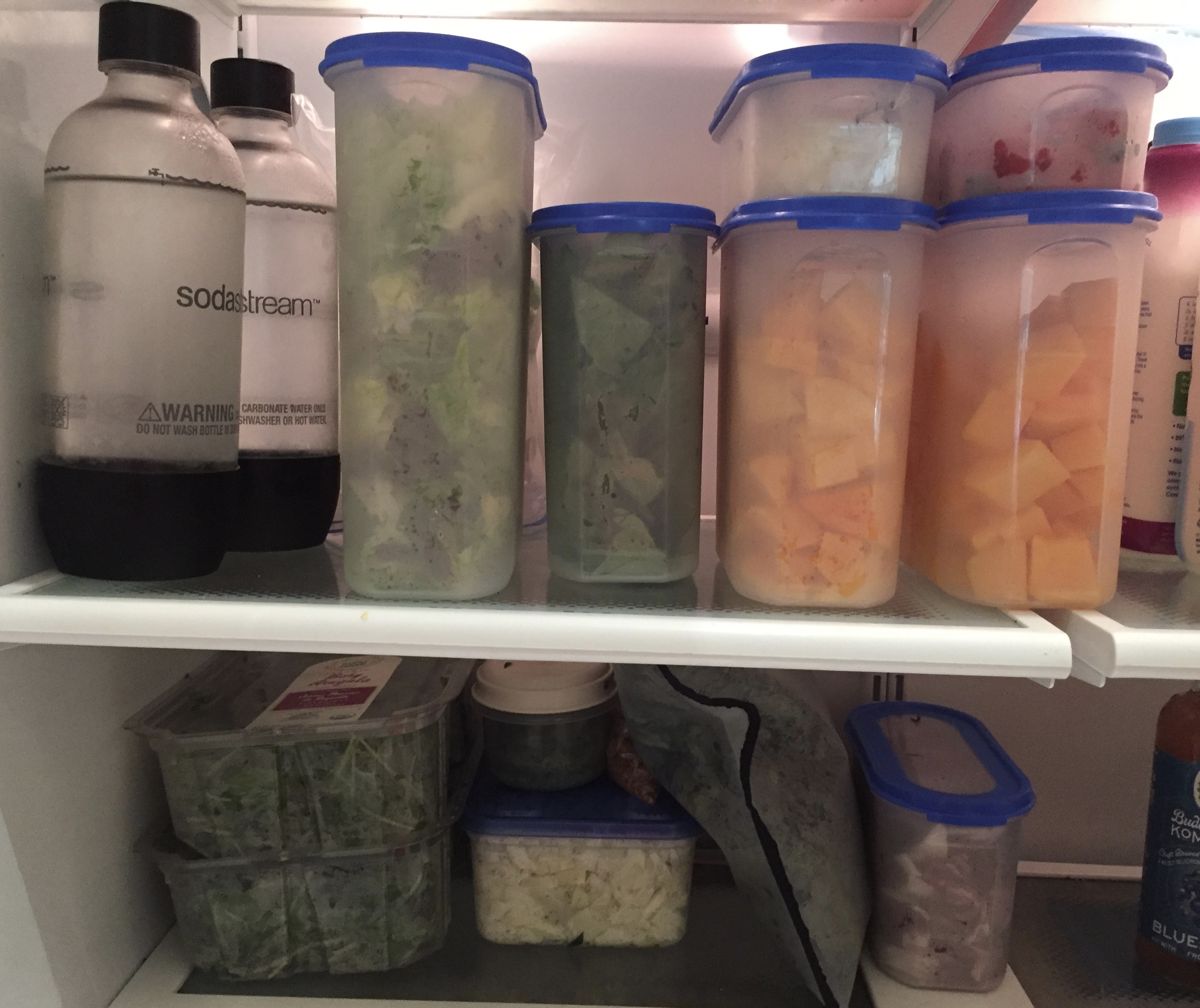
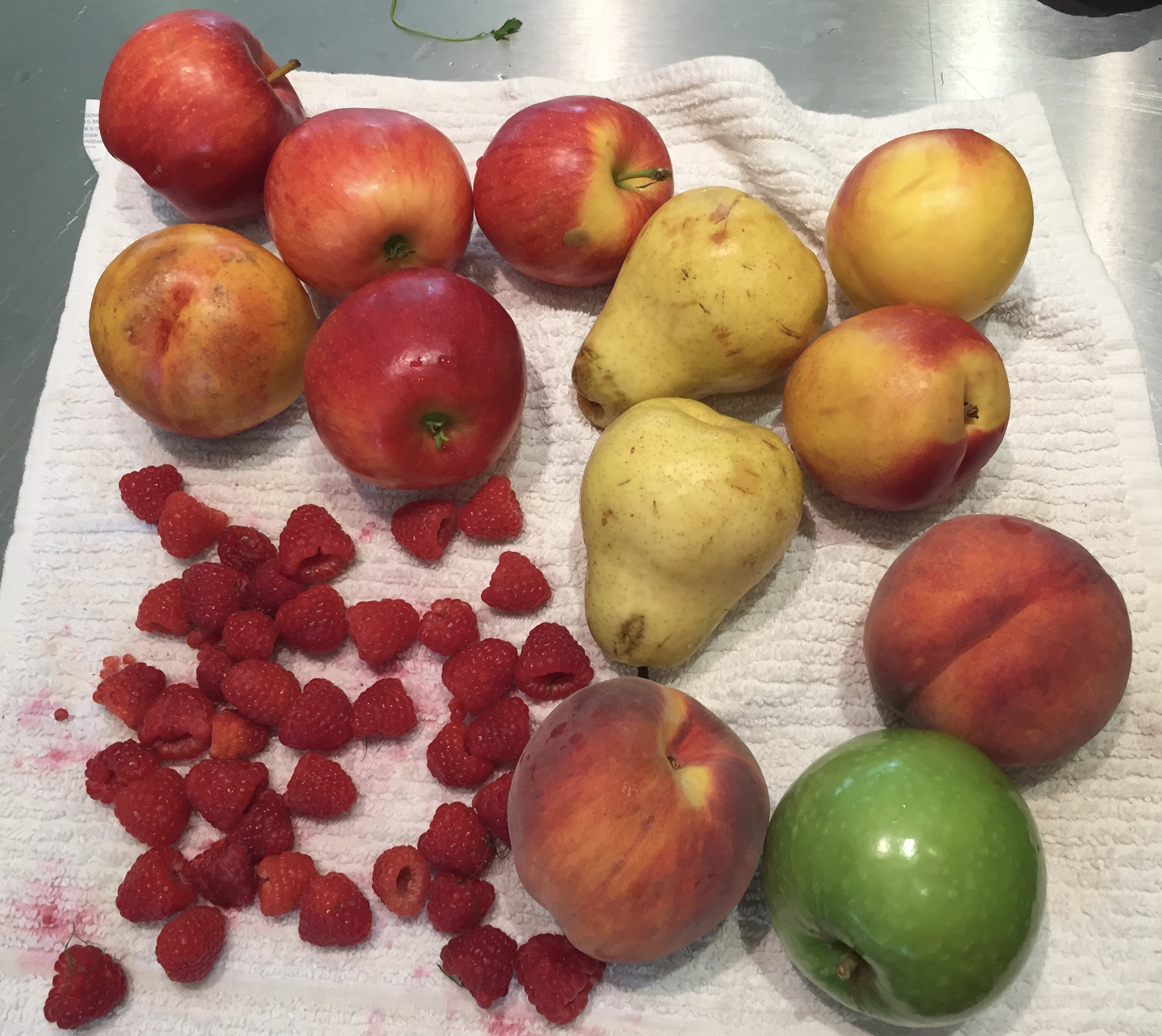
Photo credit


Step 2:  Keep a big ziplock bag in the freezer and toss the washed bits you saved into the bag.  When you drain beans, tomatoes or other vegetables from cans, put the juice in the bag, too.

Photo credit


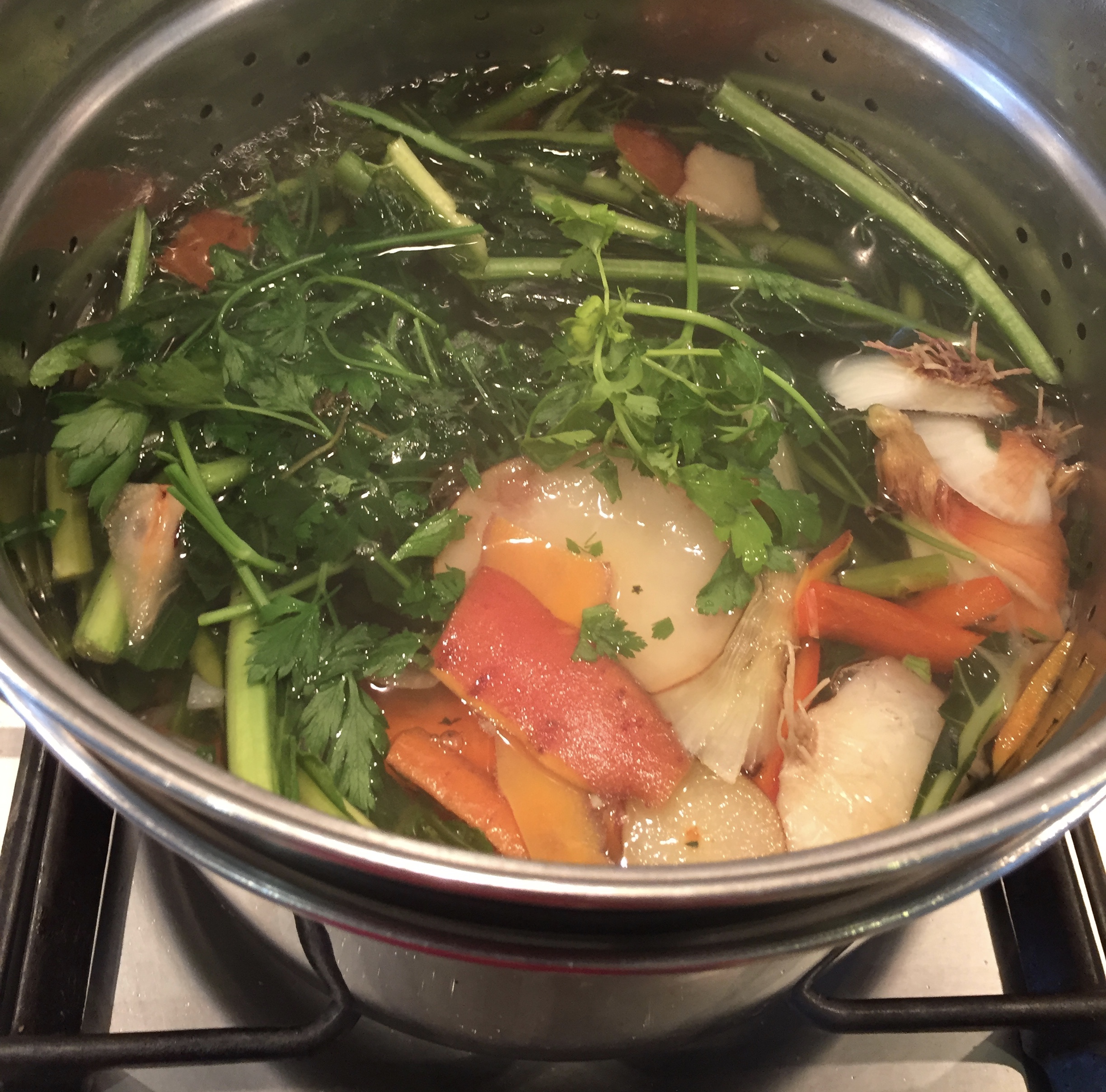
Step 3:  When the bag is full, put the frozen vegetable bits in a big pot with water to cover them, bring to a boil and then simmer for about an hour.


If you have an Instant Pot, you can make stock in less time.  I don’t add salt while making the stock because it lets me season the dishes I make to taste.


 Step 4:  Freeze the stock you don’t use in a day or two.

 I usually freeze my stock in 1-2 cup plastic containers.  Alternatively, use freezer bags if you want to take up less space in your freezer (Push the air out of the bags and lay them flat on a cookie sheet to freeze).  Another trick is to freeze the stock in ice cube trays or muffin tins and then put the frozen stock in freezer bags.

Photo credit

In addition to recipes, use this stock instead of water when you make rice or grains. Thaw your stock in the refrigerator (if you remember) or in the microwave (if you don’t).

We eat a mainly plant based diet, so I only make vegetable stock.  If you eat meat, you can save the bits from the meat or fish you cook – or ask your butcher for stock worthy bones and add them to the vegetables to make great chicken, beef or seafood stock.  If you want perfect chicken or beef stock, you may have a bit more work to do… 🙂

Enjoy!


Hate cooking but want to eat better? (By the end of this post I bet you buy this app!)

It is hard to eat well when you are a medstudent, resident or busy doc (also true for busy people not in medicine  The key to eating well if you are busy is planning.. but it takes time.  As I’ve written before, here are the basic steps that you need to follow to eat well if you are “too busy to cook”.

  • Use a calendar to organize which days you need to have dinner ready
  • Find the recipes you want to cook
  • Fill in the calendar with what you will take to work for lunch and your planned dinners.
  • Make a shopping list.
  • Shop once, then follow your plan

To follow these steps, I’ve used the internet to find recipes, Evernote to map out the week, and Grocery IQ for the shopping list.  I’ve gotten pretty efficient, but it’s still takes a non-trivial amount of time… and who has that kind of time, right?

Photo credit

And then I read Jane Friedman’s post “My Must-Have Digital Media Tools: 2018 Edition” and I saw this…

I was skeptical, but I downloaded it.

Here’s the bottom line… this app is “expensive” ($25).  But I promise, even if you are medical student without much money, it will be the best $25 you’ll spend this year.

Here’s why – this app takes the five steps listed above and puts them all into one place.  It not only makes it easy to choose recipes, plan your week and shop, it almost makes it fun.  Here’s how:

Use a calendar to organize which days you need to have dinner ready.

Start on the “meals” tab and put notes in for your week.  If you share cooking with a significant other or roommates, you can share the account with them so everyone is (literally) on the same page.

Find the recipes you want to cook and put them in the calendar for the week

Click on the browser tab to find new recipes.  As you gather recipes in the app, it becomes your  own personal “cookbook” which is searchable by category, name, or  ingredients.

Fill in your calendar with what you will take to work for lunch and your planned dinners.

This was the first moment I knew I was really hooked.  All you do is drag and drop the recipes you want into the appropriate day.  Wow.

Make a shopping list and go shopping.

This is when I was completely sold.  When you pull up the recipes you’ve chosen, there is a little “hat” icon at the top:

When  you click this icon EVERYTHING IN THE RECIPE appears in a shopping list.  Unclick what you don’t need and repeat for all the recipes.

Because this app is on your computer and your phone, just take your phone with you to the grocery store.  As you pick up the item, click the box next to it and move on to the next item. If you are sharing the app with your significant other or roommates, anyone can add to the grocery list or unclick things they have bought.


Here’s the official website for Paprika: https://www.paprikaapp.com/.   Enjoy your healthy eating!!!!  Try this plan (instead of the bagels, pizza, peanut butter and other “free” foods in the hospital) for a week or two.  I promise you’ll feel better, learn better and have more energy to take good care of your patients.


“I don’t have time to cook”… Oh, yes, you do!!!

I just got back from vacation and had the pleasure of attending a session where Shawn Brisby, the demo chef for Canyon Ranch in Tucson, gave us a great piece of advice …

Photo credit

“Have you ever gotten raspberries home and within a day they are mush with white stuff on them?”

He had my attention.

“The problem is that home chefs don’t keep their refrigerator cold enough.  They should be set at 40 degrees.”

Hmmm…


So I’ve been experimenting and … it works!  (not that I doubted you, Shawn :-).


Step 1.  Decide what you are going to eat for the week.

This planning is essential.  It takes me 20-30 (very enjoyable) minutes to find recipes in a magazine (Clean Eating and Cooking Light are my favorites), one of my cookbooks or on line.  Here’s what we’re cooking this week:

Pasta with sardines and fennel

Kale salad with apple and cheddar

Moroccan butternut squash chickpea stew

Pumpkin soup with almonds and sage

Fall salad with apples, walnuts and stilton

And, for breakfast for the week…

Sweet potato casserole with crunchy oat topping


Step 2. Make a shopping list and go shopping.


Step 3:. Prep all the food for the week

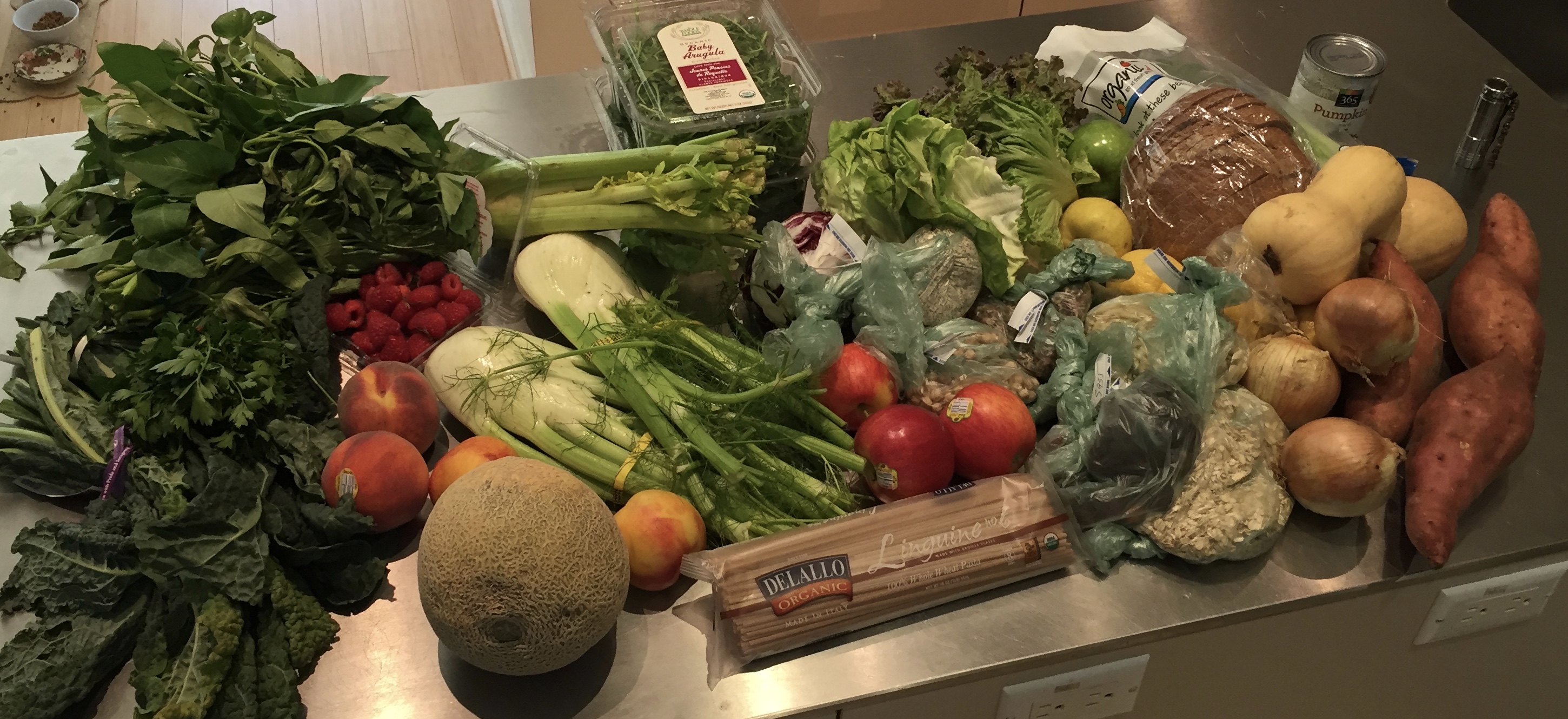
This is what makes it work in terms of efficiency. For the rest of the week, when you get home, everything will be washed, cut up and ready to throw in the pan.  I timed myself and it took 1 hr 22 minutes to turn the pile of veggies you see above into this:

An hour and a half is nothing compared to the time it takes when you get home late and really don’t want to do it.  Turn on some music, chop while you are watching some football.. it is a great return on investment to insure you eat well!

Other helpful hints

  1. Get some fun containers. These are the ones I bought, but any food quality containers will work.
  2. Wash the other produce, cut everything up for all the recipes, spin dry them and put them in your 40 degree refrigerator. (If you don’t own one, get a lettuce spinner.)
  3. Wash the fruit and dry it before you put it in the refrigerator.

One other tip…. Make stock! I throw all the vegetable bits (peels, seeds, etc) into a pot with water and make vegetable stock while I’m working. In addition to using this stock for any soup we decide to make, we use it instead of water for rice or pasta to increase the flavor.

What’s for dinner? How to eat well if you are too busy to cook….

I wish someone had taught me this when I started medical school.  Seriously, I would have loved it…  Let me walk you through what I did today to prepare for my week, and I think you will understand.

So, first… it’s summer… In Houston.

The weather makes a difference in how this unfolds, since I’m talking about cooking… i.e. (usually) adding heat.

So here’s what I did today..

  1. I spent about 20 minutes looking through what is my current favorite cookbook for three recipes that a) I liked b) were easy and c) were summer appropriate.

2. I entered all the ingredients I needed into GroceryIQ, … plus stone fruit (that is so ripe and delicious right now), a watermelon (because it’s summer and I love them), bread and ingredients for sandwiches for lunch.

(how can you not love a cookbook that says “Heat a big glug of olive oil in a skillet”?)

3. I went to the grocery store and bought everything on the list. When you have a list, it’s really fast, so you make up the time you spent looking up the recipes and making the list. Also, you are much less likely to buy more than you need (which leads to interesting microbiology experiments in your refrigerator) or things you really don’t need (i.e. junk food).

4. I took a nap. (I was on call Friday, up all night, so I’m still catching up). Plus, Sunday          naps are amazing… so don’t think you EVER have to justify them!

5. I spent about 20 minutes preparing the ingredients for Joshua McFadden’s recipe for the tuna melt “casserole” and for one of my summer favorites, ratatouille. Every time I make ratatouille, I think of Maryvonne, Monique and Maddy, my French “mothers” who taught me this recipe when I lived in France as an undergraduate.

6. Here’s where the Houston weather comes in. To minimize stove top and oven time, I roasted the squash for the tuna melt and the vegetables for the ratatouille at the same time – while they were cooking, I sautéed the onions and garlic for the ratatouille and added the tomatoes (canned). (In case you were wondering, the sweet potato is for snacks or something else TBD.)

So, we’ll have the tuna melt tonight, with some store made coleslaw (Brussel sprout and kale), and there is enough for the same meal another night, or lunches if we choose.  The ratatouille can be sides to our sandwiches, or can be another meal with a protein (we are mostly “pescetarian” so probably fish… but you can choose what you want).  Ratatouille is also delicious cold on it’s own or with cottage cheese, or you can add it to broth with chicken meat and make a great soup/stew.Bottom line… maybe an hour today for a week’s worth of amazing food… which is what I wish I’d been taught when I started medical school.

 Photo credit

 p.s. Since you were wondering…  The other two recipes for this week are cooked seafood salad with fennel, radish basil and crème fraiche (p115) and crunchy mixed bean salad with celery, tarragon and soft boiled eggs (p260).

p.p.s Do not get intimidated if you don’t know how to cook. YOU CAN LEARN.  (and you should).  Find someone to help you.

Photo credit


I Forgot To Tell You About My New Favorite Breakfast!

This morning I was lecturing to the first year medical, PA and DNP students. At the end of my embryology lecture I included some advice on how to eat well as a busy student. I talked to them about how to set a good example for their future patients, how to increase vegetables in their diet by making Mirepoix every weekend, shopping at the farmer’s market, and how to plan for the week. I also talked about why it’s important to eat breakfast. I told them about one of my favorite fast breakfasts, but forgot the second one!

keep-calm-and-have-second-breakfast-4

MLB BREAKFAST TACOS

Here are the ingredients:

FullSizeRenderThis batch had beans, cheese, a red bell pepper, a jalapeño and some cilantro, but you can add anything!  Spread out the tortillas and divide up the ingredients between the tortillas.

IMG_3511-1024x1016Roll them up, put them in the freezer. Two minutes in the microwave and they are ready to eat!


OVERNIGHT OATS

This is SO easy and really delicious.  Put ~1/3 cup rolled oats in a bowl and add twice as much (~2/3 cup) liquid. (You may need more of both depending on your caloric needs)

My favorite liquid is kefir (liquid yogurt), but it can be milk, almond milk, soy milk, etc. Leave it in the refrigerator overnight. Eat it in the morning. That’s it!

You can add any variety of fruit, nut or nut butter the evening before or in the morning. My current favorite is blueberries and slivered almonds added in the morning.

Screen Shot 2016-08-19 at 5.58.27 PMPhoto credit


I