My “Top 10” from  Theology Beer Camp 2025 

  1. It is mind blowing and soul nourishing to listen to talented orators and scholars about the “whys” and “hows” of current challenges in our individual and communal lives…especially when surrounded by joy and laughter.
  1. “Have you ever noticed that the happiest people on television are on medication? … but the side effects are hell!” Jean Dominic Crossan (Hmmm… and did you know that there are only two countries in the world that allow direct to consumer marketing of prescription drugs?) 
  1. “Heaven and hell are not locations in the future, they are options in the present.” Jean Dominic Crossan
  1. “The battle is not how we worship but what we worship at the altars of our daily lives. That which is central to us is sacred to us.” Stacey Floyd-Thomas
  1. “We were chanting, dancing, and trancing before we could speak… Religion started before belief.” Tripp Fuller
  1. “The United Daughters of the Confederacy sought to create “living monuments” through what children were taught” (This is a history I sort of knew, but not really). We are repeating this today in the current policies of school boards and the Dept of Education to erase our history because it makes white kids “uncomfortable”…“A little discomfort is required to improve. An education that never discomforts never transforms.” …“Control of the narrative is more powerful than bombs.” Kelly Brown Douglas
  1. “What books have torn you wide open?” Kelly Brown Douglas (What an amazing question and truth – the education that sets you free is not just what you learn from teachers in classrooms but also from books… supporting my deep belief that librarians will save our civilization)
  1. West Coast IPA may be my favorite type of beer, and the one that was specially brewed for this event was among the best I’ve ever had. 
  1. “Paul intended and wrote to speak to the ages, not just the time he lived in. In thinking about his words, his instructions, his understandings we can and should judge Paul against where we find ourselves today. This means that originalism, or fundamentalism is the wrong approach to the writings of Paul.” Jean Dominic Crossan
  1. Spiritual/faith journeys must be done in community (church) so each of us can do “the work our soul must have” (Church). (the quote is from Katie Geneva Cannon, shared by Stacey Floyd-Thomas)
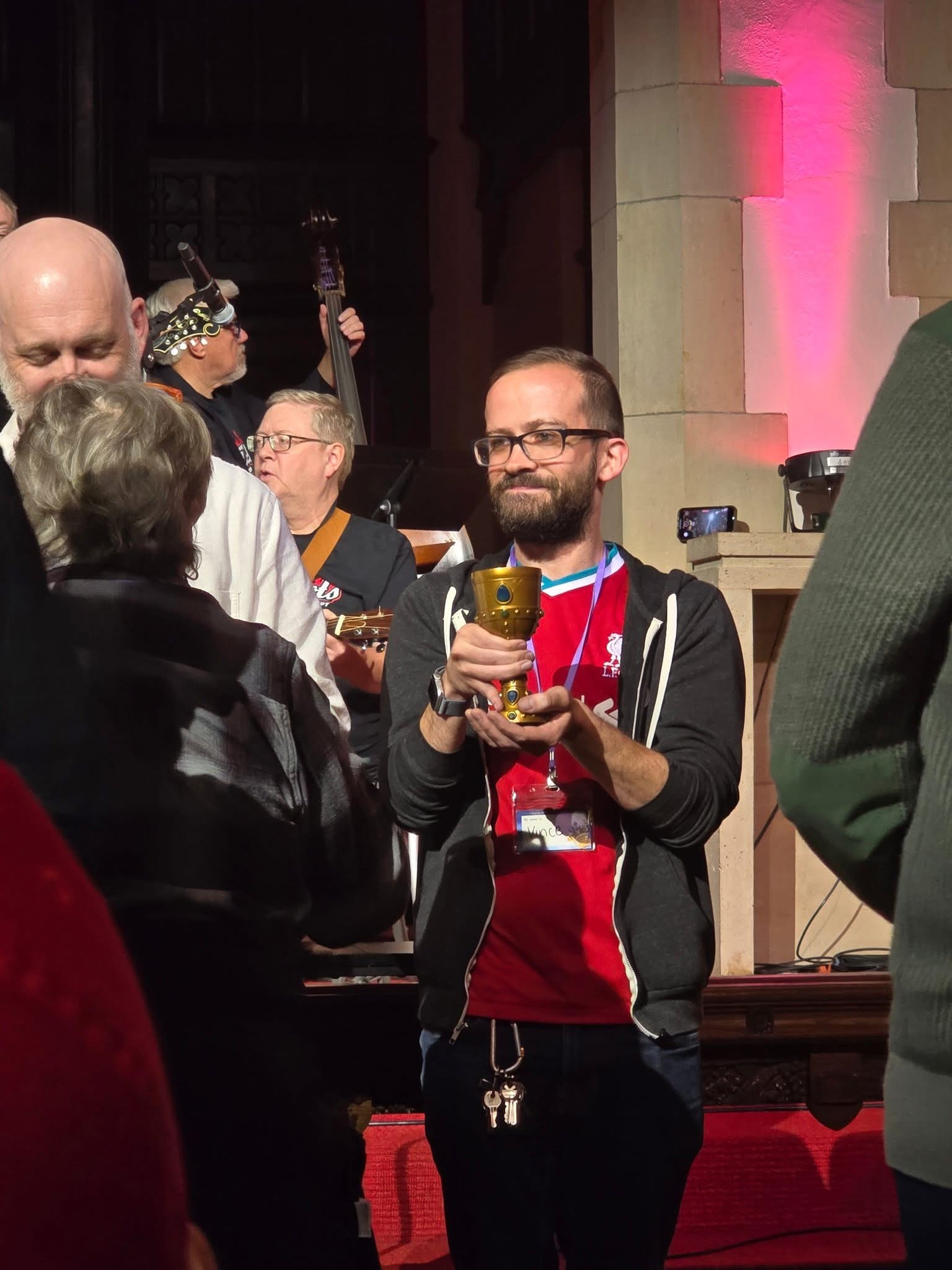
Photo from Brian Jones

Here’s the website for Theology Beer Camp 2025, so you can see the full list of speakers, topics, and events. Many of the speakers have wonderful podcasts, too!

Life, Faith, and Frogs

I have a practice of curating cool things that I share with friends…and (#coincidence?) this post from last week made me think about that practice in a different way. Austin Kleon writes an amazing weekly “newsletter” to send curated stuff he loves to people he knows… but more importantly, to people he wants to know.

I’ve been pondering how to use this website to best serve the people I know (and the people I want to know!) … and I think Austin Kleon just gave me the answer.

So here goes! 

My first “letter” to you… a short list of cool stuff that a pediatric surgeon/almost pastor who loves cooking and art (especially writing) thinks approaches “astonishing” (or at least really interesting) and is therefore worth sharing. 

Is it Church or church? I’m about to be ordained in the United Church of Christ. I know that surprises you… it kind of surprises me, too, to be honest. But I have come to understand that this is an unexpected extension of my life’s work as a healer… and that church (the place) is really about community (which includes the messiness of being human) while Church is about possibilities. There is something about it that also feels like an act of resistance against a tide of not-love. I’m still figuring it out. 

Frogs in Portland. Speaking of resistance… What a statement that Amazon is struggling to keep up with orders for inflatable frog costumes! Although inflatable animal costumes aren’t listed specifically, this kind of protest (mockery and humor) is one of the three ways to undermine autocracy that Nicolas Kristoff describes in this column. (The other two are 1) point out corruption and excess (like massive ballrooms and gold toilets?), and 2) tell individual stories more than making appeals for the principles of democracy.)

Air fryer Okra. If you hate okra this might make you reconsider. No slime, great taste, in a super healthy popcorn-like snack (1lb of okra makes a good snack size bowl for two and has 150 calories, 7.5gm protein, and 14 gm fiber). Add some cumin, garlic powder, or any other spice(s) if you want.

Also Accidental by Ellen C. Bush  This poem made me remember and wonder… How many times did I lose count of stitches I placed (or more likely never counted in the first place)? It always seemed to be the first question from my patient (or their parents) once the drapes were off and the dressing placed… “How many stitches did I need, doc?”. What a beautiful reminder that these moments disappear for the sewer, but not those we treat … thanks to a scar (and sometimes a tiny piece of glass left under the skin). 

About Blessings (which we need more of IMHO). “A blessing is a form of spoken poetry about the divine. It’s an incredibly positive form of speech, but it’s not simply “reframing.” (We don’t need to say, Oh, never mind. Tragedy is great! I love it. This is my new mind-set practice!) We might use blessing as a kind of act that scholar Stephen Chapman calls “emplacement.” Calling something blessed can let us say: This goes here, that goes there. This is beautiful. This is awful. And all of it can be called true.”  Kate Bowler in The Book of Alchemy: A Creative Practice for an Inspired Life by Suleika Jaouad

Source

Yes, You Need a “Business Card”…

Scenario 1: A new team of residents meets in the lounge. They text each other their phone numbers with their names.

Scenario 2: You are in your last year of training, and your mentor introduces you to a friend of theirs who is trying to hire a new partner. You chat for a minute and they ask you for your contact info.

Scenario 3: You run into an old friend and realize neither of you have updated information for each other.

Scenario 4: You get home from a meeting and pull 8 (actual) business cards people gave you out of your coat pocket and then… Take a photo of them? Throw them away? Actually take the time to enter the info into the contacts on your phone?

Please open your phone and find the contacts app. At the top of the list of contacts there is a contact labelled “My Card” which is A  DIGITAL BUSINESS CARD YOU DIDN’T KNOW YOU HAD!

Next, fill in the information (don’t forget a photo). It’s ok to include your personal info (home address, personal email, etc). Based on this reddit feed (and in my experience) when you click “Share Contact” you can select what will become the default going forward. (If you are worried, exclude your personal information and make a second “personal info” contact card that you can share with friends.)

Then, go to Settings  > General > AirDrop, then turn on “Bring Devices Together”.

Here’s the cool part (If you have an iPhone)…

When you touch the top of two iPhones together your contact (aka business card) will be shared with the other phone (They cleverly call this “Name Drop“). You have to agree to share the info each time (a nice security measure). If you don’t have an iPhone, or the direct transfer doesn’t work for some reason, you can open your contact, click on “Share contact” and then choose airdrop, text message, or email to share it.

Scenario 1 revisited: A new team of residents meets in the lounge. They all open their contact card and hit “Share contact” via Airdrop. In less that 2 minutes everyone has the contact information for the entire team.

Scenario 2 revisited: Your mentor introduces you to a friend of theirs who is trying to hire a new partner. You chat for a minute and they ask you for your contact info.You pull out your phone and transfer the information directly to their phone. (which also wins you their contact if they agree… and impresses them if they haven’t see it before)

Scenario 3 revisited: You run into an old friend and realize neither of you have updated information for each other. See above! You touch phones and transfer your contact info instantly.

Scenario 4 revisited: You get home from a meeting and pull 8 (actual) business cards out of your coat pocket and… Take a photo of them? Throw them away? Actually take the time to enter the info into the contacts on your phone?   Old news! This won’t happen again… 😊

Why I’m Leaving Substack

When I first signed up to post on Substack, it was because there were many writers and theologians I respected who were posting there. I was vaguely aware of the controversy about white supremacists who were self-proclaimed Nazis who posted on Substack, but I was also told that Substack had taken steps to block posts that “incite violence based on protected classes”

I’ll be honest.

I didn’t do my homework.

But once you become aware that things like this post (from today) are being allowed on Substack, how can you stay?

Most of the time, I cross posted between Substack and this website, but there were exceptions. There won’t be any going forward, which means there will be a blend of a lot of different things I’m exploring. Hope you enjoy them. Let me know what you think.

The Meatloaf Rule

Let me tell you a story about an extraordinary recipe, one that had been handed down for generations, a recipe for meatloaf that was the centerpiece of every family celebration and holiday dinner. 

On the day in question, those responsible for preparing the dinner realized that the 7 year old great-grandson was now ready to learn the family recipe. Needless to say, when they found him and told him they needed him in the kitchen so they could teach him to make meatloaf, he jumped up immediately and started running to the kitchen. His mother got a stool for him to stand on and an apron. She showed him the proportions of the different meats and taught him about the eggs and breadcrumbs. Together they combined the herbs and spices and then mixed everything together until it looked just right. Once it was the right consistency, she showed him how to mold it into a free-form loaf, cut an inch off each end, and place it in the oven to bake for an hour at 350 degrees.

He turned to her and asked the obvious question…

 “Why do we cut an inch off each end?”

His mother looked up at him with a puzzled look on her face. 

“I’m not really sure.  Let’s ask your grandmother.”

The two of them went in to find her mother and asked the same question. Again, there was a quizzical look…

“I’m not sure either but Great-Grandma is sitting in the living room and it’s her recipe.” 

They went together to find the matriarch of the family. She looked up as they entered the room and he started to speak…

“Grandma, I have a question for you.”  She looked at him and he continued, “Why do we cut an inch off of each end of the meatloaf before we bake it?” 

She started laughing and responded, “That’s how big my pan was!”

Click here for a great article on the history of meatloaf (and the source of this photo)

It’s not hard to find examples of the “meatloaf rule” in our personal and professional lives.  Many of the incrementally small but steady improvements in medicine have been the result of someone saying… “Wait a minute…just why do we do it that way?”* 

The same applies for our own well-being and growth. Some of the ways we’ve learned to be and act have been passed down for generations by our family and our teachers, but no longer serve us. 

Here’s the practice: Look for examples of the “meatloaf rule” in your life. Use humor, use contemplation, use whatever works, but learn to recognize and then change the things that you were taught and now do automatically… but which no longer serve you. 

*One of my favorite examples is how we have decreased the total days of antibiotics we use to treat appendicitis after folks asked if we really needed to do it the way we were always taught. We’ve gone from 2 touchdowns (14 days) to 1 touchdown (7 days), to stopping them when they are no longer helping (decided by a variety of signs and symptoms that indicate the patient has successfully conquered the infection). And yes, I meant touchdowns. It has always struck me as somewhat hilarious (and maybe a little worrisome?) that we give antibiotics based on (American) football scores.( 3,7,10,14,21). I know – It’s not really football scores. But having 5 fingers on a hand and 7 days in the week isn’t that much better of an explanation! 

Becoming an Influencer

A pediatrician told me recently that when she asks kids in her practice what they want to be when they grow up the two most common answers are “an influencer” and “a rapper”.

An influencer? (I sort of get the desire to be a rapper..)

The Merriam Webster online dictionary defines an influencer in two ways: 1) one who exerts influence : a person who inspires or guides the actions of others and 2) a person who is able to generate interest in something (such as a consumer product) by posting about it on social media.

One definition is about inspiring and guiding others.

The other is about clicks (and money).

Image appears to be in public domain

Words matter.

Influence matters.

It’s worth pondering…

p.s. In the 13th century the word “influence” described an “emanation from the stars that acts upon one’s character and destiny”.

p.p.s Influenza comes from the same root since disease outbreaks in medieval times were thought to be influenced by the stars.

Choose Hope.

When we stare political conflict (here or elsewhere) in the face, try to help wounded healers, or (for many) just do our best to get through the day, we can’t help but feel discouraged. But that’s when it’s especially important to remember two important things:

Hope is a choice*.

Real change happens slowly.

When we choose hope we become oriented towards creating, sustaining, and connecting… instead of anger, destruction, and fear.

When we choose hope we join others who boldly look hatred in the face and say out loud “Not this.”

When we choose hope we hold space for others so they, too, can begin to see the possibility of change.

When we choose hope we act in small ways that inevitably (and delightfully) “move the needle” towards love. And these collective small actions result in persistent and unrelenting progress towards the goal of the beloved community.

Churchill, Manitoba, Canada

Choose hope.


*Choosing hope means to cherish a desire with anticipation with an expectation that it will happen (even if the likelihood is small).

Learn to be Brave

“The wrong side of history will always tell you to be afraid – the right side of history will always expect you to be brave.”

JB Pritzker, Knox College Commencement Address, June 8, 2025

It is easy to be swept away by fear, to respond to fear with more fear (as well fear’s cousins anger, hatred, and anxiety). This is particularly true right now,when we are contantly confronted with messages of invasion, violence, and “others” who are trying to somehow hurt us. But it’s crucial to recognize that our response to these messages, the fear we are all feeling right now, is a normal, hard-wired, very primal response. When we become afraid, we move automatically – without conscious thought – into “flight, fight, or freeze” mode.

Fear as a response to threat is hard-wired because our response to what frightens us is protective, much like our immune system protects us from bacteria, viruses and other causes of disease. But, like the immune system, if our initial fearful response is not met with balancing forces to “turn down” the heat, fear can destroy us.

Fortunately, we can learn to be brave…

1. Realize that your fear is not the “truth”. Recognize it for what it is… an emotional response to a threat (perceived or real). Because it’s an emotion, it can be regulated (not as good as eliminated, but still very helpful). Joan Halifax’s technique which uses the mnemonic “GRACE” is a great place to start.

2. Welcome fear with a sense of gratitude. I know, this seems crazy. Everything in us wants to throw fear out the window, suppress it, rationalize it, compartmentalize it, transform it into anger… anything that makes it seem less threatening. But none of those techniques work. Like making you pull your hand away from a hot stove, your fear is there to protect you. This welcoming practice is a much better way to defuse the emotional impact of fear.

3. Don’t lose your moral compass. Fear of the other is weaponized and used in all societies, but it is rampant now. Don’t let that change your basic goodness, don’t let it force you into becoming someone you don’t want to become. Make sure you articulate and then follow your “true north”.

4. Choose courage. After all of this I have some bad news – You will still be afraid. As Franklin D. Roosevelt said, “Courage is not the absence of fear, but rather the assessment that something else is more important than fear.”

And what are the things that are more important than fear in your life?

What makes up your “true north”?

It will vary a bit between us, but honesty, generosity, integrity, fairness, and compassion tend to be anchoring principles for a good life that are found in virtually all philosophies and faiths.

Choose honesty, generosity, integrity, fairness, and compassion… and then choose to act on them despite the fact that you are afraid.

I started this essay with a quote from JB Pritzker’s recent commencement address …. but there’s another recent quote (unattributed) that also blew me away. It seems a fitting book end to these thoughts…

If you can’t be brave, at least be kind.

If you are interested in reading more about learning to be brave:

Big Magic: Creative Living Beyond Fear by Elizabeth Gilbert

Fierce Love, by Jaqui Lewis

Fear: Essential Wisdom for Getting Through the Storm by Thich Nhat Hanh

Standing at the Edge: Finding Freedom Where Fear and Courage Meet by Joan Halifax

How We Learn to Be Brave by Marian Edgar Budde

You Need an Instant Pot

I love good recipes and cooking in traditional ways … but I’m absolutely convinced that busy students, trainees, practicing docs, other healers (and all busy people for that matter) should own Instant Pots.

Assuming you want to eat real food but you don’t have a lot of time to cook… here’s what you need to know:

With an Instant Pot you don’t have to follow the recipe.

I know, that’s blasphemy, especially for someone like me who loves to cook and learn new techniques, flavors, and foods. But trust me…

Just throw all the ingredients into the pot and cook it for the time it says.

Make your shopping list, make sure you have the right containers to freeze any leftovers (glass is more expensive, but worth it), cook when it’s convenient (so it’s ready when you are tired), and enjoy!  

A collage of food in a pot

AI-generated content may be incorrect.

Here’s some ideas to get you started…

Butter Chicken  – from  Kristine’s Kitchen “50 Healthy Instant Pot Recipes (Quick and Easy)”

Salmon and Rice Bowl – from  Food TV “20 Healthy Instant Pot Recipes You’ll Crave Year-Round”

Vegan Lasagna Soup – from Vegan Instant Pot/Pressure Cooker Recipes

Instant Pot Steel Cut Oats – from 20 Instant Pot Breakfast Recipes that Will Start Your Day on the Right Note

One more thing that will help…

Unlearn what your family taught you about using a dishwasher.

You don’t have to rinse or do anything else to your plates (or your Instant Pot) before it goes in the dishwasher – except scrape off hunks of food.

p.s.  if you have the time and interest, it’s probably 5% tastier to sauté things first i.e. follow the recipe… but I know the pressure you are under (no pun intended). The 5% isn’t worth it compared to having delicious, fast, healthy food.

p.p.s. If you know a really busy person, take note – this is one of the best birthday/holiday/special occasion gifts you could possibly give them!

Migration Meals Illustration: Pot of soup with people around it
Photo credit